As Catalans call for independence, you can feel it in the air: Spain is once more heading for break-up
All through its history Spain has broken up and joined back together
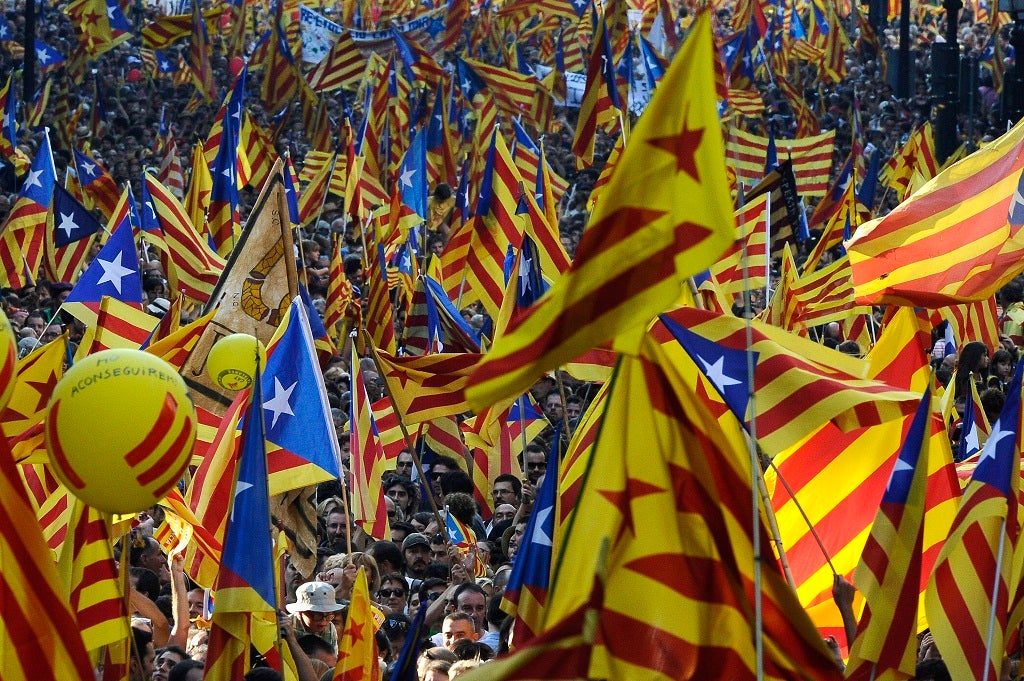
It’s the one Arabic word that all Spanish people know – taifa. And well they might. First the Basques, voting in a new, very nationalist parliament, just over a month ago. Now it’s the Catalans’ turn, with a regional election centred on their future relationship with Spain. Back in September, a million and a half of them marched in the streets demanding independence. Meanwhile, Spanish military commanders talk of their constitutional duty to prevent the country from breaking up; riot police violently beat up anti-austerity demonstrators; the Madrid government hesitates over asking for a pride-damaging bailout; the Red Cross collects money for the starving – not in some far-flung land overseas, but for the couple living rough at the bottom of the road; and a weakened king watches his country crack apart...
It’s no wonder that observers are drawing parallels between Spain in 2012 and the situation in 1936, on the eve of the civil war. Back then, the infant republic proved too weak to deal with the problems afflicting the country, both external and internal. Social inequality, a polarised political spectrum and the demands of regional identities – not least Catalonia – played out against the backdrop of a European continent descending once again into world war.
The faultlines opening up today are not dissimilar, and are producing a palpable sense of injustice and anger. But is there really a correlation? Is history repeating itself quite so obviously? Could Spain break apart? Is some form of civil conflict a possibility?
Round again
There is a long history to all this. Spain has been splitting up and joining back together again for thousands of years. The Romans themselves – the first people to unify the Iberian peninsula – had a taste of this. It took them 200 years to subdue the various tribes and cultures in the area. After the Romans, the Visigoths had to share the peninsula with the Suevi in the northwest and the Byzantines in the south for much of their rule. When the Islamic armies invaded in 711, they found a country that was far from united: it took them less than 10 years to conquer the former Christian kingdom.
Despite their energy and power, the Moors found it just as difficult to keep the country together, before Islamic Spain broke up entirely into over a dozen mini-kingdoms in the 11th century. These were the taifas. After a brief interlude of renewed unification, the pattern was repeated 100 years later – the so-called “second taifa period”. The disunity proved a bonus for the Christians nibbling away at Islamic territory.
Yet despite the gains of the Reconquista, over the next 300 years the peninsula remained a grouping of small, separate states, both Christian and Islamic. Only in 1512, once Granada had been conquered for Christendom and the Kingdom of Navarre had been successfully invaded by Castile, was Spain finally governed under a single authority for the first time in the modern era. Even then, the old ways continued. There were revolts in Castile and Valencia; Moorish hangers-on rose up in the 1560s. And so on, and so on…
Every war or conflict in Spain over the past centuries has had the question of centralism or regionalism at its heart, from the War of Spanish Succession to the three Carlist Wars of the 19th century to what we refer to as “the Spanish Civil War” of the 1930s (as though there had only ever been one).
What is Spain? Should “Spain” even exist? These are questions that the peoples of the Iberian peninsula have been killing and dying for since the very idea of the country was first raised. Is that tendency set to continue?
Pressure
Were Spain a person, it would probably have been institutionalised a long time ago. Destructive and aggressive behaviour like that, once established as a pattern, is unlikely to change. But, I used to tell myself, these are uncharted waters. In the past, once a centralising authoritarian power was removed, the country inevitably broke up. But that need not mean it would happen again. The healing, co-operative spirit of the transition, when Spain successfully moved from dictatorship to democracy, gave the country a chance to break away from the paradigm.
Now, though, I am less sure. The warring, brilliant, creative family that is Spain is under intense pressure. And just as in any ordinary domestic scenario, the stress is highlighting the usual problems. Mum and Dad hardly talk to each other any more, and in the past they have never managed to separate without the kids getting caught up in the fight.
History would teach us to be cautious, even pessimistic about the current situation. It is hard to avoid the feeling that the country has been here many times before: opinion polls predict that Catalan pro-independence parties will win a majority in tomorrow’s elections. But when looking ahead, history is blinkered – it can only “see” what it has already known.
Change is coming – you can feel it like a current in the air. It is unstoppable now, despite the insistence from Madrid that Catalans have “no right” to self-determination. Personally, I think it would be a shame if this Iberian family broke up. As a country, Spain feels greater than the sum of its parts. Yet the question has almost certainly gone beyond “if” and is moving towards “how”. How the next few weeks and months are played out – how the Catalan nationalists and Madrid centralists react to the election results – will be crucial.
A collective memory of the taifas remains strong. One hopes for the best, but Spain is entering a delicate and potentially explosive new period in her history.
Join our commenting forum
Join thought-provoking conversations, follow other Independent readers and see their replies
Comments