As in The Paperboy and Side Effects, there's nothing more thrilling than a jump between genres
Plus, the spirit of the Blitz in Kate Atkinson's Life After Life and a funny man who can pull off straight roles
One of my favourite Hitchcock moves occurs in a film that I don't think anybody would identify as one of his greats – the 1976 crime caper Family Plot. As I remember it opens with Bruce Dern and Barbara Harris driving at night, bickering together about their next scam. Suddenly Dern slams on the brakes and you see that a woman (Karen Black, in fact) has walked out in front of his car and very nearly under it. At which point Hitchcock doesn't cut back to Dern and Harris and the evolving plot they've been talking about but pursues the jaywalker instead. It's as if the camera has completely forgotten what it was doing and been lured into another film entirely.
You eventually discover, of course, that the connection between these three people isn't just a vehicular near miss – but for the moment it seems that the narrative has jumped the tracks, landing upright on a nearby line that curves away in a different direction.
Hitchcock's device is pure control, of course, not its absence, but I still think of it as an emblem of those moments in the movies when a film either gets away from the audience or – sometimes – from the director. I've seen three examples recently, all of which got mixed reviews (the full one-star to five-star range in at least one case) and all of which were marked by the thrilling jolts you experience when a film leaves the paved road for rougher ground.
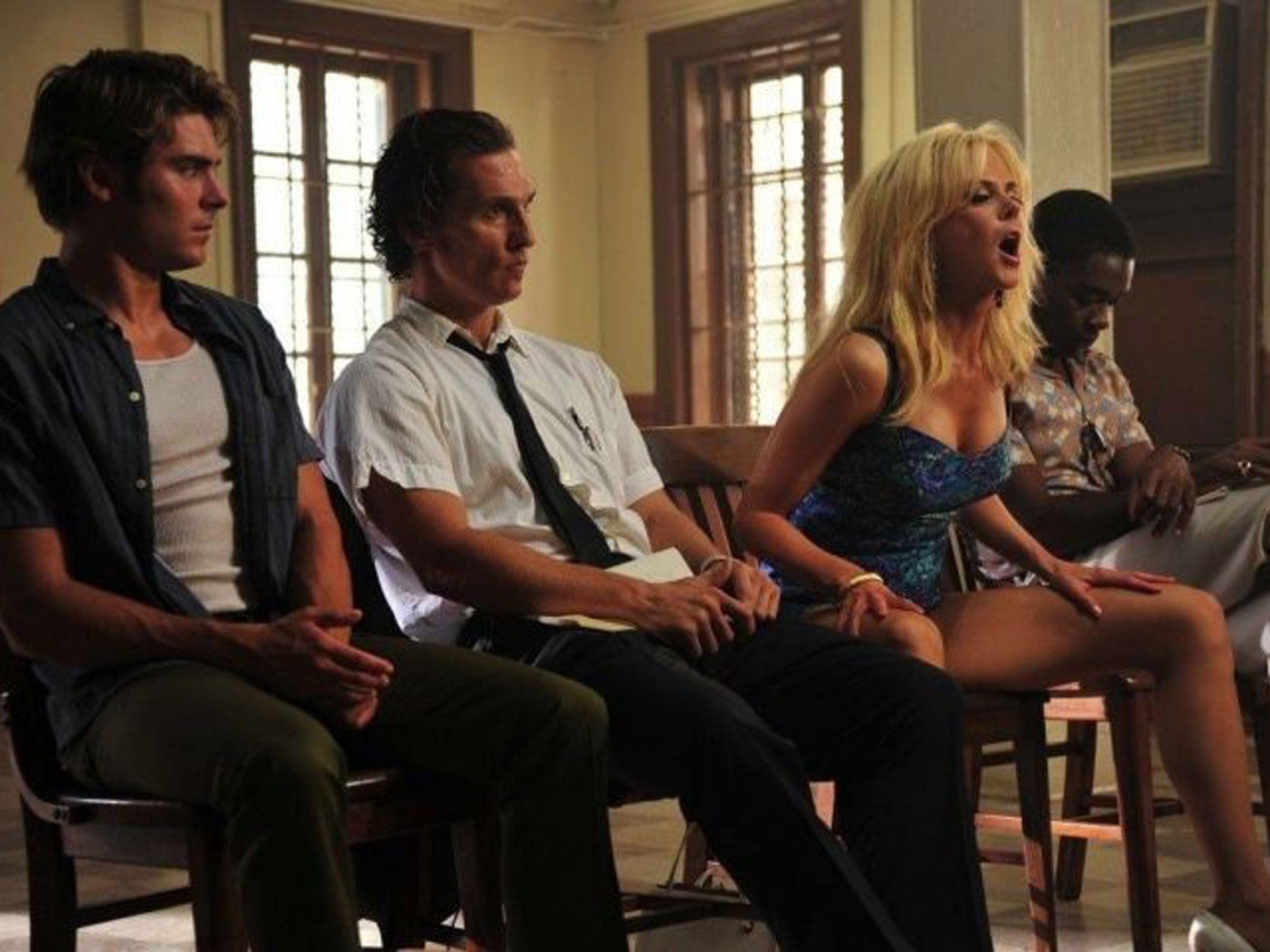
I think they're thrilling anyway, though judging from some reviews of Chan-Woon Park's Stoker, Steven Soderbergh's Side Effects and and Lee Daniels' The Paperboy this view isn't universal. And I say "paved road" because what you don't get in any of them is that expeditious Hollywood freeway, which, once you know what genre you're in, will take you predictably from A to B, with well-signposted rest stops along the way. In some of these films establishing the genre is tricky in itself. Soderbergh's Side Effects, for example begins as what looks like an arraignment of Big Pharma, full of tart scenes that expose the corrupting crossover between clinical and commercial judgement. But then gradually it morphs into something else entirely – the sort of twisted noir you can imagine Bette Davis starring in back in the Forties. You think you have Stoker placed as one of those artful studies of teenage disaffection when it suddenly bucks sideways towards horror and then back again to a category for which the index card hasn't yet been written. And The Paperboy seems to be several things all at once – a steamy gumbo of miscarriage thriller, Southern gothic and overheated sexual fantasy.
The question that arises with all of them is how much did the directors intend things to get this messy? It shouldn't stay up for long with Park, because he's manifestly in charge of every frame of Stoker, a film art-directed to within an inch of its life (but only if you expand that cliché to allow for auto-erotic strangulation).
It won't stay up for long with Soderbergh, simply because his filmography is extensive enough to make most viewers assume that the bumpy ride is deliberate.
But Lee Daniels is likely to have a harder time. And if you don't actively get the credit for turbulence in style and narrative line, then you almost always get the blame for it. This isn't a knowing game with genre expectations and narrative arcs, we think; it's incompetence. It's not improvisation, he just can't read the score. I'm not sure it always matters, though, if the official score is duller than the departures from it.
Don't see any of these films if you like a smooth ride that gets you there on schedule. But if you like unexpected swerves and bumps I'd recommend all three.
Spirit of the Blitz, again and again
Kate Atkinson's Life After Life offers re-runs at the existence of its lead character, who dies repeatedly only to reappear in a parallel history in which she has cheated death. In the Blitz she figures both as victim and as air-raid warden. I was reminded of Sarah Waters's novel The Night Watch and of Elizabeth Bowen and others. It occurred that for a woman wanting a character to experience war at first hand there can be no better setting. It's essentially a co-ed version of the trenches, surreally confounding domestic mundanity with arbitrary and terrible violence, and a famous promoter of nocturnal encounters too. We'll surely see more.
Funny man pulls off a straight role
It's always risky casting a performer best known as a comedian in a straight role, but Harold Finley gets away with it in his production of his own play, A Thousand Miles of History, in part because the character Adam Riches plays was a comic of sorts himself. Riches' performance as Andy Warhol is a treat – a kind of living Warhol portrait in which the actor's association with flamboyant pastiche sits just slightly out of register with the character's self-parodic persona. But I wondered who should get the credit for the funniest moment – a scene that ends with Warhol alone on stage, discomfited by the rapid disappearance of his friends. "Well, this scene's obviously over," he says, tartly. Ad-lib or script? Or incorporated ad-lib? In which case, perhaps honours should be shared.
Join our commenting forum
Join thought-provoking conversations, follow other Independent readers and see their replies
Comments
Bookmark popover
Removed from bookmarks