Balls and Miliband know talking about themselves is easy, but policy is hard. At least they've made a start
The ideas Labour leaders have brought to this conference are distinctive, potentially vote-winning and far more important than their own personalities

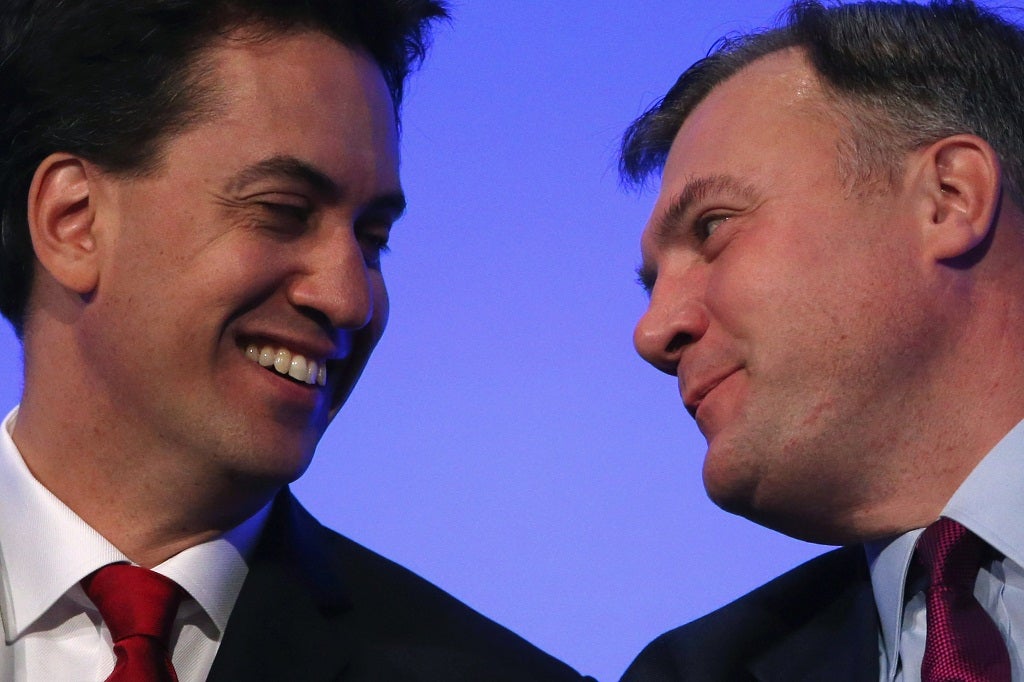
I read or hear persistently that we do not know enough about Labour’s policies. The lofty observation is nonsense, partly because the next election is probably more than two years away. More to the point, we know quite a lot already.
For all their differences, Ed Miliband and Ed Balls share a common past. They were at the heart of the campaign that returned Labour to power in 1997. Although Miliband has declared it is necessary to move on from the New Labour era, he and Balls are influenced by the last time Labour moved from opposition to power. For all senior political figures, opposition is a strange, intimidating foreign land. Miliband and Balls learnt the foreign language in their twenties and find that they need to speak it again in their forties. They turn to memories of their previous visit for guidance.
From the public declarations of Miliband and Balls, Labour’s position in relation to tax and spend is clear. They will try to close the issue off, as Tony Blair and Gordon Brown did in 1997. They are right to do so. There is no point trying to have a grown up pre-election debate in the UK about tax and spend. It is impossible. So they have been emphatic. Both say they work on the assumption there will be no money to spend in 2015. Both have taken a tough stance on public sector pay and provoked predictably hostile reactions from union leaders. They witnessed similar responses when they worked for Brown.
In his astutely judged speech, Balls deployed familiar devices from the mid-1990s. Part of the art of opposition is to make every sum appear to add up, and so he hit upon the auction of 4G licences to pay for a house-building programme, making it a little harder for Cameron/Osborne to portray the proposal as “reckless”. I heard other echoes from the mid-1990s including the clever appointment of an iconic figure from London 2012 to conduct an independent review into infrastructure needs “in order to secure a consensus” on the issue, once more making it harder for the Conservatives to oppose. The only difference is that in the mid-1990s the iconic figure was normally a banker.
In his interview with The Independent last month, Balls indicated two areas where he might pledge to increase spending: the NHS and training. He is looking to raise the money through a popular tax increase, possibly a mansion tax that would impact on a tiny proportion of the electorate. Labour did the same in 1997 with its tax on the privatised utilities. Apart from these two areas, the two Eds will at first stick closely to the spending plans they inherit while they conduct a root-and-branch spending review. They know that Cameron/Osborne plan to fight a 1992-style campaign in which Labour is portrayed as the irresponsible party of tax and spend. As two figures that were participants in the journey from traumatic defeat in 1992 to victory in 1997, they will not give the Conservative leadership much ammunition.
That means Labour’s distinctive pitch at the election is bound to relate more to Miliband’s themes of “responsible capitalism” and the drearily inaccessible “predistribution”. The language needs changing, but both areas are rich with possibility, for electoral populism and for giving the leadership a defining edge without getting caught in pre-election tax and spend traps. As I’ve predicted before, prices will become more political – the cost of energy bills and train fares, in particular. Already, Miliband has pledged to regulate more stringently the energy companies and to radically overhaul the banks. Obviously, there is more to come by 2015. The idea of “predistribution”, in which the state seeks to prevent inequalities occurring in the first place, is often explained with the example of the living wage. But in the build-up to the election, Labour will focus on training and improving productivity. Miliband stated on Sunday that the living wage would only happen “in due course”. Balls declared carefully yesterday that they would “promote” a living wage. The message on wages for the election will be as it is now.
So we know as much about what a future Labour government would do as we did at the equivalent stage when both Thatcher and Blair were heading from opposition to power. None the less, Miliband and his senior colleagues must make some very big decisions before the next election, from their policy on the top rate of tax to public sector reform. In both areas, there are internal divisions.
In his speech today, Miliband will tell the audience, in the hall and beyond, more about himself. Yet the personal is the easy bit. Policy-making in opposition is much more difficult and can easily come unstuck as Miliband discovered in his first policy review, and as he struggles for the precise response to the Coalition’s revolution in health and education. In the end, policies and the ideas they represent are more important in opposition than the personality of the party’s leader, which will take shape if he or she makes the right calls.
Join our commenting forum
Join thought-provoking conversations, follow other Independent readers and see their replies
Comments
Bookmark popover
Removed from bookmarks