Hugo Chavez proves you can lead a progressive, popular government that says no to neo-liberalism
Is all the Western media coverage that portrays him as a dictator by chance related to his politics? Here in Venezuela, the truth is very clear to see
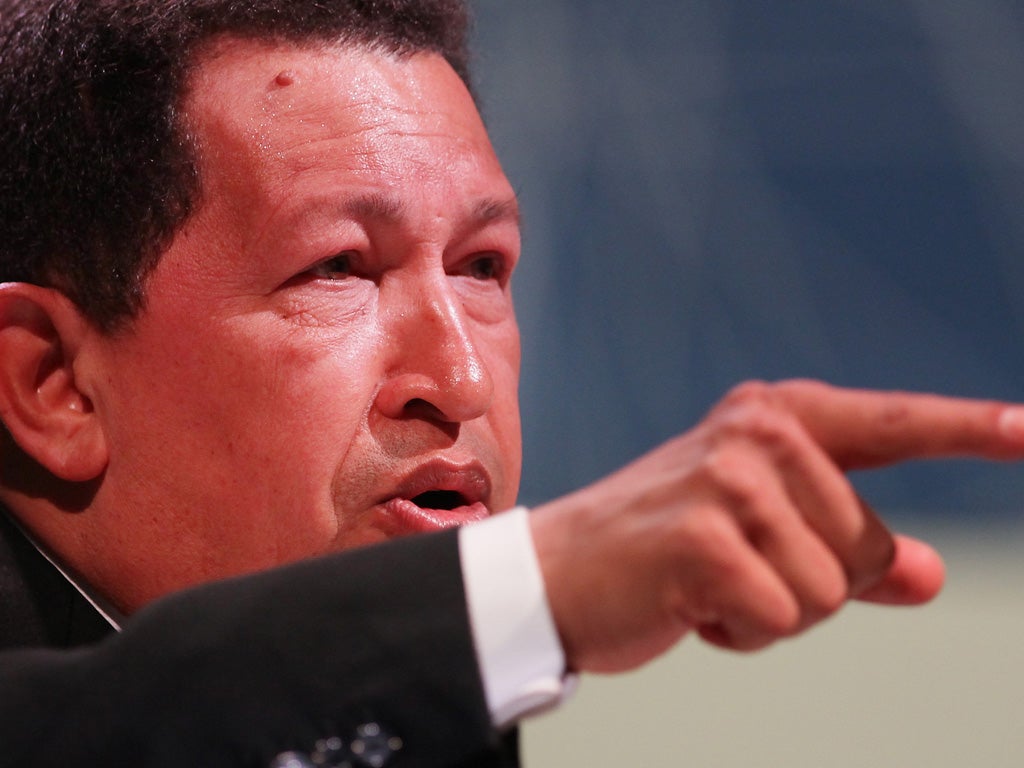
If much of the Western media is to believed, I write this column from a country brutalised by an absurd tinpot caudillo, Hugo Chavez, who routinely jails any journalist or politician with the temerity to speak out against his tyranny.
According to Toby Young, Venezuela is ruled by a “Marxist tyrant” and a “Communist dictator”. Chavez’s defeated opponent in Sunday’s presidential elections, Henrique Capriles, was portrayed by contrast as an inspiring, dynamic democrat determined to end Venezuela’s failed socialist experiment and open the country to much-needed foreign investment.
The reality of Venezuela could not be more distant from the coverage, but the damage is done: even many on the left regard Chavez as beyond the pale. Those who challenge the narrative are dismissed as “useful idiots”, following in the footsteps of the likes of Beatrice and Sidney Webb who, in the 1930s, lauded Stalin’s Russia, oblivious to the real horrors.
Venezuela is a funny sort of “dictatorship”. The private media enjoys a 90 per cent audience share and routinely pump out vitriolic anti-Chavez propaganda, pro-opposition areas are plastered with billboards featuring Capriles’ smiling face, and jubilant anti-Chavez rallies are a regular event across the country.
Venezuelans went to the polls on Sunday for the 15th time since Hugo Chavez was first elected in 1999: all of those previous elections were judged as free by international observers, including ex-US President Jimmy Carter, who described the country’s election process as “the best in the world”. When Chavez lost a constitutional referendum in 2007, he accepted the result. Before his massive registration drives, many poor people could not vote. In stark contrast to most Western democracies, over 80 per cent of Venezuelans turned out to vote in Sunday’s presidential elections.
Even opponents of Chavez told me that he is the first Venezuelan president to care about the poor. Since his landslide victory in 1998, extreme poverty has dropped from nearly a quarter to 8.6 per cent last year; unemployment has halved; and GDP per capita has more than doubled. Rather than ruining the economy – as his critics allege – oil exports have surged from $14.4bn to $60bn in 2011, providing revenue to spend on Chavez’s ambitious social programmes, the so-called “missions”.
His critics attack him for his association with autocrats and tyrants such as Gaddafi, Ahmadinejad and Assad. They have a point, but given the West’s own support for dictatorships such as Saudi Arabia, Bahrain and Kazakhstan – whose regime is currently paying Tony Blair $13m a year for PR services – a giant glasshouse looms behind them. Venezuela’s main allies are fellow Latin American democracies, themselves ruled by progressive governments that Chavez helped inspire, such as Brazil, Ecuador and Bolivia.
That’s not to say that Venezuela is free of problems, or even close. Security was the main concern of Venezuelans I spoke to, and little wonder: violent crime has surged, with up to 20,000 people murdered last year. An ineffective and often corrupt local police and justice system, the spill over from conflict in neighbouring Colombia, and a society with more guns than people are largely to blame. The government is beginning to roll out a national police force, but urgent action is clearly required.
But when it comes to his relationship with his opposition, Chavez has arguably been pretty lenient. Many of them – including Capriles – were involved in a US-backed, Pinochet-style military coup in 2002, which failed only after Chavez’s supporters took to the streets. It was incited and supported by much of the private media: I wonder what would happen to Sky News and ITN if they had egged on a coup d’état against a democratically elected government in Britain. Five years later, the government refused to renew the licence of one broadcaster, RCTV, because of its role in the coup. Even many Chavistas acknowledge that it was a tactical mistake, but I wonder how many governments would tolerate TV stations advocating their armed overthrow.
Venezuela’s oligarchs froth at the mouth with their hatred of Chavez, but the truth is his government has barely touched them. The top rate of tax is just 34 per cent, and tax evasion is rampant. Why do they despise him? As Chavez’s vice-minister for Europe, Temir Porras, puts it to me, it’s because “the people who clean their houses are now politically more important than them”. Under Chavez, the poor have become a political power that cannot be ignored: no wonder even Capriles at least claimed he would leave the social programmes intact.
Chavez’s critics in the West are entitled to passionately disagree with him. But it’s time they stopped pretending he is a dictator. Chavez has won fair and square. Despite formidable obstacles, he has proved it is possible to lead a popular, progressive government that breaks with neo-liberal dogma. Perhaps that is why he is so hated after all.
Twitter: @OwenJones84
Join our commenting forum
Join thought-provoking conversations, follow other Independent readers and see their replies
Comments
Bookmark popover
Removed from bookmarks