Saddam and the US failed, so why should Maliki think he can control Iraq by force?
World View: The Prime Minister may have electoral legitimacy, but the Sunni revolt against his government is growing in strength

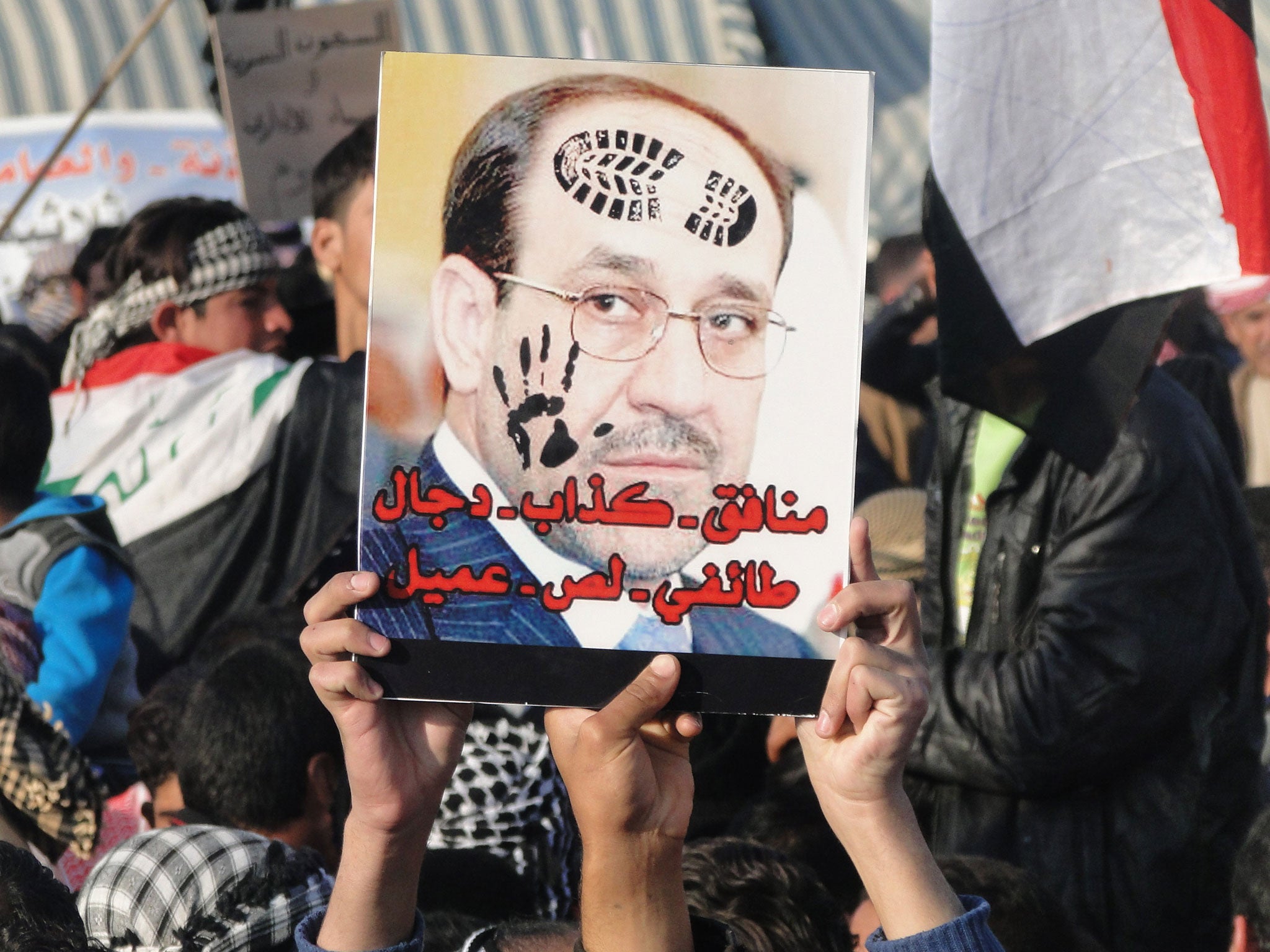
The civil war in Syria is destabilising Iraq as it changes the balance of power between the country's communities. The Sunni minority in Iraq, which two years ago appeared defeated, has long been embittered and angry at discrimination against it by a hostile state. Today, it is emboldened by the uprising of the Syrian Sunni, as well as a growing sense that the political tide in the Middle East is turning against the Shia and in favour of the Sunni.
Could a variant of the Syrian revolt spread to the western Anbar Province and Sunni areas of Iraq north of Baghdad? The answer, crucial to the future of Iraq, depends on how the Prime Minister, Nouri al-Maliki, responds to the seven-week-long protests in Anbar and the Sunni heartlands. His problem is similar to that which, two years ago faced rulers in Tunisia, Egypt, Libya, Yemen and Syria. They had to choose between ceding some power and relying on repression.
Most Arab rulers chose wrongly, treating protests as if they were a plot or not so broadly based that they could not be crushed by traditional methods of repression. The situation in Iraq is not quite the same, since Maliki owes his position to victory in real elections, though this success was not total and depended overwhelmingly on Shia votes. He has nevertheless ruled as if he had the mandate to monopolise power.
Maliki has been ambivalent about the protests since they started in December last year. On occasion, he has denounced them as a plot by ex-Baathists or other enemies of the state acting as proxies for hostile foreign powers. At others, he has offered concessions, but nowhere near enough to quell the protests. His strategy is probably to play for time, an approach that has served him well in the past.
Traditional Sunni leaders such as the Deputy Prime Minister, Saleh al-Mutlaq, and the Finance Minister, Rafi al-Issawi, are largely discredited in the eyes of the Sunni in the street. They are seen as greedy opportunists – as are all other politicians – who make deals in their own interests. Instead, protesters look to Sheikh Abdul Malik al-Saadi, a highly respected religious leader long opposed to Saddam Hussein and whose brother was murdered by al-Qa'ida in Iraq in 2010.
He has sought to keep the protests from being hijacked by armed groups, demanding civil and political rights that fall short of overthrowing the state and thereby alienating the Shia majority. From the Sunni point of view, the unspoken threat of a resort to arms is more effective than actually using them, a move that would isolate the Sunni, who make up only a fifth of the country's population.
Muqtada al-Sadr, the nationalist religious leader with a powerful constituency among the Shia, has supported the demonstrations so long as they are not a precursor for Sunni counter-revolution against the post-Saddam political settlement. The Shia religious authorities in Najaf – the Marji'iyyah – have made as clear as they ever do, in their deliberately elusive language, that they do not want Maliki to play the sectarian card by appealing to Shia solidarity.
Another advantage for the Sunni is that, for the first time since 2003, their community is largely united. I met, last week in Basra, a Sunni sheikh, leader of a sub-tribe of Bedu formerly in Kuwait and close to the Sadrists, who nevertheless expressed strong sympathy for the demonstrators and their demands. A Sunni mistake in 2003 and 2004 was to allow their insurgency against the US to become violently sectarian, rather than based on an Iraqi nationalist appeal. Iraqi politics may be sectarian and tribal, but Iraqi nationalism in the Arab part of the country (Kurdistan is different) remains a powerful, often underestimated force.
The government in Baghdad is wrong to imagine that the protests are a plot orchestrated and paid for by Saudi Arabia, Qatar and Turkey. There is plenty of discontent in Iraq over state corruption, incompetence, lack of jobs and failure to provide basic services despite the nation's oil revenues topping $100bn a year. But the government is correct in believing that the international environment has changed to the advantage of the Sunni in Iraq and that an anti-Shia and anti-Iranian counter-revolution is in full swing. For the counter-revolutionaries in the Sunni world, Baghdad would be a greater prize than Damascus.
Bitterness among the Sunni over the discrimination against them runs deep. People are imprisoned for long periods on the evidence of secret informants under an all-embracing anti-terrorism law. Thousands sit in jail without even being investigated. De-Baathification, supposedly targeting Baathist leaders, has become a form of collective punishment for all Sunni. The political scientist Ghassan al-Atiyyah relates how, in Abu Ghraib district in Baghdad, he "met a man who had been a schoolteacher for 30 years and had just got a message written on a scrap of paper sacking him [as an alleged Baathist]. It simply said 'go home'. He is penniless, has no pension, and if he was a young man, he would get a gun." There are plenty of young men in cities like Salahuddin and Mosul who have no job and no prospects of getting one, and are going to do just that since they have access to arms.
But it is wrong to think of the Maliki government as being gripped by self-serving paranoia in suspecting that the demonstrations in Anbar are the advance guard of a Sunni counter-offensive. I said to one Sunni observer: "Unfortunately, many Shia think you want a counter-revolution." He replied: "But I really do want a counter-revolution."
Al-Qa'ida is showing renewed signs of strength. Over the last week, they launched a multiple suicide bombing against the police headquarters in Kirkuk that killed at least 16 people and wounded 90. The following day, a suicide bomber blew himself up in the middle of a gathering of Sahwa anti-Qa'ida Sunni militia in Taji, north of Baghdad, killing 22 of them. A further 26 Shia were killed in Baghdad and Hilla on Friday. The attacks show that al-Qa'ida can still recruit suicide bombers in large numbers, and an open border with Syria makes their task easier.
The lesson of recent Iraqi history is that force alone does not work against alienated communities, be they Sunni, Kurdish or Shia. Even the extraordinary violence of Saddam Hussein's regime only periodically gave him control over all of Iraq. The same was true of the US army – for all its sophisticated equipment, highly trained troops and vast expenditure.
It is unlikely the Maliki government would succeed where Saddam and the US failed. It has military superiority but not dominance in Iraq, fully controlling only about half the country. It has no authority in the Kurdistan Regional Government's three provinces or in the Kurdish-held disputed territories further south. Its authority is contested in the Sunni majority provinces and cities in western and central Iraq. "The problem is that all parties and communities in Iraq have strength," said one Iraqi politician last week. "Nobody feels so weak that they must compromise with their opponents."
Join our commenting forum
Join thought-provoking conversations, follow other Independent readers and see their replies
Comments
Bookmark popover
Removed from bookmarks