What my generation can learn from the Holocaust
We should recall that hatred continues to be fanned against entire peoples, and that man is capable of both wonderful benevolence and unspeakable horrors
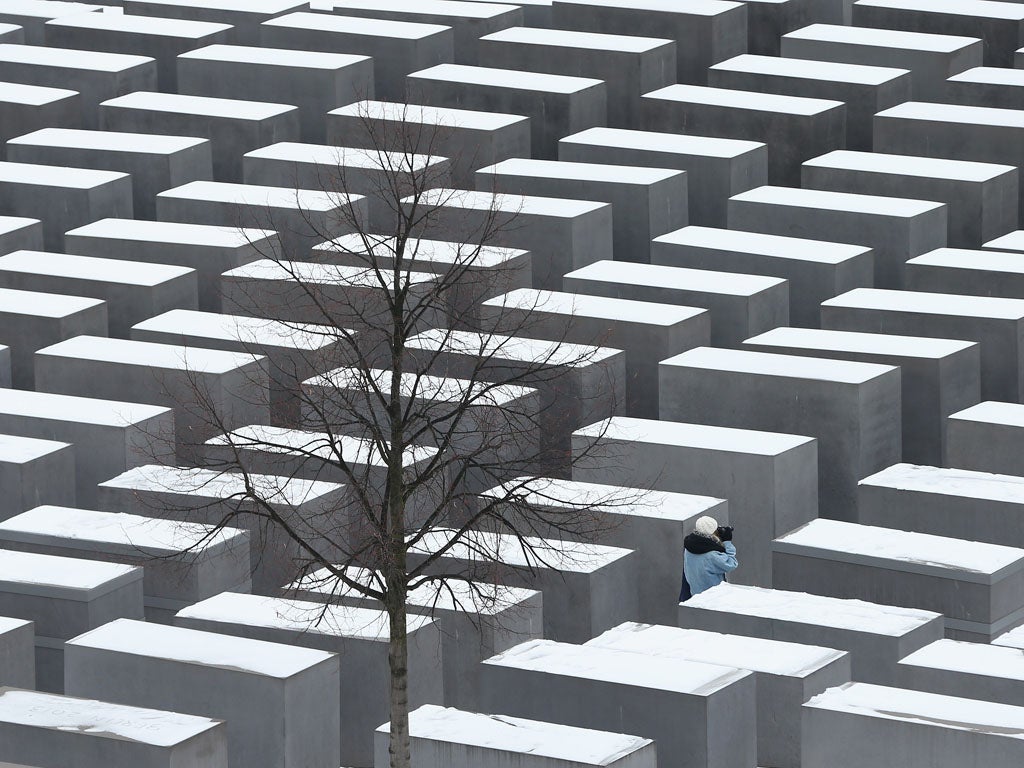
A few months ago, I stood with a close friend on the abandoned platform 17 of Berlin-Grunewald railway station. Seven decades ago, on this same platform, his grandmother’s relatives were crammed into a train with hundreds of other German Jews. They would be shot in the forests near Riga in Latvia, before the Nazis settled on gassing as a more efficient means of extermination.
It’s a spookily quiet place now, with trees growing from the tracks; difficult to imagine wailing children being dragged into overcrowded trains on a journey lasting days without food or water, on their way to be remorselessly, bureaucratically murdered. A steel grate by the tracks chronologically documents the butchery: on 18th October 1941, 1,251 Jews transported to Lodz; on 17th March 1943, 1,160 Jews sent to Theresienstadt; and so on.
It was Holocaust Memorial Day yesterday, but for a new generation, the Shoah – the Hebrew word for calamity – often seems too distant, too overwhelming, too horrific to be real. Easy to think of it as an abstract horror from another universe, not an atrocity that remains a memory in the minds of people, some still tattooed with their concentration camp numbers. The author Primo Levi, who survived Auschwitz, recounted how the ashes of murdered Jews became fertiliser or lined the path of SS commando villages. How could such grotesque schemes even be thought of, let alone proposed, let alone realised, by human beings?
Lost on some
The gravity of the Holocaust is lost on some. In the run-up to Holocaust Memorial Day, the Lib Dem MP David Ward wrote of being “saddened that the Jews, who suffered unbelievable levels of persecution in the Holocaust, could within a few years of liberation from the death camps be inflicting atrocities on Palestinians.” A later clarification was even worse: “It appears that the suffering by the Jews has not transformed their views on how others should be treated.”
A dismissive generalisation of a whole people should always provoke alarm. So should attempts to conflate the Israeli government and the entire Jewish people. Or, for that matter, to try and portray an entire people as homogenous, as though Jewish critics of Israeli policies such as Naomi Klein, Harold Pinter or Noam Chomsky can be lumped together with Ariel Sharon and Avigdor Lieberman.
But the lessons of the Holocaust must be learned and re-learned by each new generation. The first is that vigilance against the poison of anti-Semitism must remain. In Latvia, there have been marches to commemorate Nazi collaborators as patriotic freedom fighters. In Hungary, the deputy chair of Jobbik – the country’s third biggest party – called for a national register of Jews to determine whether they posed a “national security risk”: thousands of Hungarians laudably marched in disgust.
Yet neither should we fatalistically believe that anti-Semitism is somehow inherent or part of the European condition. The Holocaust was the culmination of two millennia of prejudice and persecution, and unlearning that heritage was never going to be instantaneous. Britain’s last anti-Jewish riots were in 1947, not long after the emaciated survivors of Auschwitz-Birkenau, Belzec and Treblinka had been liberated. But anti-Semitism – once rampant in Britain – has been driven back, and can be defeated everywhere.
The Shoah should be remembered as a unique warning from history. Mass murder, even genocide, predate the gas chambers: indigenous people were wiped out across Latin America; up to ten million died in Congo at the hands of the Belgian King; millions perished from avoidable famines in British-ruled India; German colonists themselves committed genocide against the Herero and Nama people in South-west Africa.
But the Shoah – along with the Porajmos, the Nazi extermination of the Roma people – was unique as an industrialised, systematic attempt to wipe out an entire people. It was bureaucratically planned and executed; all the appropriate forms were diligently filled in. It was capitalism gone mad as corporate giants like IBM, IG Farben and Siemens provided the required technology and profited from the slaughter.
The Holocaust should teach us that evil does not exist. An odd, perhaps ludicrously offensive statement. But to dismiss such atrocities as “evil” is to abdicate responsibility, to comfort ourselves by pretending somehow it was not human beings committing such sickening acts, but monsters who are nothing like us. Germany was one of the most advanced countries on earth at the time. Studies suggest that only about 1 per cent of humans are genuine psychopaths. Millions helped the organised slaughter of Jews – as well as Roma, disabled people, socialists, Slavs and so on – and they were thinking, feeling human beings capable of grief, love and fear, however distressing it may be to accept that fact.
Infinite malleability
The atrocity teaches us about what it means to be human. As a socialist, I am compelled to have an optimistic view of humanity, to believe we are not all motivated by greed, selfishness or hate. But what the Holocaust reveals is the almost infinite malleability of humanity: that we have the capacity to do wonderful things, and yet to perpetrate the most unimaginable horrors.
It demonstrates the terrifying potential of dehumanisation, too. When you strip someone of their humanity, you become capable of committing unspeakable acts against them; you immunise yourself against normal human emotions. This is the process that allows suffering to be inflicted on innocent people on a daily basis.
We must remember, too, that hatred continues to be fanned against entire peoples. Muslims are the current target of choice for the European far-right; they are demonised by the mass media and mainstream politicians; nearly half of Britons polled think too many live here.
The Holocaust cannot be glibly remembered in passing as a tragic aberration, an extreme and unrepeatable atrocity that happened because millions of people somehow went mad. The remembering and learning has to go on. As Karl Jaspers, himself persecuted by the Nazis, put it: “That which has happened is a warning. To forget it is guilt. It must be continually remembered. It was possible for this to happen, and it remains possible for it to happen again at any minute. Only in knowledge can it be prevented.”
Join our commenting forum
Join thought-provoking conversations, follow other Independent readers and see their replies
Comments
Bookmark popover
Removed from bookmarks