Alex Preston: Don't expect morality from a faceless behemoth that exists purely for profit
Banking is not a vocation. No one becomes a trader in order to follow a childhood dream
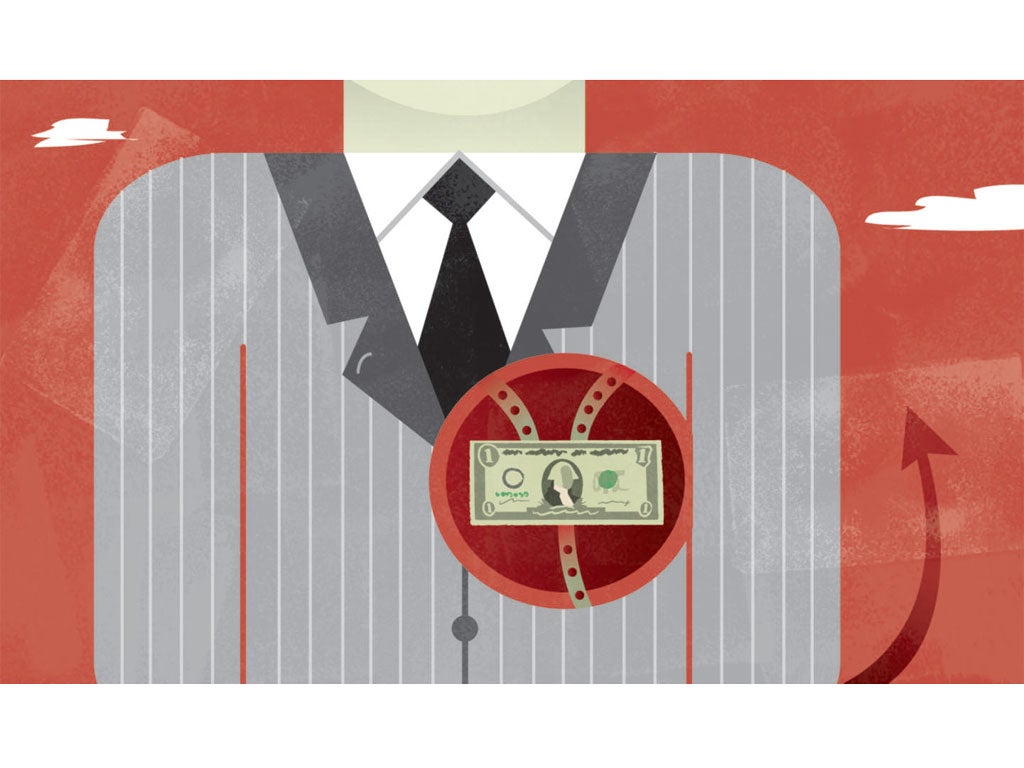
During the credit crisis, when all was giddy turmoil and bankers suddenly found themselves the target of a fierce volley of public ire, many people in the Square Mile dreamed of drafting a stinking letter of resignation. A letter that expressed in laconic, jaggedly incisive prose exactly why they were too good for this job and how the camel's back had finally broken – a letter that painted the bright, creative future they had mapped out for themselves once free of the grubby embrace of the corporation.
Few of them, even in the hubristic bubble that working in finance in the early years of the last decade had inflated in their minds, dared to dream that this letter might not only get written, but also be published as an op-ed article in The New York Times, explode across the internet, and wipe $2bn off the stockmarket valuation of the company with which they were so publicly severing relations. But this is exactly what happened to Greg Smith, an executive director (less grand than it sounds) in Goldman Sachs's equity derivatives division.
In his resignation letter, Smith described his gradual disenchantment with the corporate ethos at Goldman Sachs, how the firm had become "morally bankrupt", how he was by turns "bothered" and "made ill" by the way Goldman Sachs had lost sight of its duty to its clients. It seemed as if Smith's major complaint was semantic. He bridled against the language of the trading floor, the way that clients were referred to as "muppets", how everything was about "getting paid" and "ripping eyeballs out" (the last a rather Patrick Bateman-ish euphemism for making money at someone else's expense).
Smith also pointed his finger directly at Goldman Sachs's CEO, Lloyd Blankfein, and president, Gary Cohn. They had "lost hold of the firm's culture", he said, and "this decline in the firm's moral fibre represents the single most serious threat to its long-run survival". It had become all about the money under Blankfein and Cohn's stewardship. Whereas in some halcyon (and, frankly, fictitious) past, Goldman Sachs existed solely to serve the interests of its clients, now, Smith said, "if you make enough money for the firm (and are not currently an axe murderer) you will be promoted into a position of influence".
In the letter, and the faintly embarrassing security pass photographs that accompany them, Smith comes across as an amiable egghead. A Rolling Stone article about Goldman Sachs published in 2010 described the former investment bank (post-crisis it is now technically a bank holding company) as "a great vampire squid wrapped around the face of humanity, relentlessly jamming its blood funnel into anything that smells like money". While Rolling Stone wins plaudits for the striking metaphor, Smith's letter will do more damage. It is the geeky earnestness, the sense of a good man pushed over the edge by a "toxic and destructive" working environment, that will resonate long after Smith has gone off to teach/work on a farm/write his Great American Novel.
From the first, valedictory line: "Today is my last day at Goldman Sachs", to the touchingly clumsy language – "The culture was the secret sauce" – to the faintly bizarre references to our hero's youthful sporting and academic triumphs (including a bronze medal in a table tennis tournament), the letter carries a note of authentic despair. This is the sound of a disciple discovering that his idols have feet of clay, or, more correctly, that the personal narrative he had constructed that allowed him to navigate the cut-throat world of high finance had unravelled.
For this is what is at the heart of this story. Banking is not a vocation. No one becomes a trader in order to help the less privileged, or save lives, or follow a childhood dream. That he worked to serve his clients rather than make money feels like a comforting nostrum that Smith used to placate his conscience – to explain to himself how he'd ended up chained to a desk doing sums rather than living the bright, meaningful life he'd dreamed of as a child.
There's a lovely scene in Jason Reitman's film Up In The Air. George Clooney, a professional "firer" called in by large firms to make their employees redundant, looks down at a man's CV, sees he had trained as a chef, and asks him: "How much did it take to buy you away from your dream?" This is the story of banking: an industry that pays enough to persuade bright people to do tedious jobs. Or rather it used to.
Despite the headlines that would have you believe that City players are earning as much as they ever did, pay for the average banker has dropped dramatically. Those who might have previously felt themselves unable to leave jobs that they disliked because of the promise of the next bonus, the vesting of stock options, the annual pay rise, can now box up their belongings and follow their dreams. Greg Smith apparently didn't get a bonus last Christmas; stripped of a financial reward that had come to feel like an entitlement, he cut himself loose from a world that was no longer worth the candle.
As for the main thrust of Smith's accusations – that Goldman Sachs had gone from the sort of avuncular institution that existed only to give a leg-up to the small firms it serviced to a wicked and twisted embodiment of all that is wrong with capitalism – what seems strange is that Smith could have believed that a company so synonymous with the sharp end of high finance would ever have put anything else before the making of oodles of money.
Smith attempts to personify the firm by fingering Blankfein and Cohn, but speaking of "moral fibre" when talking of an institution as vast and deeply integrated into the global financial system as Goldman Sachs is specious.
In Frank Norris's great novel of derivative speculation The Pit (1903), he refers to the Chicago Board Options Exchange as "a monstrous sphinx with blind eyes, silent, grave". Drawing on the naturalistic model established by Emile Zola in L'Argent (1890), Norris presents the world of finance as disquieting precisely because it is free from such human traits as morality. More recently, in his thriller The Fear Index, Robert Harris created a financial computer model, VIXAL, which "had no purpose other than the self-interested pursuit of survival through the accumulation of money. If left to itself, in accordance with Darwinian logic, it would seek to expand until it dominated the entire earth". One could "no more pass moral judgement on it than one could on a shark".
Goldman Sachs is like VIXAL, a faceless behemoth with one sole aim: profit. To blame its bosses for the immorality of this machine grants them far more power than they actually wield.
I had lunch with a friend who works for one of Goldman Sachs's competitors the day Smith's resignation letter was published in The New York Times. What surprised him, he said, was not the tone of the letter, or its content, but that Goldman should have hired someone whose greatest claim to pre-banking fame was a bronze medal in a table tennis tournament. "I thought they only hired winners," he said.
Alex Preston's latest novel is 'The Revelations', published by Faber
Join our commenting forum
Join thought-provoking conversations, follow other Independent readers and see their replies
Comments
Bookmark popover
Removed from bookmarks