Robert Fisk: 'The army was told not to fire at protesters'
Our writer presses Assad's key adviser on the violent battle for Syria's future
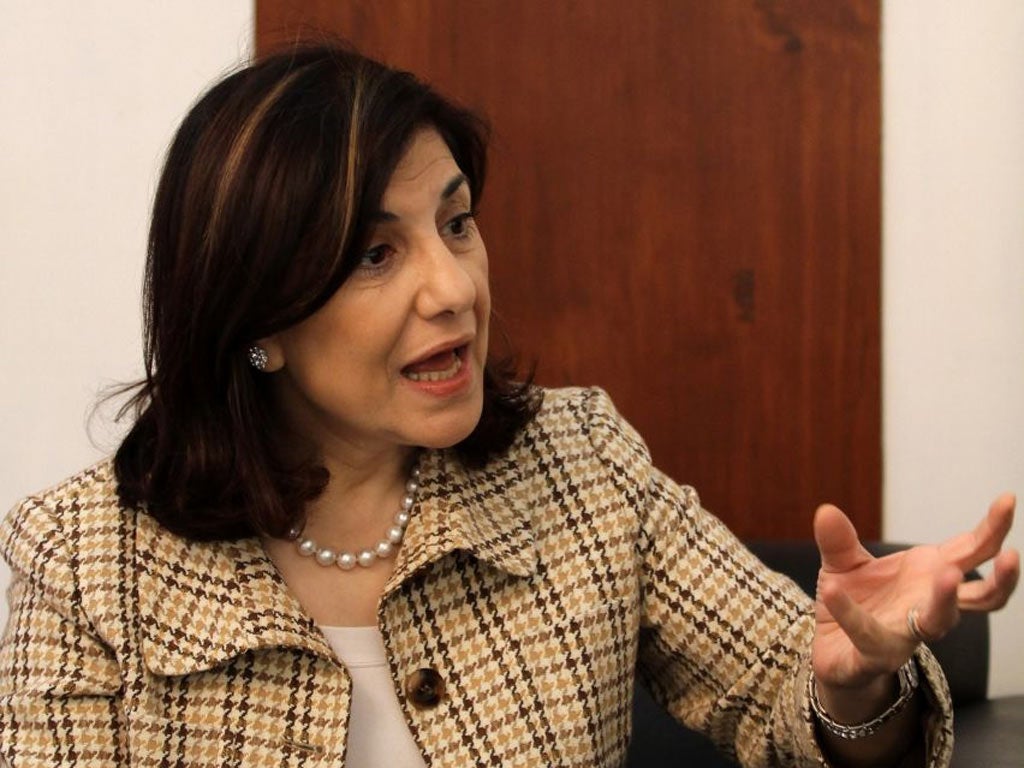
Bouthaina Shaaban is one of only six Syrians on America's personal sanction list against the Assad regime. She is political adviser to the President. A middle-aged mother and author who speaks perfect English, as much at home in Paris as in Cairo. And all those assets of hers, frozen in America. Wow.
So I sit in her Damascus office and ask the obvious question: what does it feel like to be on the sanctions list of the most powerful nation on earth? "Nothing really," she says, quick as a flash. "I have no assets – except the assets of the love for my people. The Americans understand 'assets' only as dollars. I don't have dollars anywhere in the world."
The "assets of my people" is a bit of a cliche. But touché. She isn't on a European sanctions list – yet – and thinks she can go to Europe if she wishes. "It's a bit ironic, really, to be on an American sanction list when my books are on sale all over the USA. At present my only travel plan is a possible trip to Saudi Arabia."
It's one of those frequent Syrian interviews – Shaaban prefers an off-the-record chat. I insist we are on the record. Once in full-flow, however, I can't stop her, and she confirms what every other Syrian in Damascus says: that the security situation in Homs is terrible, that the army is being attacked all over the country. Anyone with a military registration plate on their car is a target. Shaaban herself is from Homs. "Today is the second anniversary of the death of my mother. And you know we like to go to the grave of our family on the anniversary of their death. But I can't go to my mother's grave – I am afraid of being killed in Homs. Everyone is suffering.
"The other day, I went to the woman who is the best baker in Damascus – she works on the road to the airport, I always buy my bread from her but she was crying. She told me that some bearded men came to her and said: 'You are a Christian and you are putting whiskey in your bread.' So she had to close her bakery. These are the kind of people who want to destroy Syria. Now people, for the first time, are interested in the religion of their neighbours. This has never happened before. You know, Syria is one of those countries where people have the names of jobs – like Najr (carpenter) and Haddad (blacksmith). Now people are asking about what their religion is."
The political narrative is, of course, familiar. Violence is being directed at the army. "It is being directed at our public buildings and cities. This has nothing to do with peaceful demonstrations. This violence is the most dangerous thing happening now in Syria. Syrians all want to live in peace, to press ahead with pluralism and reforms. This violence is not the introduction to democracy. There is obviously a sector which is interested in conflict and not in reforms. They are all given money to shoot at demonstrators and the security forces – or they are extremist fundamentalists."
I have been down this path before. Surely – surely – I said to Shaaban, those original, terrible YouTube pictures of demonstrators being fired at in Deraa and Homs and Hama were real. One even shows Syrian soldiers turning and firing on the man filming them with his mobile camera. We all know how brutal the intelligence services can be. I remember – but do not mention – walking past the "muhabarrat" headquarters not far from my own hotel and commenting to a friend the same night that they must be hard at work on "interrogations". "They are done in the basements," he replied. "You wouldn't want to know what happens there."
"I think you have to know both sides of the story," comes the reply. "I would not be able to tell you the other side of the story. There are always now two sides of the story – I will not be defending anybody. Early in the crisis, our army and police and security services paid terrible sacrifices but they were told not to shoot at demonstrators. I really don't know why people should make things up. The Syrian civilians who went to Turkey – they returned and said the Turks had promised them passports, all kinds of things which turned out to be untrue. Why would a person wanting to flee Idlib go to Turkey? They would go to Aleppo."
I tell Shaaban that I have spent hours talking to Syrian refugees in Lebanon, poor farming people who told terrible stories of the "shabiha" militia and the brutality of the intelligence services in their village of Tel Khalak. Surely she doesn't believe these people were all making these things up? She talks about the "armed groups "playing with these people" and about how weapons are coming across the borders. "In Deraa, we found weapons that were Israeli. I told our people they should show these weapons to the media..."
So how come Syria's former best friends – Turkey and Qatar – are now among its fiercest critics, I ask? "I find the stand of Turkey a mystery. When you have a good friend – and it was Syria which opened for the Turks the front gate of the Arabs, we allowed Turks to come here without visas, Syria was flooded with Turkish products – we do not expect to have to abide by other people's policies. I think there are bigger, larger reasons. There is to be an anti-missile shield in Turkey, Turkey is a member of Nato – I don't know what is in the cake for Turkey. When I heard yesterday some statements by a Turkish official about us, I felt like he was supposed to be the teacher and we the students. We did not do anything to provoke this stand from Turkey."
There is puzzlement over Qatar's fierce condemnation of Syria but apparent relief that Wednesday's Arab League meeting with the Syrians went well. "I thought they came with a positive attitude. They said that Syria was a very important country in the Arab world, that anything that happens to Syria will affect all of the Arabs. Of course, a lot of their questions were based on the reports of Al Jazeera and Arabia [TV channels]."
I bet they were. Al Jazeera is banned in Syria.
Join our commenting forum
Join thought-provoking conversations, follow other Independent readers and see their replies
Comments
Bookmark popover
Removed from bookmarks