Robert Fisk: Western agreement 'could leave Syria in Assad's hands for two more years'
Special Report: Need for oil routes buys time, claims key Damascus figure

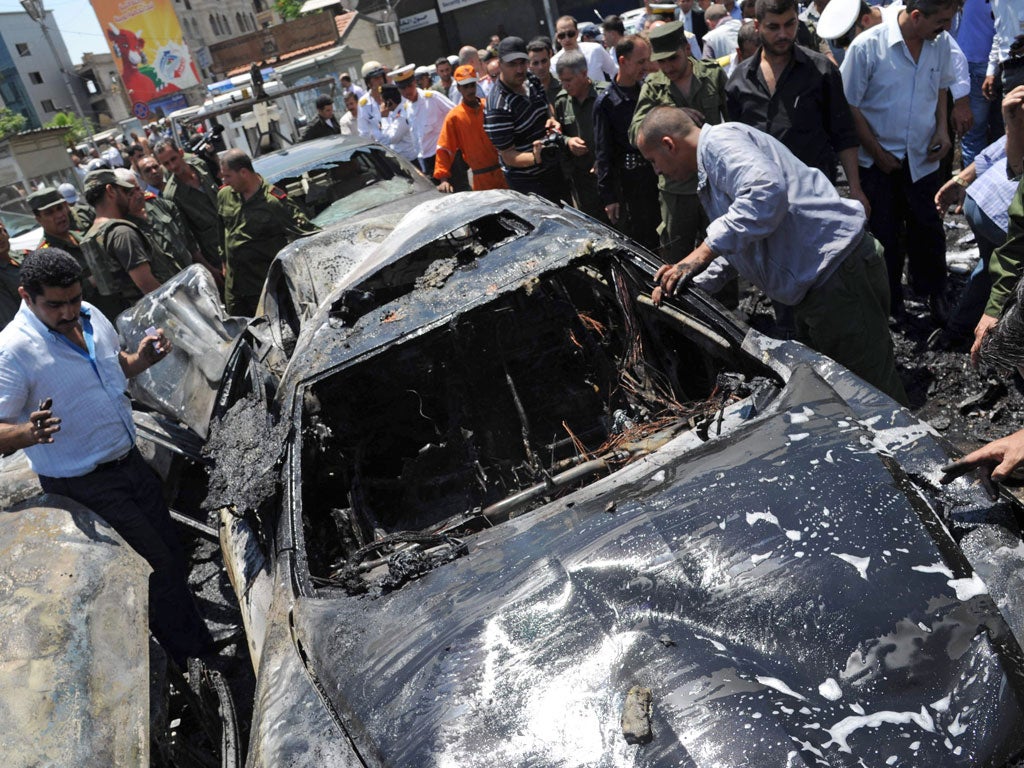
President Bashar al-Assad of Syria may last far longer than his opponents believe – and with the tacit acceptance of Western leaders anxious to secure new oil routes to Europe via Syria before the fall of the regime. According to a source intimately involved in the possible transition from Baath party power, the Americans, Russians and Europeans are also putting together an agreement that would permit Assad to remain leader of Syria for at least another two years in return for political concessions to Iran and Saudi Arabia in both Lebanon and Iraq.
For its part, Russia would be assured of its continued military base at Tartous in Syria and a relationship with whatever government in Damascus eventually emerges with the support of Iran and Saudi Arabia. Russia’s recent concession – that Assad may not be essential in any future Syrian power structure – is part of a new understanding in the West which may accept Assad’s presidency in return for an agreement that prevents a further decline into civil war.
Information from Syria suggests that Assad’s army is now “taking a beating” from armed rebels, who include Islamist as well as nationalist forces; at least 6,000 soldiers are now believed to have been murdered or killed in action since the rebellion against Assad began 17 months ago. There are even unconfirmed reports that during any one week up to a thousand Syrian fighters are under training by mercenaries in Jordan at a base used by Western authorities for personnel seeking ‘anti-terrorist’ security exercises.
The US-Russian negotiations – easy to deny, and somewhat cynically hidden behind the current mutual accusations of Hillary Clinton and her Russian opposite number, Sergei Lavrov – would mean that the superpowers would acknowledge Iran’s influence over Iraq and its relationship with its Hezballah allies in Lebanon, while Saudi Arabia – and Qatar - would be encouraged to guarantee Sunni Muslim rights in Lebanon and in Iraq. Baghdad’s emergence as a centre of Shia power has caused much anguish in Saudi Arabia whose support for the Sunni minority in Iraq has hitherto led only to political division.
But the real object of talks between the world powers revolves around the West’s determination to secure oil and particularly gas from the Gulf states without relying upon supplies from Moscow. “Russia can turn off the spigot to Europe whenever it wants – and this gives it tremendous political power,” the source says. “We are talking about two fundamental oil routes to the West – one from Qatar and Saudi Arabia via Jordan and Syria and the Mediterranean to Europe, another from Iran via Shia southern Iraq and Syria to the Mediterranean and on to Europe. This is what matters. This is why they will be prepared to let Assad last for another two years, if necessary. They would be perfectly content with that. And Russia will have a place in the new Syria.”
Diplomats who are still discussing these plans should, of course, be treated with some scepticism. It is one thing to hear political leaders excoriating the Syrian regime for its abuse of human rights and massacres – quite another to realise that Western diplomats are quite prepared to put this to one side for the proverbial ‘bigger picture’ which, as usual in the Middle East, means oil and gas supplies. They are prepared to tolerate Assad’s presence until the end of the crisis, rather than insisting his departure is the start of the end. The Americans apparently say the same. Now Russia believes that stability is more important than Assad himself.
It is clear that Bashar al-Assad should have gone ahead with extensive reforms when his father Hafez died in 2000. At that stage, according to Syrian officials, Syria’s economy was in a far better state than Greece is today. And the saner voices influencing Assad’s leadership were slowly deprived of their power. One official close to the president called him during the height of last year’s fighting to say that “Homs is burning”. Assad’s reaction was to refuse all personal conversation with the official in future, insisting on only SMS messages. “Assad no longer has personal power over all that happens in Syria,” the informant says. “It’s not because he doesn’t want to – there’s just too much going on all over the country for one man to keep in touch with it all.”
What Assad is still hoping for, according to Arab military veterans, is a solution a-l’Algerie. After the cancellation of democratic elections in Algeria, its army and generals – ‘le pouvoir’ to Algerians – fought a merciless war against rebels and Islamist guerrillas across the country throughout the 1990s, using torture and massacre to retain government power but leaving an estimated 200,000 dead among their own people.
Amid this crisis, the Algerian military actually sent a delegation to Damascus to learn from Hafez el-Assad’s Syrian army how it destroyed the Islamist rebellion in Hama – at a cost of up to 20,000 dead – in 1982. The Algerian civil war – remarkably similar to that now afflicting Assad’s regime – displayed many of the characteristics of the current tragedy in Syria: babies with their throats cut, families slaughtered by mysterious semi-military ‘armed groups’, whole towns shelled by government forces.
And, much more interesting to Assad’s men, the West continued to support the Algerian regime with weapons and political encouragement throughout the 1990s while huffing and puffing about human rights. Algeria’s oil and gas reserves proved more important than civilian deaths – just as the Damascus regime now hopes to rely upon the West’s desire for via-Syria oil and gas to tolerate further killings. Syrians say that Jamil Hassan, the head of Air Force intelligence in Syria is now the ‘killer’ leader for the regime – not so much Bashar’s brother Maher whose 4th Division is perhaps being given too much credit for suppressing the revolt. It has certainly failed to crush it.
The West, meanwhile has to deal with Syria’s contact man, Mohamed Nassif, perhaps Assad’s closest political adviser. The question remains, however, as to whether Bashar al-Assad – however much he fails to control military events on the ground – really grasps the epic political importance of what is going on in his country. Prior to the rebellion, European and Turkish leaders were astonished to hear from him that Sunni forces in the northern Lebanese city of Tripoli were trying “to create a Salafist state” that would threaten Syria. How this extraordinary assertion – based, presumably on the tittle-tattle of an intelligence agent – could have formulated itself in Assad’s mind, remained a mystery.
Join our commenting forum
Join thought-provoking conversations, follow other Independent readers and see their replies
Comments
Bookmark popover
Removed from bookmarks