Owen Jones: Getting rid of George W. Bush wasn't enough. The US remains a bully
The issue isn't Obama, any more than it was Bush before him. The issue is US power
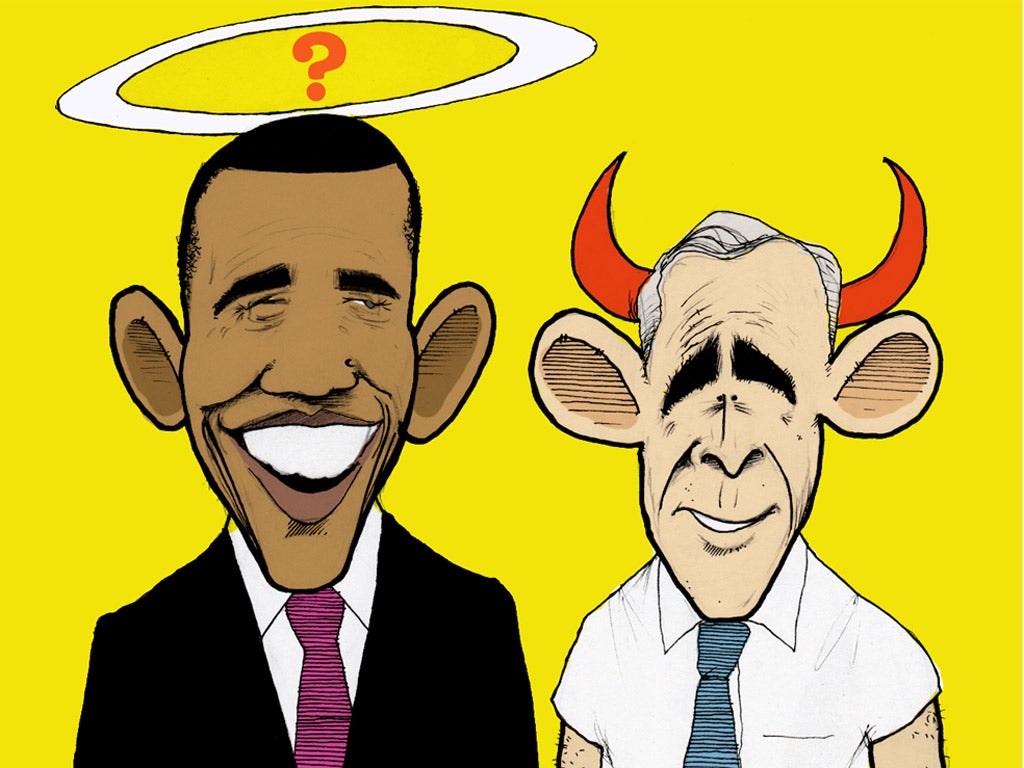
How easy it was to scrutinise US power when George W. Bush was in office. After all, it was difficult to defend an administration packed with such repulsive characters, like Dick Cheney and Donald Rumsfeld, whose attitude towards the rest of the world amounted to thuggish contempt.
Many will shudder remembering that dark era: the naked human pyramids accompanied by grinning US service personnel in Abu Ghraib; the orange-suited prisoners in Guantanamo, kneeling in submission at the feet of US soldiers; the murderous assault on the Iraqi city of Fallujah. By the end of Bush's term in office, favourable opinion of the US had plummeted even in allied countries, and those desperate for a Republican rout in the presidential elections ranged from resolute socialists to committed Tories.
It was a bad dream that went on for eight years, and no wonder much of the world is still breathing a sigh of relief. But US foreign policy these days escapes scrutiny. In part, that is down a well-grounded terror of the only viable alternative to Barack Obama: the increasingly deranged US right. A deliberate shift to a softer, more diplomatic tone has helped, too. But it is also the consequence of a strategic failure on the part of many critics of US foreign policy in the Bush era. As protesters marched in European cities with placards of Bush underneath "World's No 1 Terrorist", the anti-war crusade became personalised. Bush seemed to be the problem, and an understanding of US power – the nature of which remains remarkably consistent from president to president – was lost.
This week, the UN's Special Rapporteur on Human Rights and Counter-Terrorism, Ben Emmerson QC, demanded that the US allow independent investigation over its use of unmanned drones, or the UN would be forced to step in. These drones target militants, it is claimed, but according to a study by the Bureau of Investigative Journalism, between 282 and 585 civilians have died in Pakistan as a result. In one such attack in North Waziristan in 2009, several villagers died in an attempt to rescue victims of a previous strike.
According to Pakistan's US Ambassador, Sherry Rehman, the drone war "radicalises foot soldiers, tribes and entire villages in our region". After the latest strike this week, Pakistan's foreign ministry said the attacks were "a violation of its sovereignty and territorial integrity and are in contravention of international law". Its Parliament has passed a resolution condemning the drone war. It is armed aggression by the Obama administration, pure and simple.
If it was happening under the Bush presidency, the opposition would be vociferous and widespread. But while there were 52 such strikes in Pakistan in eight years of Bush, there have been over 280 in three and a half years of Obama. Numbers have soared in Yemen and Somalia, too. Two months ago, former US President Jimmy Carter described drone attacks as a "widespread abuse of human rights" which "abets our enemies and alienates our friends". He's not wrong: the Pew Research Center found just 7 per cent of Pakistanis had a positive view of Obama, the same percentage as Bush had just before he left office.
But, in the West, Obama can get away with acts that Bush would rightly be pilloried for. Indeed, he seems to think it's all a bit of a laugh: in 2010, he jokingly threatened the Jonas brothers with a Predator drone strike if they came near his daughters. How droll, Barack.
Guantanamo was iconic of Bush's brutality, and after his election Obama signed executive orders mandating its closure. The camp remains open for business, pledged to take new "high-value" detainees if captured. The same goes for Obama's pledge to shut down CIA-run "black site prisons" in Afghanistan. At least 20 secret temporary prisons remain in place, with widespread allegations of ill-treatment. US involvement in a senseless, unwinnable war in the country – ruled by a weak, corrupt government that stole the 2009 presidential election with ballot stuffing, intimidation and fraud – continues.
Under Obama, the US role in the Middle East remains as cynically wedded to strategic self-interest as ever. Despotic tyrannies like Saudi Arabia are armed to the teeth: in 2010, the US signed an arms deal with the regime worth $60bn, the biggest in US history. Obama has resumed sales of military equipment to Bahrain's dictatorship as it brutally crushes protesters struggling for democracy. Last year, Saudi Arabia invaded Bahrain with tacit US support. And even when the US-backed Mubarak dictatorship was on the ropes in Egypt, Obama's administration remained a cheerleader, with Secretary of State Hillary Clinton arguing that the "Egyptian Government is stable and is looking for ways to respond to the legitimate needs and interests of the Egyptian people".
Coupled with the US's ongoing failure to pressure Israel into accepting a just peace with the Palestinians, no wonder there is rising global anger at Obama. But of course, the issue isn't Obama, any more than it was Bush before him. The issue is US power. But despite its best efforts – and as menacing as it can be for Pakistani villagers and Bahraini democrats – its power is in decline. The US share of global economic output was nearly a quarter in 1991; today, it represents less than a fifth. The financial crash has accelerated the ongoing drain in US economic power to the East. Latin America, regarded as the US's backyard since the 1823 Monroe Doctrine claimed it for the US sphere of influence, is now dominated by governments demanding a break from the free-market Washington Consensus. And the Iraq war not only undermined US military prestige and invincibility, it perversely boosted Iran's power in the Middle East.
With the last remaining superpower at its weakest since World War II, there is an unmissable opening to argue for a more equal and just world order, restricting the ability of Great Powers to throw their weight around. And a word of warning: if we don't seize this opportunity now, one superpower will simply be replaced by another – and our world will be as unequal and unjust as ever.
Join our commenting forum
Join thought-provoking conversations, follow other Independent readers and see their replies
Comments
Bookmark popover
Removed from bookmarks