Patrick Cockburn: As the violence intensifies in Syria, there can be only one winner - the Kurds
World View: Ankara is watching events unfold with growing anxiety as Assad withdraws his forces from the Turkish border area

A favourite line of defence of embattled dictatorships is that if their rule is relaxed, their country will be torn apart by ethnic, religious or social strife. Opponents of autocracy commonly respond that these fears are exaggerated and self-serving and it is dictators themselves who foment such divisions to justify their monopoly of power. Moreover, critics of existing regimes hopefully claim that democratic elections will defuse the explosive potential for confrontations between opposing communities by giving them a non-violent path, denied under arbitrary government, to achieve their aims.
All these arguments contain elements of truth and self-deception. In Iraq under Saddam Hussein, many of his opponents genuinely believed that the divisions between Sunni, Shia and Kurd were primarily the result of his machinations. "Only get rid of Saddam," Iraqi friends would say to me before 2003, "and just watch Iraqis settle their differences peacefully." They chided me for naively taking at face value the self-serving propaganda of the Baathists about how they provided a necessary barrier to ethnic and religious strife.
The arguments of the regime in Baghdad were so evidently self-serving as to largely discredit them. During the great Shia and Kurdish uprisings of 1991 in the wake of defeat in the Gulf war, Saddam was able to consolidate the Sunni core of his regime in the capital by persuading the Sunni that they faced massacre by the rebels. Likewise, in Syria today, Bashar al-Assad has sought with some success to persuade the Alawites, Christians and other minorities that they face oppression, if not slaughter, at the hands of Sunni insurgents.
When I was in Damascus earlier this summer, one insurgent sympathiser insisted to me that "this is still essentially a struggle of the people against the government". When I talked of sectarian divisions to a Christian from Hama, whose family members had cumulatively spent 60 years in prison under the Baath, he insisted with obvious sincerity that communal antagonisms in Syria "are much less significant than the outside world imagines".
His words made my heart sink a little. I hope the Christian from Hama is right, but I started as a journalist in Belfast in 1972-75 at the height of sectarian warfare in Northern Ireland. I had many good-hearted friends who would tell me with complete conviction that they did not have a sectarian bone in their body. But, as the conversation progressed, it would emerge that they had an encyclopaedic knowledge of the sectarian geography of Belfast and they would no more knowingly intrude into the territory of the community to which they did not belong than they would walk off the edge of a cliff.
A degree of self-deception about the extent of their own divisions is common to most cities and countries where different communities live side by side. The blindness is normally greatest on the part of the dominant community, for obvious egocentric motives. Today Bahrain is probably the country in the world most divided by sectarian differences between Sunni and Shia. The Sunni al-Khalifa dynasty has established what amounts to an apartheid state in which its minority community monopolises power. But in Bahrain I found it impossible to discover any Sunni who would admit to this even in the most private conversation.
How far do these precedents apply to Syria after a year and a half of escalating conflict? It is not just what happened in Lebanon during the civil war (1975-90) or Iraq (2003 to the present) that look ominous. The whole history of cosmopolitan and multicultural societies in Eastern Europe and the Middle East over the past century has been one of murder and expulsion.
Politicians, diplomats and journalists are aware of the dangers of communal strife in Syria. The example of Iraq after the 2003 invasion is too recent to be ignored in foreign capitals. There is also the knowledge that it is much in the interests of the Syrian insurgents to play up the example of Libya, where Nato intervention appeared to succeed, and down play Iraq when looking for foreign support. Unlike Libya, three conflicts are intertwined in Syria: the people against autocracy; the Sunni against the Shia; and the US, Israel and Saudi-led coalition against Iran and its allies.
At this stage most people who see news of fresh fighting and atrocities in Syria, and are not directly involved in the conflict, pay less and less attention to what is happening there. Syria comes across as one more murderous imbroglio, like Iraq, Somalia, eastern Congo or Lebanon used to be or remain today. Television pictures of extreme violence in such places no longer shock because they are part of the expected landscape.
These expectations have numbed the outside world and most Syrians into paying too little attention to a crucial recent development in the Syrian crisis. It is an event likely to have immense impact not just on Syria but on several of its neighbours. I do not mean the spread of inter-communal fighting pitting Sunni against Shia and Alawites in Lebanon or the strengthening of the position of al-Qa'ida in Iraq, both of which have been widely reported.
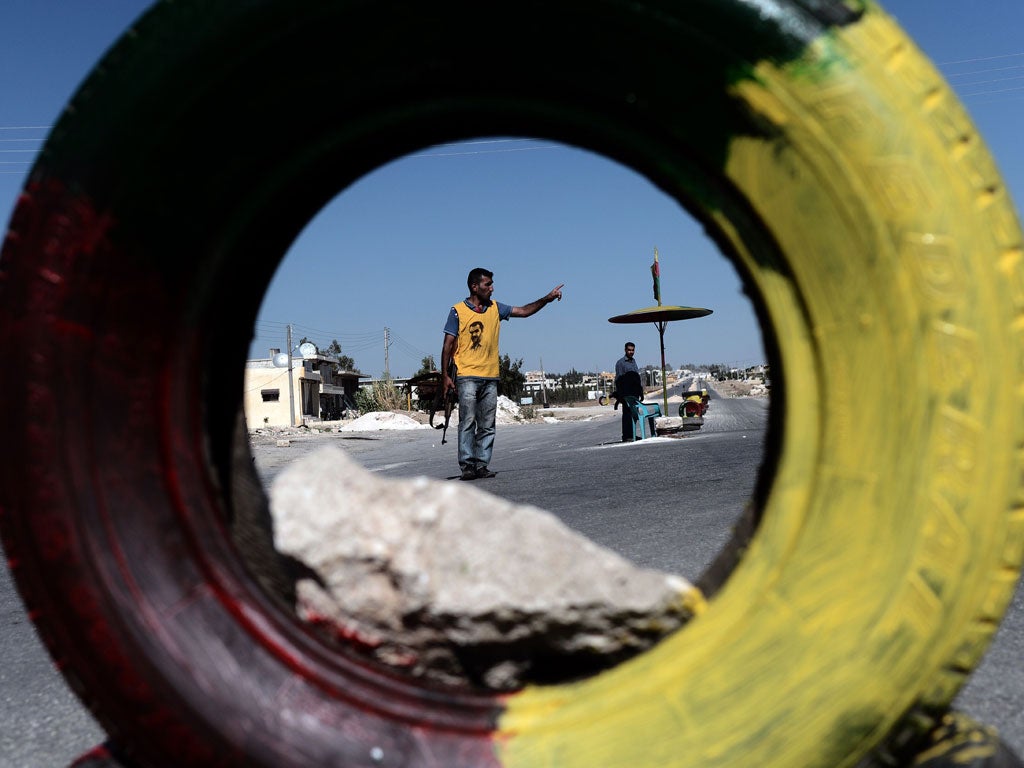
The new development is the withdrawal of almost all of the Syrian army in the north of the country along the Syrian border. The Syrian Kurds (whose total numbers are about 2.5 million or 10 per cent of the Syrian population) have achieved de facto autonomy just as the Iraqi Kurds did in 1991. Both Bashar al-Assad and the Syrian rebels are vying for Kurdish support and have to accept, at least for now, the establishment of a Kurdish enclave. For their part, the Syrian Kurds may wish for the present civil war to continue so their shaky control of their own areas can put down roots.
The significance of what has happened is not immediately obvious until it is recalled that Kurdish nationalism is one of the great forces in Middle East politics. The position of the Kurdish minorities in Iraq and Turkey is crucially important for their stability. In Iraq, the Kurdistan Regional Government (KRG) enjoys autonomy from Baghdad but, in practice, the KRG is more powerful politically, militarily and financially than most states in the UN.
If the Syrian Kurds achieve the same status of autonomy close to independence as in Iraq, how will Turkey be able to deny similar status to its own Kurdish minority in the south-east of the country? In the years since the PKK (Kurdistan Workers Party) started guerrilla war against the Turkish state in 1984, Ankara has failed to crush the insurgents politically or militarily. In the past couple of years, the Turkish Prime Minister, Recep Tayyip Erdogan, has short-sightedly opted for repression rather than concessions.
Turkey may come to regret its intervention in Syria. Turkey threatens to invade northern Syria if the PKK gains control there, but since it has failed to eliminate the movement at home, it is unlikely to do so abroad and would be in an even bigger mess. In Washington, Ankara, Baghdad and elsewhere there is alarm that the political chessboard of the Middle East has suddenly changed in an unexpected way. "The real fear isn't that Syria will be divided," says Aliza Marcus, an expert on the Turkish Kurds writing in The National Interest magazine. "It's that the Kurds are uniting."
Join our commenting forum
Join thought-provoking conversations, follow other Independent readers and see their replies
Comments
Bookmark popover
Removed from bookmarks