Anselm Kiefer: Artworks as reconciliation
A new Anselm Kiefer show will bring Germany and Israel closer together
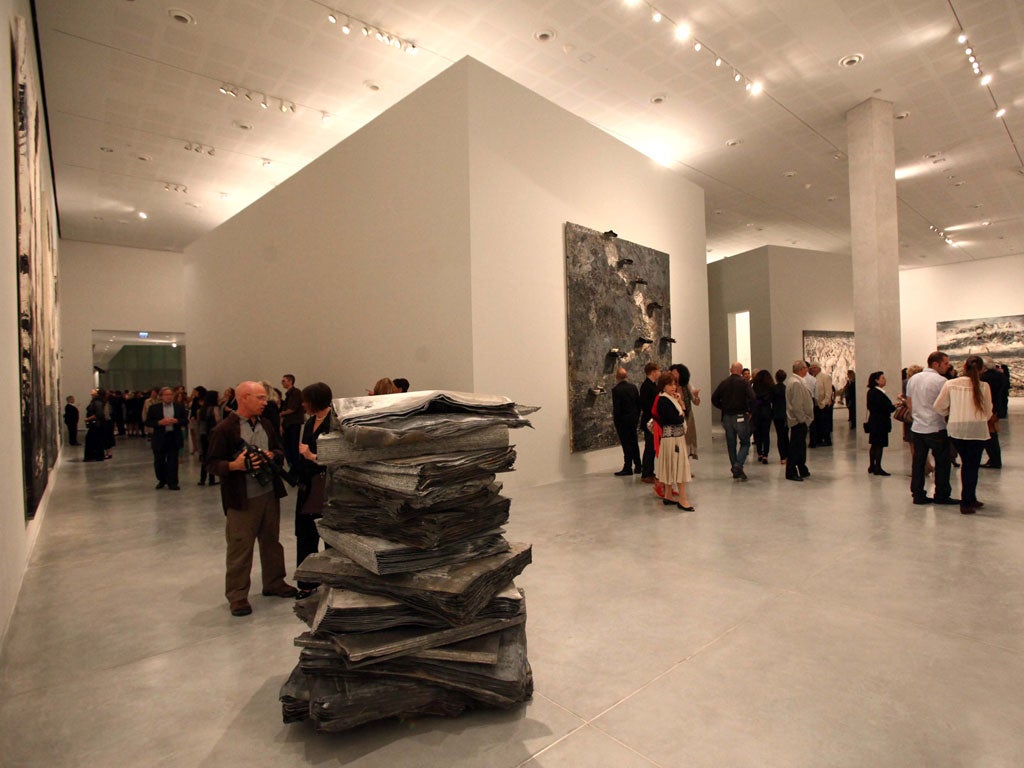
German shakes hands with Jew. A major exhibition of paintings and sculpture by Anselm Kiefer, a man born a Catholic in a small village in the Black Forest during the last year of the Second World War, opens today in the new wing of the Tel Aviv Museum of Art, the very building in which Ben Gurion declared the independence of Israel in 1948.
"It is an act of reconciliation," he explains. "I am striving for a kind of reunification." It is also a ghostly reminder of all that has been lost: during the 1920s there was a profound collaboration between Jewish and German culture. "Those who carried this culture have perished by the hands of others," Kiefer explained at the opening of the exhibition. "I try in my own way to reverse this irreversible and brutal self-mutilation, knowing that this too is impossible..."
As an artist, Kiefer has been engaged with Jewish mysticism, the Bible and the idea of the nationhood of Israel for more than a quarter of a century. As a child, he was fascinated by images of Samson, Abraham and others by Gustave Doré. In 1983 he visited Jerusalem for the first time. Looking out from his window in the King David Hotel, he could see the Mount of Olives to the left, and the desert to the right. The shock he felt at that moment felt like the beginning of a kind of initiation. "I felt myself suddenly propelled to a crossroads, where the layered sediments of a 4,000-year-old universal history superimposed themselves upon my own personal history." The iconography of Catholicism, he recognised, was profoundly bound up with its sources in Judaism. He began to study the Kabbalah, and the founding cosmic myth of Lurianic Kabbalah, shevirat ha-kelim (the breaking of the vessels), which gives the exhibition its title.
Breaking and mending. There is much evidence of violent making and unmaking in the work of Kiefer. The installation which takes its name from the title of the exhibition shows us stark images of the building of knowledge – and the unbuilding of violence. Ranks of lead books hang from a metal frame and, scattered indiscriminately across the floor which stretches away from those books, we stare at strewings of shattered glass.
The paintings on the walls look like huge fragments wrested from a heavily contested battleground. Every painting is bruised, pitted, scarred. Textures are densely re-worked. Some of them are so heavily encrusted with paint that you feel for the conservators. Kiefer puts paintings through their paces, coating them with water, slathering them with mud, attacking them with an axe when the mood seizes, subjecting them to the ministrations of the flame-thrower. All this seems entirely appropriate, given their themes – Ararat, Samson, Cain and Abel. The Old Testament was a bloody, vengeful arena. The physical state of these paintings feels at one with their themes.
Many of these densely textured paintings, all realised on an enormous scale, begin in hallucinatory landscapes or seascapes (or somewhere in between). At first glance they remind the onlooker of the 19th-century romanticism of Caspar David Friedrich or Turner. Everything seems to be yearning towards sublimity and a kind of turbulent symphonic excess. Mountains rear balefully. Fields scored by furrows seem to be receding towards infinity. But these paintings never end in landscape. Nor do they begin or end at any particular historical moment. The totality of the history of human conflict seems to have been poured into them. A painting called Samson includes both an allusion to the biblical Samson – a representation of the gates of Gaza – and a rusting machine gun (with Samson's name painted on it) whose presence here reminds us of Israel's war of independence.
Join our commenting forum
Join thought-provoking conversations, follow other Independent readers and see their replies
Comments
Bookmark popover
Removed from bookmarks