David Hepher: Estate of the nation
David Hepher's pictures of London tower blocks are on show at Flowers Gallery. He explains why he's a landscape not an architectural painter
Walk down the Walworth Road, away from the hideous south London mêlée of the Elephant and Castle road junction. The first thing you see is the nightmarish Heygate housing estate, surrounded by builders' boards. It is coming down, less than 40 years after the borough of Southwark erected it. Misguidedly, the high, blank flats replaced the previous Victorian terraces, then seen as slums.
Walworth is still a slum. Tall blocks were the wrong answer. Yet even slums have their bright side. Walworth's high street is thronged: a multitude of nail bars; a jerk-chicken restaurant; a storefront solicitor, offering advice for legal actions against the police; a bespoke tailor, Threadneedleman, "established 1995", with the motto "Nulli Secundus". East Street market, on a side-street, is a wondrous fandango of vegetables, fruit and fish.
The crowd scenes evoke the paintings of the young Edward Burra. But jostle your way down East Street – past the plaque marking Charlie Chaplin's birthplace – and turn right. You come to the grey slab blocks, up to 14 storeys high, of the notorious Aylesbury estate. This is where many of the people bustling along the Walworth Road actually live. The Aylesbury is also the remarkable leitmotif of David Hepher's work as a painter.
Covering 65 acres, and a decade in the building (1967-77), the estate is all constructed from the repetitive units of an industrialised building system (Jespersen 12M). An early opponent described the outcome as "the highest-rise prefabs in Britain." One block is reputedly the longest array of flats in Europe.
All the vast blocks were given dinky names from Buckinghamshire villages and small towns. (A failure of nerve?) But, symbolically, Tony Blair held his first photo-shoot as Prime Minister at the Aylesbury, in 1997, promising a brighter future. Nowadays, a bizarre montage of film-shots of the Aylesbury is one of the "idents" opening the Channel 4 News. After the Heygate, the Aylesbury is Southwark council's next big project, but they say demolition may take another quarter of a century.
In one of the most extraordinary conjunctions in British painting, the Aylesbury is to Hepher (as he acknowledges) what the Stour valley was to Constable or the Medway to Turner. For most of his career, he has painted this and other near-by blocks and towers. Tate Britain's collection holds one of his best-known depictions of an Aylesbury slab block (painted 1979).
In some of his earlier work, David Hepher portrayed bog-standard interwar suburban houses with almost surrealistic precision. He has, he says, "an obsession with how people live". He has a painting of everywhere he has ever lived. But studying, and eventually teaching, at the Camberwell School of Art, and moving to live there, he personally saw the Aylesbury begin to rise from the dust. He says that "an artist is a witness". Since the early 1970s, he has borne witness to these pharaonic monuments. Hepher never forgets the original idealism. His is an uplifting story of sheer persistence, even stubbornness.
When you talk to him, Hepher courteously distances himself from any sortie into social issues. He comes from a long line of teachers and clergymen. But he is as non-didactic as anyone could be. Before he became fascinated by the Aylesbury, he saw another famous megalith, the Park Hill estate (built 1957-61), start to soar up behind Sheffield's steelworks, in place of the then derided back-to-backs. His father was a local vicar. The first grain of Hepher's fascination may lie here. Also, perhaps the first impressions of architectural idealism.
Buildings may be what Hepher paints, and what he is enthralled by. (He admired Lowry, for example, for his townscapes when these were routinely mocked by art critics.) But he resists being called "an architectural painter". He says: "I am a landscape painter."
At first, his portrayals of south London flats had an almost hallucinatory concern for detail. The geometric design of the blocks carried a faint echo of Modernism in its heyday – of Mondrian, in particular. And Hepher's punctiliousness brought this out. Each picture was long in the painting. As in the Tate example, the greys and blues of the steel and concrete were broken only by the balconies' multicoloured lines of washing and the occasional plant. People were rare or non-existent. These were homes that might have been inhabited by ghosts. Paradoxically, I am reminded of Claude, another landscape painter who whittled human figures away almost to nothingness.
As the Aylesbury has shifted away from being a hope for south London's future, the balcony windows have become more and more closed up by shabby curtains, bought cheap. The crime rate has soared. The unfriendly walkways are more and more deserted. By now, Hepher found himself painting yesterday's future.
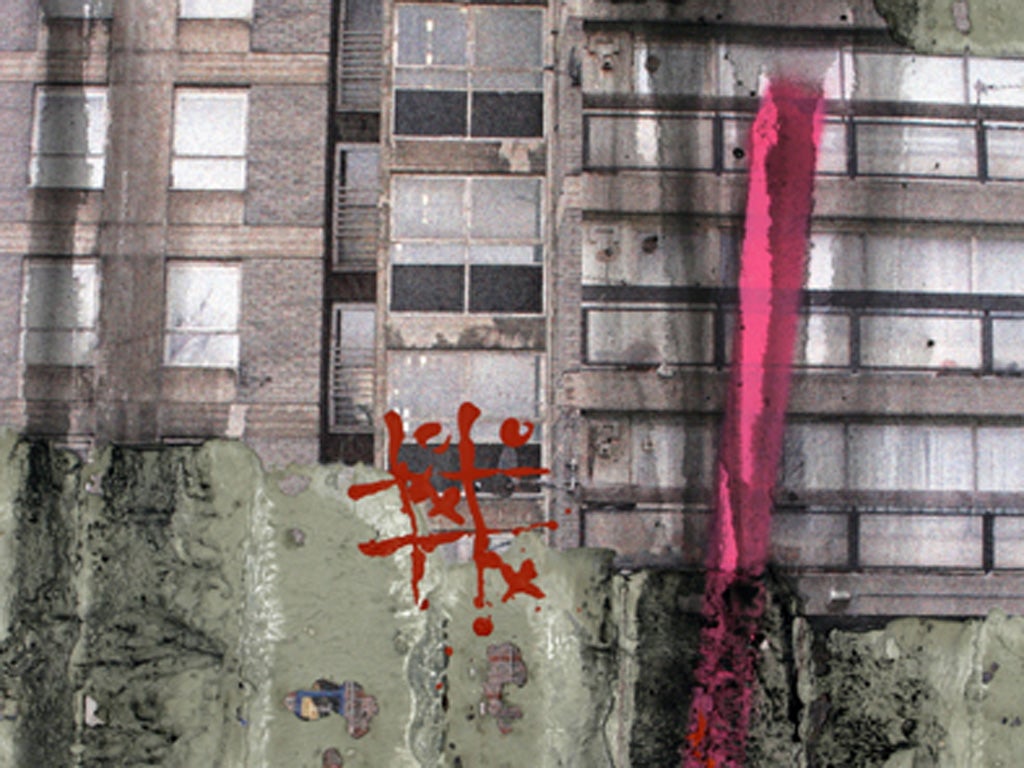
He moved away – as the present exhibition shows – from detailed observation into a highly painterly manipulation of surface and image. I find the impact vehement, even angry; David Hepher sees it as a kind of celebration. He makes a comparison with the work of his almost exact contemporary Gerhard Richter. But this is no longer the friendly world of interwar suburbia or the over-optimistic world of mid-20th century mass social housing.
In Hepher's latest pictures, the viewer is immersed in sheer size. All five images in a polyptych are more than seven feet high. Is it coincidence that Grünewald's incandescent Isenheim Altarpiece also has five components? With a painter so historically aware, I doubt it.
One Hepher diptych is arranged vertically. The upper half is strongly based on photography. Some of the canvas has a cement surface, shutter-marked like brutalist architecture. The lower section, like almost all Hepher's later paintings, is scrawled with graffiti: "Aylesbury" is scribbled over by "Gordale Scar" (Yorkshire stomps on Buckinghamshire?). To make things even more complex, Hepher inserts into his diptych a miniature version of James Ward's romantic painting of the ravine, Gordale Scar (1812-14), with Dales water slicing through the limestone.
David Hepher has focused his unique vision on a highly concentrated range of subject matter. But there is nothing simple about what he sees. He constantly slices through to new layers of meaning.
Paul Barker is the former editor of 'New Society'. His books include 'The Freedoms of Suburbia' (2009). His new book, 'Hebden Bridge: a Sense of Belonging', will be published in May
The exhibition of David Hepher's recent paintings is at Flowers Gallery, London E2 (020 7920 7777) to 25 February
Join our commenting forum
Join thought-provoking conversations, follow other Independent readers and see their replies
Comments
Bookmark popover
Removed from bookmarks