Finding a new place for the map
It's a tool that has shaped modern civilisation, but is the map as we know it redundant? Samuel Muston wonders if it's now more valuedfor decoration than for navigation
If the explorer David Livingstone had a star, then by summer of 1873 it was falling. The glare of the central-African sun had carried off another of his bearers. Two others had succumbed to malaria. The whirling buzz of tsetse flies was incessant. Leaches the size of children's fists attached themselves to every patch of bare skin. The greatest Victorian explorer, the man who crossed Africa and spent several long lonely years mapping its centre and fruitlessly searching for the source of the Nile, lay prone on a stretcher. Dysentery and fever, the result of being carried through never-ending swamps, was the cause. He would be dead in a month. As he had written three weeks earlier: "It's not all pleasure, this exploration."
But, then again, he wasn't in it for the laughs. Livingstone and explorers like him were driven by a loftier calling. They took great risks, suffered hardships, faced death for the singular purpose of making the unknown known. Exploration was, and is, the precursor to map-making. And maps allowed humans to spread across the world, trade fruitfully, co-exist peacefully, and find our way from Winchester to Worksop without asking strangers for directions.
Skip forward a century and a bit, across an ocean to a flat – my flat, in fact – in east London. On the back wall of the bedroom above the small headboard, cheek-by-jowl with a Joy Division poster (yes, I know) lies the fruit of Livingstone's travails: a map of Africa. Only, in this one, the tributaries of the Nile, Livingstone's nemesis, curl up into stylised flower heads. I bought it for £40 quid from an art website a couple of months ago. It's torn and Kenya is mottled with hair wax from where I've been leaning on it. But I don't really mind as I have no current plans to go to Kenya. The longitudinal lines that cut it and the rivers, lakes, tributaries and coastlines that mark it are as useless to me as the treatment doled out to Livingstone. I'm just in it for the look. It perks up the wall no end.
If I did plan to traverse Africa I'd reach for a laptop and maybe a GPS positioner, if indeed I had such a device. As David Howard of the AA, which sells both atlases and sat navs, points out: "You are never going to be able to pick up a map and instantly know where you are. You can do that with a sat nav. In lots of circumstances – if not quite all – technology has rendered the map nearly redundant." Sales figures certainly seem to back him up. Nielsen Bookscan, a publishing consultancy, reports a 31 per cent drop in sales of road maps over the past six years. World atlas sales face the same fate, with a 25 per cent fall in sales. Meanwhile Halfords claims 10 million UK drivers (nearly a third of all those in the UK) now rely exclusively on sat navs. The map, though, is not dead: in fact my own bit of cartographical decor winks at a counter trend.
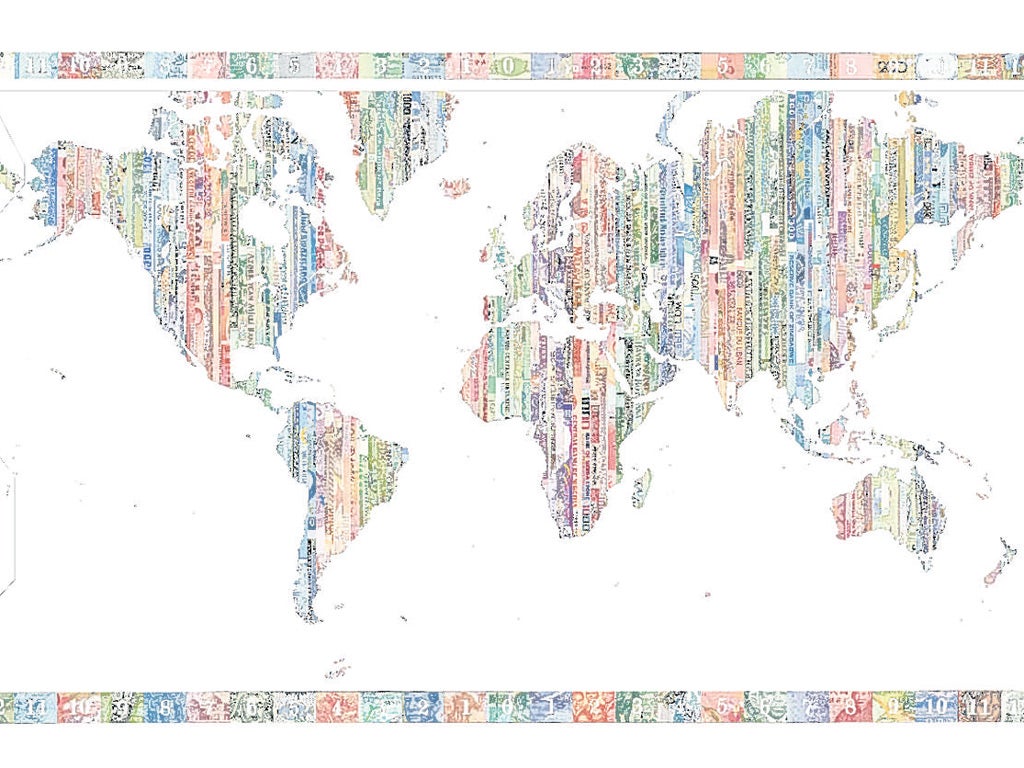
Once the preserve of outdoor types, maps are now as much a part of the interior decorator's armoury as magnolia paint and stripped-wood floors. American magazine Elle Decor recently ran a feature on decorating with maps. John Lewis reports a 150 per cent increase in sales of its decorative maps in the past six months. "Sales of our Bold & Noble's range of UK maps are increasing by 24 per cent each week," says a spokeswoman for the store. The art crowd is getting in on the act, too: an exhibition of map art opens at London's Air Gallery in November. (Highlights are pictured, left.)
What is it that makes maps so attractive as a decoration or art? According to Katharine Harmon, author of The Map as Art, it's the idea behind them. "They are so compelling because they allow us to see places in context. They locate people, places and things we are curious or care about. We have more information, experiences available to us than ever before – and it's comforting to know where we are among it all."
Comfort and quirky design were not the pre-occupations of cartographers and explorers down the ages though. So, have we hollowed out maps and demeaned the efforts of the people who produced them? "Certainly not," says Tom Harper, curator of antiquarian maps at the British Library, "before the 17th century and the European Enlightenment maps were primarily devotional or artistic objects. The same monks who illustrated manuscripts in England made maps. Often they told biblical stories. If you look at the maps of Ortelius – the geographer to the King of Spain – in the 16th century, you see the art of the day shining through; his work has heavy baroque decoration that mirrors renaissance frescos. They were artistic objects more than tools of direction."
So what of my own bit of decoration on the cheap? In his final days, Livingstone probably didn't seek comfort in the thought that his work would spruce up the magnolia walls of a flat in Shoreditch. But at least England's medieval monks – and Elle Decor – know what I'm aiming at. Which must count for something.
Join our commenting forum
Join thought-provoking conversations, follow other Independent readers and see their replies
Comments
Bookmark popover
Removed from bookmarks