Art

10° London Hi 12°C / Lo 6°C

How to spot a golden calf - or a cash cow

A new exhibition aims to teach visitors the true value of art.

By Emma Love

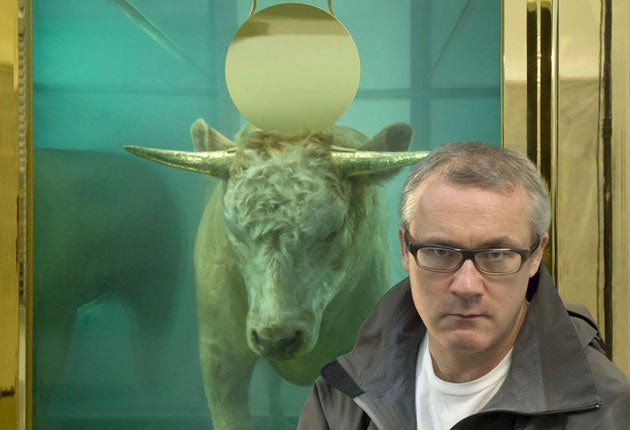
Priceless? Damien Hirst with 'The Golden Calf', which sold for £10.2m

REUTERS

Priceless? Damien Hirst with 'The Golden Calf', which sold for £10.2m

Damien Hirst has famously said that art is only worth what someone will pay for it – which in the case of his creations always seems to be a ludicrously high amount of money. He is a hugely divisive figure – collectors see his art as an investment, yet critics have questioned the value of pieces such as The Golden Calf, a calf in a tank of formaldehyde which last year sold for £10.3m in a record breaking two-day auction at Sothebys.

Of course, the amount people are willing to pay for art directly relates to the artist themselves. (Funnily enough, if anyone else tries to sell a shark in chemicals – as the Stuckist movement did last year – it’s not nearly as popular.) Take the annual RCA postcard sale where well-known artists contribute work anonymously. Do you choose a postcard with a design you don’t like because you think it might be by a big name artist and therefore worth a lot more money than the £40 you paid for it? Or do you just go for what you like? And what happens when art is free, such as when street artist Adam Neate did an art drop in London last year, leaving 1000 pieces of art at locations around the capital. Is its value less or more to those who found it because they didn’t have to pay?

Continuing the debate and aiming to test Hirst’s sentiment, next month AUGUST art gallery is carrying out an experiment, entitled On CDOs and Double Clubs, on how we decide the value of art. It is part of this year’s East Festival of culture in London, and anyone can show work in the exhibition from 5 to 12 March (artists won’t have to go through the usual gallery validation process) and then choose whether to take part in the art swap on |10 March.

The idea is that those submitting a piece of art have to put their own value on it and swap it for another piece they consider to be worth an equal amount or more. The experiment – which is just as much about what artists (or viewers who are submitting pieces of art that they have previously bought) would pay for their own work as it is about what they would consider paying for others – highlights the difference between personal value and the amount of money something is worth. An artist might value a painting because they’ve spent hours perfecting the colour of the sky until it’s exactly the right shade of cobalt blue, but that doesn’t necessarily determine a high price.

Hirst’s point isn’t just relevant to the art world either. If you think that a new just-in parka in Topshop is so fabulous that it’s worth £55, you’ll pay that money. If you think a house that’s for sale isn’t worth the £150,000 asking price, you’ll only offer £130,000. And it’s the same when it comes to art. Someone else – in the art world the galleries or auction houses – sets out the guidelines and then it’s up to you if you agree that their valuation is accurate.

Monetary value and personal value are two very different things and, with no help or advice being offered from the gallery during AUGUST art’s experiment, it will be interesting to see if those taking part in the art swap think with their heads or their hearts.

After all, Damien Hirst might think his own art is great, but whether he would honestly price it in the same way as a paying punter is another matter.

www.augustart.co.uk

Post a Comment

View all comments that have been posted about this article.

Offensive or abusive comments will be removed and your IP logged and may be used to prevent further submission. In submitting a comment to the site, you agree to be bound by the Independent Minds Terms of Service.

Comments

The Stuckist shark is still available
[info]stuckist wrote:
Thursday, 19 February 2009 at 03:58 am (UTC)
The Stuckist shark is still available at a bargain one million pounds. Get the original: why settle for less? Save eight and a half million pounds on the Hirst parody. Check www.stuckism.com/Shark.html for details.
Art Market vs Art History
[info]cdelutz wrote:
Saturday, 21 February 2009 at 12:09 pm (UTC)
Van Gogh sold a single painting in his lifetime - to the owner of his local bar. Now his paintings go for 8 and 9 figures. In the mid and late 19th century the 'conventional widom' of the marketplace was that the important artists were Gerome, Cabanal, Bouguereau and above all Meissonier. The latter dominated the market, not unlike Hirst. His paintings fetched higher prices than the masters of the previous generation - Delacroix and Ingres - and many times what Courbet and Manet received.

Indeed the Realists and Impressionists were mocked as amateurish and ugly (I believe Ruskin referred to impressionism as a 'pot of paint flung in the face of the public' - it is not easy for us today to consider Impressionism - which appears almost cloyingly beautiful to our eyes was considered harsh, even ugly in its time and was every bit as radical as Pollock's drip paintings were in the late 1940s).

Who were the buyers of the Salon art? They were the Nouveau Riche industrialists of the first age of liberal capital. Uninterested in art that depicted the world they were changing, they chose to collect a pastiche of Romantic themes and neo-classical style to decorate the Manoirs and Hotels that they were buying up from the declining aristocracy.

Today's bankers and hedge fund managers are also looking for baubles to decorate their third and fourth Mc Mansions and urban lofts. Generally they choose work by younger artists who imitate the art of the 1970s and 1980s - early post-modern painting, drawing, collage, sculpture. A trip to the Tate or MoMA to see the original sources validates the collectors choice. The concept of innovation in contemporary art has become outdated...new art must be heavily derivative!

And yet the world we live in has changed so radically since the 1980s - and in an especially visual manner -computers, digital cameras (on our cellphone!), the internet, self publishing via website, blog, online communities, transformational visualisation software such as photoshop (or open source GIMP). Yet art that refers to the changes of the last 20 years (known as New Media) exists only on the margins of today's art world (and is virtually invisible from the art market).

It will be interesting to see how the collapse of the financial world will affect its attendant art world. No one, up to now has questioned a system that has paid so well (not least for critics and art publications). How did the bankers and fund managers, who were unable to foresee the damage they would do in their own fields, become experts in contemporary art? An MBA offers little, if any, expertise in aesthetics or Art History!

Christian de Lutz
The author studied Art History at NYU in the 1980s. worked as a Photojournalist in the 1990s, and now lives in Berlin where he works as an artist, curator and co-founder of the alternative exhibition space Art Laboratory Berlin. He will be represented in the exhibition "On CDOs and Double Clubs" by the work 'the Copyright Piece', a work offered free of charge to anyone willing to accept the 'rights and responsibilities' for an appropriated (and altered) audio piece.

Most popular