Peter Doig: A perfectionist in paradise
Last year, one of Peter Doig's paintings smashed auction records. Author F G Cottam tracks him down in Trinidad ahead of his Tate Britain retrospective
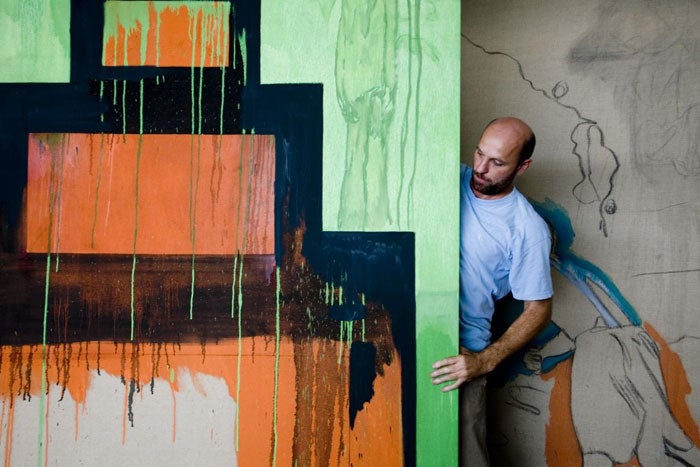
In Port of Spain, on the way to visit his studio, Peter Doig detours to show me the house where he lived as a child while his father worked in Trinidad. "The house is exactly the same," he says, pointing to the area outside where he used to play as a boy with his younger brother. "The only thing that's changed is the coat of paint they've given the garage." His childhood memories of the Caribbean island are themselves bright and vivid and happy.
Earlier, we had swum and then eaten shark from one of the huts serving food on the public beach where Doig swam as a boy. I sense he likes this sort of narrative linkage, this continuity. Perhaps it's the consequence of moving around a lot, following his father's work postings from a very young age.
He was invited to return to Trinidad eight years ago, to take up an artist's residency with his friend and fellow painter Chris Ofili. At the time Doig was living in London. Six years ago, he took the decision to come to Trinidad with his young family to live permanently. He has had a house built high above a bay on the north side of the island. Only a couple of miles from Port of Spain, it is still remote enough to need a four-wheel-drive vehicle to make the ascent. The views are spectacular and the equator very close. It is hard to imagine anywhere on earth more different from Clerkenwell, close to central London, where he lived before.
The natural assumption is that a painter associated most with landscapes relocates in search of new subject matter or a different quality of light. But this couldn't be more wrong than in the case of Peter Doig.
"I'd think it was patronising, in a way, to relocate to another country just to look for new things to paint. Anyway, it doesn't apply to me, because I paint from photographs.' I see some of these, dog eared with study and spattered with paint in the huge studio he occupies on an industrial estate when we arrive there. Most were sourced not in Trinidad, anyway, but in London. It's fair to say, though, that they seldom very much resemble the finished work.
"The painting evolves in the making," he says. "It's the only way I can work. I never know what I'm going to do next. There's no masterplan and I have no idea how a painting will end up. There could be a hundred paintings in every one painting, depending on when you stop."
Sometimes there are technical challenges. He shows me a painting featuring a middle-aged man, stripped to the waist and in good shape, executing a table-tennis shot. He had hoped to have it ready for the next week's opening of his exhibition at Tate Britain. But he isn't yet happy with the torso. He's tackling the problem with a cheerful perfectionism. "It will be ready when it's ready." He says. Doig's demeanour in the studio seems the opposite of the stereoptype of the tortured artist. But the work has a scale and a fundamental seriousness that communicates his commitment and ambition almost palpably when it surrounds you in the place where he creates it. Getting a painting to the point where it satisfies him is a process that can take him years. "I could not get the top part of this one right," he says, moving on to a large painting called Music of the Future. It's a signature Doig work. All the themes the more perceptive critics identify are there; the water, the indistinct figures, the dreamlike sense of ambiguity and dislocation. "I took it back to the beginning. It was a question of taking paint off. It took a long time to get it right, but I think it's ready."
I nod but reserve comment. There is a serene power embodied in his best work, the painted images possessing an almost hypnotic quality. Music of the Future has this.
Next door to the studio is the large space where each week members of the film club Doig and artist Che Lovelace set up four years ago gather. There are substantial loudspeakers and a screen at one end of the room and a makeshift bar with piled beer crates at the other. The members sit on plastic Adirondack chairs. "Very comfortable," he says. The fare is art-house, independent and non-English speaking films screened free every Thursday night.
Studiofilmclub is probably the single most obvious example of his commitment to the social and cultural life of Trinidad. It is also a reflection of Doig's enthusiasm for film and of his personable nature. Painting is a solitary business. Doig might be a one-man band in the studio, but outside of working hours he likes doing things that involve other people. He enjoys company.
Perhaps that's one reason why he is so passionate about sport. In London in the 1980s he played ice hockey for the Romford Raiders and other clubs. He is a formidable skier and owns a hand-built road bike. In Trinidad he plays racquetball and table tennis – with a former pro. Three kayaks hang from the roof of a veranda at his home. Chris Ofili is a neighbour now, as well as a friend and they kayak together.
When I ask Doig whether he misses London, he says, "I was never really one for the Soho members' club scene. And I do get to travel, it's not like I'm living in exile. I get to London and, of course, I travel to Germany, too." He has a professorship in Düsseldorf. He has taken most of this semester off to prepare for theTate exhibition, but gives the impression that he enjoys teaching too much to give it up. "Some of my students are talented. A couple are really good painters. The Germans are very serious and enthusiastic and knowledgeable students."
After the studio visit, in the hardwood and terazzo kitchen of the house above the bay, there's a cold beer to hand and it's time for serious questions. Does Doig believe that in the 21st century, painting has a function?
"No, not in the way that music or film does, it doesn't. I mean, you can dance to music. Music can be used for a soundtrack, so it has a function in that sense, beyond itself. But painting doesn't. So painting doesn't have a function. But I do believe that painting has a purpose."
Which painters have influenced him?
"The usual suspects. Everyone from Bacon to Munch. Recently I saw the Chagall portraits in the Basle Museum and they have been an influence. And I never even realised I liked him."
Embodying work spanning two decades, the Tate exhibition is the biggest and most comprehensive of his career. Is he nervous about the critical reception?
"It's out of my hands. I don't feel any real animosity towards critics when they write negative things. I think some are more perceptive than others. Some are very knowledgeable about painting. But it isn't something I have any influence over, so there isn't any point in worrying about it."
What's been most important to him in his career? "Always to have had an audience. The support of friends. That goes right back to fellow students at St Martin's. It's really important to have the respect of your peers. They regarded me as a painter. I was considered and judged as a painter and that gives you confidence and belief. It's really important and it's very influential."
Doig is famous for last year breaking the world record price paid at auction for a work by a living European painter. His painting White Canoe sold for £6.1m. The subject is a source of exasperation. He had sold the piece a decade earlier for a few thousand pounds. But money is not what irritates him about the situation. "There's a primary market and a secondary market and I have no control or influence over the secondary market. It has nothing to do with me. It affects the way people think about you and you can do nothing about it."
Does he ever regret selling a painting?
"I sometimes wish I had never had to sell a painting. Every painting you make represents the time it was made and how you were feeling and what your influences were. It represents a stage in your development and in that sense, it is unique. You are never going to feel that way again, so you can never repeat it. Because the paintings represent so much, I do sometimes wish I still had them."
He was born in Edinburgh in 1959. He was raised in Canada and the Caribbean and came to London in 1979. I first met him two years later. We've been friends since then. He even features in a cameo role in a novel of mine that was published in November.
My lift to the airport prior to departure is a litany of everything he likes about island life. He likes the climate, the carnival, the humour and the food. He likes the fierce cultural pride of the Trinidadians. He enjoys Trinidadian literature and admires the respectful way national heroes such as Brian Lara are dealt with so unintrusively by the press. So he feels at home here?
"Totally. I have chosen to make it my home. It's a great place to work and a really interesting place to live. It was a huge change, but I was ready. I must have been." He shrugs. "We're all very happy here."
Peter Doig's exhibition opens at Tate Britain, in association with The Independent, on 5 February and continues until 27 April ( www.tate.org.uk; 020 7887 8888). The House of Lost Souls by FG Cottam is published by Hodder & Stoughton
Join our commenting forum
Join thought-provoking conversations, follow other Independent readers and see their replies
Comments