Anonymous: Sea Creatures Mosaic(1st century AD)
The Independent's Great Art series

For free real time breaking news alerts sent straight to your inbox sign up to our breaking news emails
Sign up to our free breaking news emails
The pictured world is stranger than the bottom of the sea. It's a realm for which we don't have a real language. It's a place where things live simultaneously in three and two dimensions. When we talk about the contents of a picture, we must talk about entities that are both solid things inhabiting deep space, and also shapes occupying a plane, or screen, or visual field – a place where everything exists as perceived from a fixed point of view.
Looking at pictures, you're always confronted with the visual relations between things, the way their shapes and edges relate to one another. You encounter issues such as: is one thing overlapping another thing? Or is there a visible gap between them? Or are their edges exactly touching, bumping? Or are their edges very nearly touching, only just standing apart?
True, such things are not impossible to talk about. Carefully managed, our words can get these facts across. But still, I'm already having to employ a quasi-technical vocabulary, which brings its own difficulties. "Visual relations" is not an expression in everyday speech. It must be explained. Terms like "overlapping" and "touching" are normal enough in themselves, but they're being used in a special way likely to breed ambiguities.
If two things are visually overlapping or touching, they may also be physically overlapping or touching – or they may not. In three dimensions, one may be miles behind the other. Think of a pair of playing cards overlapping on a tabletop. Now think of two aircraft, whose overlapping flight paths cross quite safely in the sky.
Talking about pictures, where things are both 3D and 2D, you have to make clear what type of overlapping or touching you mean. As for a word such as "edge", a thing can have its visual edge or outline, and also many kinds of physical edge, too (rim, ridge, border, seam): the word is almost more trouble than it's worth.
Unlike scientists, or even literary critics, art critics have never got together their own proper, consistent and unambiguous terminology, which people could simply learn and use. In many cases, though, you wouldn't think it was so hard. Take that very common and important pictorial situation, already mentioned, when two or more objects in a picture are separated from one another by all-round visible gaps. They lie apart, like islands in a sea. We could say they were "islanded".
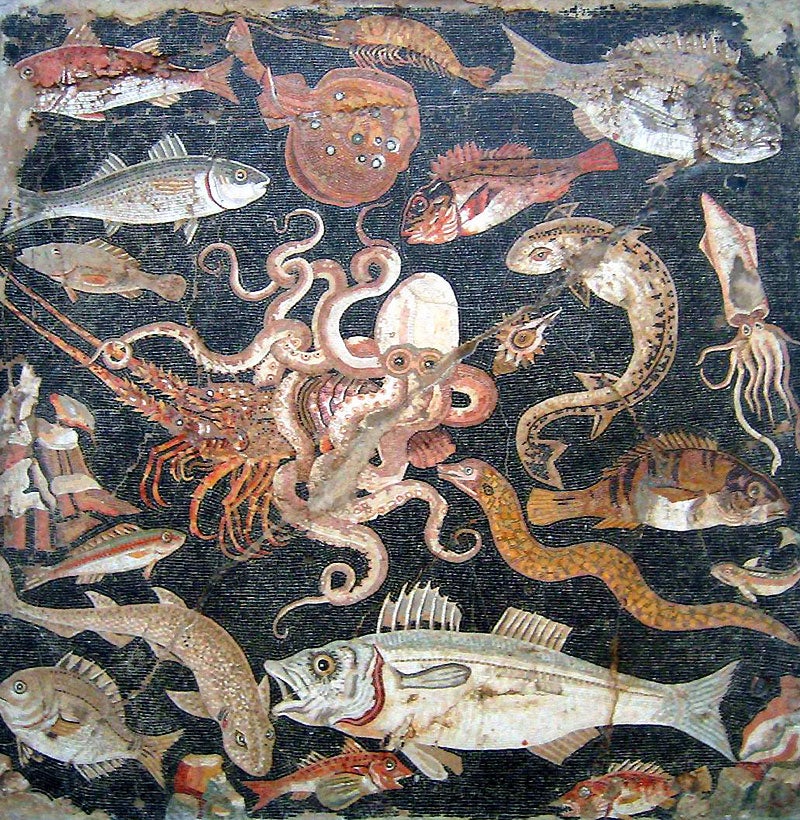
The beautiful mosaic of sea creatures, discovered in the House of the Faun in Pompeii, is a fine lesson in visual relations. Mosaics tend to bring shapes to prominence because they don't have a blur or fade-out option. Their hard-edged tiles tell you, abruptly and precisely, where a thing comes to a stop. Arranged on a black/blue background, these 21 bright forms of fish, shellfish, eel and polyp couldn't (in some ways) be clearer.
The picture probably has a culinary agenda. It's like a menu-board. The creatures, one of each kind, are sharply islanded so we can identify them. The image celebrates the wealth and variety of available marine food, and uses its quite limited repertoire of colours – red, pink, brown, ochre, grey, buff, white – to conjure a real succulence and luminescence of sea flesh. At the same time, the presence of scene-setting elements such as rocks and coral suggests more. We're looking into the depths of something, maybe a tank, maybe a section of the sea itself, in which all these different individual creatures are swimming together.
They aren't all islanded, either. In the middle, a big octopus firmly overlaps a big crayfish, or more than overlaps, since they're entangled in a struggle. That's the only definite intersection of shapes, and the only definite point of physical contact. But around them, darting forms are touching or bumping, edge on edge, while others are involved in near-misses. It all feels impossibly jostling, an incredible coincidence. The next instant, the ocean will be a pile-up.
Or will it? We don't know. The mosaic makes use of an uncertainty that's characteristic of pictures (although, again, there's no term for it). It's hard to judge how far things are from the front of the scene: 2D positions often won't tell you about 3D positions, especially here, where forms are mostly non-overlapping, and set in an underwater environment with no ground level to help orient things in space.
Their adjacent edges may make us see every form on the same level, and anticipate imminent collision. But the jostling of these sea creatures could be visual, and only visual. The next instant they might all pass one another, swiftly and safely, like planes in a sky.
Art and life in Pompeii
The devastating eruption of Vesuvius, AD 79, took a snapshot of the classical world. The volcanic ash and lava proved to be an agent of both destruction and preservation. When the excavations of Pompeii began in earnest, in the middle of the 18th century, they produced evidence of ancient Roman art, life and culture unavailable from any other source. The provincial town and holiday resort was a trove of mosaics and street graffiti, portrait paintings and erotic frescos, and a great inspiration to the neoclassical revival.
The most moving discoveries were not artefacts but the remains of the ancient Romans themselves. The ash layer was found to contain occasional voids, where a body had been and then decomposed. In the mid-19th century, the director of excavations, Giuseppe Fiorelli, decided to drill small holes into these cavities and inject them with plaster, so as to cast, and then bring to the surface, the forms of the Pompeians in their last moments.
Subscribe to Independent Premium to bookmark this article
Want to bookmark your favourite articles and stories to read or reference later? Start your Independent Premium subscription today.
Join our commenting forum
Join thought-provoking conversations, follow other Independent readers and see their replies