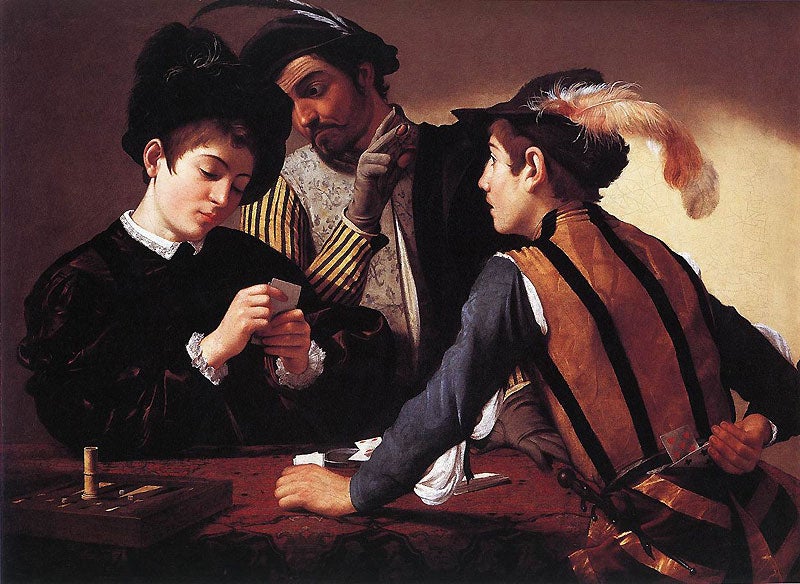
Caravaggio: Cardsharps (1595)
In a picture, all sights are fixed. Whatever's blocked from view, or turned away from view, is stuck that way. Nothing the viewer can do, nothing the picture can do, will show more, or less, of anything. But the limits of an art can be its powers.
With this petty crime scene, Cardsharps, the young Caravaggio invented a genre of trickery pictures. The cast is minimal: two cheats and one dupe. The plot is simple but tight. One cheat plays cards with the boy. Another peeps at the victim's hand, signals to his accomplice, who palms a concealed card from his belt. It's a deception tableau, a scenario borrowed from the comic stage, where looks are sneaked, things happen behind backs, and all before our eyes.
The scene was much imitated in 17th-century painting. But Caravaggio's version has one incident that nobody copies. It's the picture's hot spot, the bit where the older crook's right eye is precisely obscured, blocked out, almost jabbed out, by the obtruding peak of the boy's black hat.
But it isn't a jab, it's an overlap. And it's one of those points where you're made to feel the fixity of a picture's view. The scene's staging won't let you see something you want to see. And to single out for concealment, of all things, a boldly peering eye is especially frustrating. In the midst of its looking it is removed from our sight. It even seems to lose its own sight. The tuft of black hat, so neatly fitting over the eye, seems to lay a patch upon it, to blind it.
The device gives a contrasting stress to the other eye. Isolated, exposed, this organ acquires a strange force – a wide-open, staring eyeball, in an avid, involuntary fixation. Its gaze seems to be out of control, and therefore all the more sinful, criminal. And between them these two eyes, one hidden and one exposed, one unseeing and one peeping, manage to summarise the whole action of the picture.
See how precarious the overlap is. Cap and eye are in a precise alignment, a visual coincidence, which any slight movement among the two figures would break.
It pinpoints the precariousness of the whole occasion. It's a scene on tenterhooks, where any slight movement might give the trick away. The spy must lean and look and signal and, while the moment lasts, he mustn't do anything to draw his victim's attention. The only-just-held position of cap and eye is the index of this tension.
The blocked eye can also connect to the two crucially unseeing eyes in the picture: the dupe's, lowered as he prudently, fatally, watches his cards to the exclusion of all else. And the overlapping hat can connect to the two overlapping cards in his closely-guarded hand, the corner of one just barely peeping out behind the other – the cards that we can only see the backs of.
And that takes you into the picture's central visual-cognitive drama, where everyone is hiding something, or trying to. This scene, like any game of cards, especially a cheated game, is all about concealment, about back and front and behind and point of view. The whole action turns on what can be seen and known from the angles of the three characters – and the viewer's angle too.
No party can see or know everything they might wish to. There are things that the viewer can't observe though the figures can, and things the figures can't observe and the viewer can. The scene is constructed as a circuit of seeing and not-seeing, knowledge and ignorance, trust and deceit. The boy trusts in the invisibility of his cards. The cheats trust in the invisibility of their scheme. They must trust in their own alliance too. And something the viewer can see suggests this trust may be misplaced.
Three figures – but how many hands? Five can be counted immediately, and one tends to be noticed last: the older cheat's left hand. It emerges under the younger cheat's arm, placed on the table. It arrives out of nowhere, with nothing to make you expect it there. It lurks unobtrusively, it is surreptitious, and the more so because of where it lies – visually, very near to the younger cheat's weapon.
The opening fingers of this hand seem to be edging towards and about to pincer the dagger's hilt. This glimpse, which only the viewer sees, introduces a current of underhandness, treachery and violence between the two cheats. It suggests an unconscious level of action, something the figures are doing but don't realise they're doing.
It's like the precise overlap of cap and eye, which again only we see, but which has the whole picture in its grip. Neatly slotting, it locks the two heads together, freezes the figures in mid-action, puts them on hold. The scene is arrested, caught red-handed.
About the artist
Michelangelo Merisi (1571-1610), called Caravaggio after his home town, is now a pivotal figure in Western art. He began with a series of witty, sexy low-life scenes. He then revolutionised religious painting. He depicted the gospels from life introducing dirty realism, setting the Bible as street life. He deployed high-contrast lighting. In his short life his influence spread through Europe. Almost forgotten after his death, he has regained his supremacy only in the last 100 years.
Join our commenting forum
Join thought-provoking conversations, follow other Independent readers and see their replies
Comments
Bookmark popover
Removed from bookmarks