Great Works: Bather Opening a Cabin (1928) Pablo Picasso
Musee Picasso, Paris
Nothing new. At the start of the 18th century, Alexander Pope wrote a bad dream about household objects. "Unnumber'd throngs, on ev'ry side are seen/ Of bodies chang'd to various forms by Spleen / Here living Tea-pots stand, one arm held out/ One bent; the handle this, and that the spout..."
A teapot metamorphosed into a person? Nothing new, and nothing simpler. Folk art has known these tricks down the ages. They appear again in Walt Disney. Humans can find their images almost anywhere.
But then our standards are often not very exacting. Arms are a bonus. Our basic human model is a simple two-part thing, an object that hints at a head and a body, a pair of joined unequal units, that's all you need. A demijohn. A hand-bell. A spoon. An unusual pebble. Just add eyes.
The transformation can play in opposite directions. You can see a human likeness as liberating a simple object, conferring character on it, releasing it into life. Or you can see a human form being imprisoned within an object, reduced down to a limit state of simplification. It can play both ways at once.
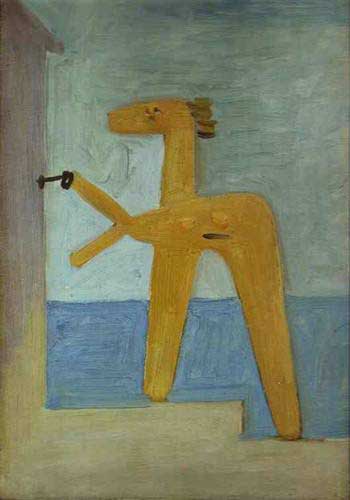
For bringing simplification games to a new level of complexity, go to Picasso. Bather Opening a Cabin shows... could it be simpler? At the seaside, a naked woman climbs up two steps to open a beach hut with a key. (This key: a sign of Picasso's conspiratorial sex-life at the time.)
The steps and hut are shown as shapes in profile, a unified area of grey. The sea behind is an area of blue. The sky above is an area of lighter blue. All these areas are straight edged and flat and simple. The bather is not.
Compared to a teapot-figure or a demijohn-figure, Picasso's bather is relatively elaborate. Its body goes beyond a basic human scheme. It has a head and a full complement of limbs. It may be a radical distortion of a human likeness, at first sight suggesting some kind of bird. But it's not derived from a single, simple form.
Still, it is put together with extreme economy, from just three very simple elements. These pieces can be given names. Coming from the right, the first one will be called the "boomerang", though it's a boomerang with arms of unequal lengths. The second will be called the "tent-peg", a straight upright that's hooked over at the top. The third will be called the "folding ruler", after one of those hinged measuring rods.
These three pieces can be identified so clearly and distinctly because that's the way they are. It's what their edges tell us. They look as if originally they were separate bits, and now they're stuck together – the boomerang laid over the tent-peg, the folding ruler attached onto the tent-peg – but could come apart again.
They look solid, too: flattish, yes, but hard, probably wooden, with a bit of volume. They are forms you could imagine carving or holding in the hand. In effect, this is a painting of a sculpture, of a work of assemblage. You could confidently reconstruct the whole thing yourself in 3D.
But dwell on the three separate components, and you also start to notice Picasso's wit. These shapes suggest not just wood but driftwood – wooden items that were once hand-made or manufactured, but are now worn smooth by the sea. So this sculpture is made from found objects, and from things you could have been found on this very beach.
They have another point in common. Though with very different shapes, each one has two prongs. Boomerang, tent-peg, folding ruler, they are all bent double, and approximately at a right angle. This fact is part of the sculpture's economy. And there's another neat fact about them. Their wood is a pale wood, and this introduces a material pun. Wood/flesh: the golden brown colour of a lightwood can equally be the colour of sun-tanned white skin.
It's not the only pun around. When you see how this assemblage of three two-pronged pieces create a human figure, further ambiguities appear. Now it's true that some equations are firmly established. The upright of the boomerang stands for the back leg. The bottom half of the tent-peg represents the front leg. Its top half is the neck. The splayed folding ruler, weirdly but clearly, makes the two arms.
At which point, play can begin. The same component part will suggest different parts of the body. For example, the bend of the boomerang is a buttock, or a hip, or a shoulder. All possible: and all possible together. The left tip of the boomerang is a protruding breast or the other shoulder. And between bend and tip there is a non-specific area of torso.
The top of the tent-peg, projecting horizontally, is a horsey head jutting out from a neck, but also perhaps a nose jutting out from a face. It evokes the general, multiple sticking-out-ness - chin, nose, brow – of a head seen in profile.
The folding ruler is certainly equated with the two arms, but what sort of action does it gives to them? Might it snap shut like a clapperboard? Is it a kind of twisting or winding instrument, to be rotated round on the tip of the boomerang – rotated like the key that one of its arms is in fact trying (somehow) to turn?
This playfulness carries a truth. The body, as we experience it, isn't a fixed and labelled anatomical map. It's made up of gestures and shapings, of curves, juttings, extrusions, bends. But Picasso also fits out his figure with a series of more precise form-jokes, explicitly sexual. The head has three marks that stand for the two eyes and a mouth. The torso has three marks in the same formation that stand for the two breasts and a vagina.
So vagina matches mouth – but also, the hairy vagina is marked by a stroke that reiterates the flicked strokes making up the brushy head-hair. And then, up between the two legs, rises a blue and light-blue shape, looking like a lighthouse (another typical seaside feature) or a circumcised penis.
Representational games abound. They link up and mix up the parts of this body, and generally mess around with it. But what they don't do is reduce them to flux. All the echoes and ambiguities arise out of forms that are themselves stably defined.
There are Picasso paintings from this time where bodies are made in flowing and unbounded lines, dreamy figures whose every form dissolves into others. They perform the same games, but they exist only on the canvas surface. It would be impossible to imagine them made in 3D. The have no suggestions of solidity.
In Bather Opening a Cabin the solidity is crucial. The figure is made from hard pieces stuck together, and what it's made of determines its character. Each piece is bent but rigid. The whole body is inarticulate. You can't imagine it flexing or moving or climbing.
Its uneven legs are fixed. It's propped on the steps like a helpless ornament on a shelf. And almost every part of this female body is as stiff and rounded and helpless as a swelling penis. It's a comic creation, which belongs with a vulgar beach postcard.
About the artist
Pablo Picasso (1881-1973) needs no introduction. The Spanish painter became in his lifetime the most famous artist in the world, with a fame up there with Chaplin and Disney and Einstein and Hitler. It wasn't just a matter of talents. He lived in the 20th century, the first century of global mass publicity. But he had everything. He was a child prodigy. He worked in every medium. He invented or inspired most modern art styles – Cubism, Surrealism, Abstract Expressionism. He had genius eyes, unflagging testosterone and political engagement ('Guernica'). His work was never really popular, not like Van Gogh's or Dali's. In recent decades his art influence has run out, replaced by Marcel Duchamp's. What was he: the great revitaliser, or the great swan-song, of the Western pictorial tradition?
Join our commenting forum
Join thought-provoking conversations, follow other Independent readers and see their replies
Comments