Great Works: Characters and Caricaturas (1743) William Hogarth
British Museum, London
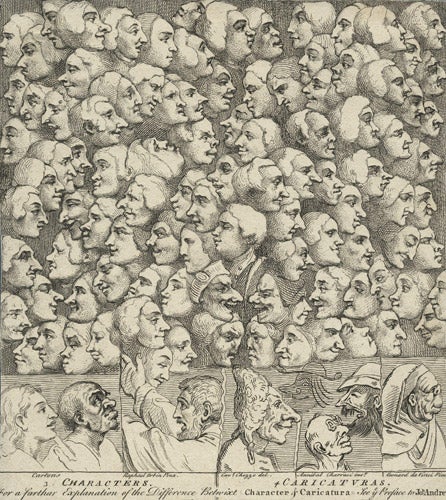
The traditional Identity Parade requires one suspect and a line-up of (say) 10 others. They should be lookalikes, roughly speaking. If they were too unlike, the identification would be too easy. But how like is too like?
William Hogarth's print Characters and Caricaturas is a kind of ID Parade. It's a picture with an argument. It's designed to demonstrate the superiority of the comic character face to the grotesque caricature. Hogarth saw them as radically different arts: one is the study of individual human nature; the other makes absurd formal play with human features.
In the strip along the bottom, at the left, three heads are quoted from paintings by Raphael, showing vivid but accurate portrayals of character. Then to the right there are a handful of heads by other Italian artists, stretched, squashed, with no psychological value, merely monstrous jokes.
That's the premise of the picture. Above it, Hogarth's illustrations unfold. More than a hundred heads are laid out. They don't need exaggeration or distortion to define them. Through discriminating variations, they show what the art of character can do. It's an ID Parade from which dozens of temperaments are to be picked out.
Like a line-up, Hogarth employs a repetitive format. His heads are all in profile. They are all approximately of the same size. They are spaced roughly in rows and columns. They are all male. They are all in wigs.
Within these repeats, we should notice differences. Each profile has a distinct face, and, what's more, an identifiable disposition. Difference by itself was not enough for Hogarth. He didn't want mere games with shape. He wanted particular personalities and speaking expressions. That was the plan.
An ID Parade is designed to make things difficult, but not impossible. There are several kinds of likenesses in this one. Do they reveal (by contrast) the individuality of each face – or do they smother it? What's more, there are many, many more heads involved than in the usual line-up. Every head is to be seen beside every other head, and in the thick of a multitude. It's possible that their repetitive forms will simply lead to a repetitive content.
You can take this assembly in various ways – at various proximities, so to speak. You can go in close-up, and read off the hundred-odd physiognomies separately. You can enjoy some of the face-offs among the single heads.
Or you can draw your attention back, and follow the sequence of heads as variations on a theme. Or you can see the image as an arrangement of almost uniform elements. Or you can overlook its component pieces entirely, and take it as a solid, undifferentiated mass.
Characters and Caricaturas becomes a test picture. How you see it measures your moral priorities and your pattern-perceptions, and suggests they may correlate. The argument it enacts is not between character and caricature, but between particular and collective.
The gravitation of a modern viewer is probably away from Hogarth's declared agenda, towards the mass, or at any rate the series. Scan these profiles? Can you name their natures? Our sensitivity to character has become too weak to pick up their clues. The minutiae of physiognomy, which Hogarth relished and the Victorians made into a science, we don't perceive so sharply, or can't take enough interest in.
The faces in Characters and Caricaturas come across as little more than units, lookalike forms in overlap, gestures turned to right or left. They may not be quite reduced to uniformity, but their differences are minimal. They're only there in order to be overridden by their similarities and repetitions.
And the values that seem to be carried by this picture are not those of individuality, but the opposite. These heads gather close and hugger-mugger. They make up a throng. They satisfy our pleasure is in the crowd, and the dense but not quite regular patterns that form within a crowd.
Can we doubt that Hogarth too appreciated these values, moral and visual? There's a limit to what an ID Parade can take, and he takes his beyond that. A hundred heads, in a repeating format, can't help congregating. The formations that he sends through this field of heads, in diagonal sweeps and curving waves, unify its design further.
In Characters and Caricaturas, character may overwhelm caricature by numbers. But between particular and collective, in Hogarth's own hands, the dispute is at least evenly weighed.
About the artist
William Hogarth (1697-1764) is often named as the father of British art. But he was much more than the bluff, plain-speaking, pug-loving Englishman of his own self-image. He was a big, complicated artist. He was a severe moralist. He was surreal. He had a sharp eye for high art and popular culture. He made jokes, daft, rollicking, savage. He was a panoramic observer of society. He packed his images with every kind of visual sign and symbol. He was an art theorist who promoted the curling Line of Beauty. Next to Hogarth, all other picture-making looks a bit specialised. And, just occasionally, he could pick up a brush and paint.
Join our commenting forum
Join thought-provoking conversations, follow other Independent readers and see their replies
Comments