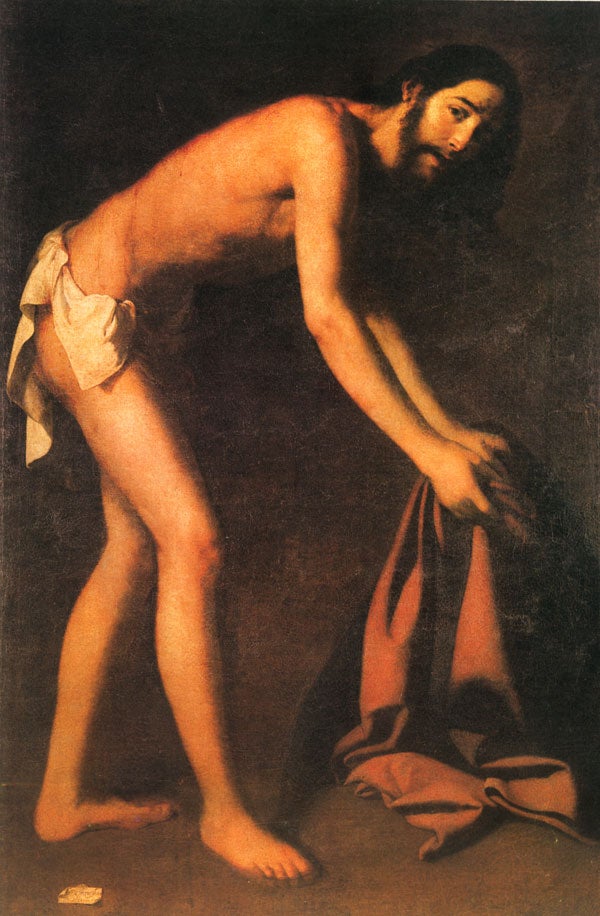
Great Works: Christ Gathering his Clothes after the Flagellation (1661), Francisco Zurbarán
Church of Jadraque
Abu Ghraib: the images, which provided such shocking evidence, were not merely evidence, nor unofficial records, nor personal souvenirs. The photos were themselves assaults. Being made into a show, a humiliating and terrifying spectacle, was part of the torment. And the picture-taking was part of that show.
There are paintings that understand how pictures and tortures can be complicit. The image is involved with the cruelty it depicts. For example, there is Francisco Zurbarán's Christ Gathering His Clothes after the Flagellation. Its subject is a minor and transitional incident from Jesus's Passion Story, an interval between episodes of more dramatic violence and mockery. It is a wretched sight.
The scene is the Roman guardroom. Jesus, after his whipping, is briefly dismissed. Of course it's normal for Christian art to present the miseries of its sacred victims. It puts them through it all over again, for the pious viewer to linger over, to pity and worship, understanding that the suffering is not final, it is a ramp to glory.
But this picture is especially degrading through its casual triviality. We aren't seeing the saviour in heroic agony and endurance, or under any physical duress, bound, violated, mocked. He is merely under arrest, finished with for the time being, ordered around, and in a state of total humiliation and vulnerability. Zurbará*shows him exposed, defenceless, frightened, expecting renewed attack, cowering, protecting his groin with a leg, turning round warily as he bends to dress himself.
He is naked, but not nobly naked, as he is for his baptism, flagellation, crucifixion, resurrection, and even when dead, but stripped, a man without his clothes, picking them up again; and not some heroic body, either, but a bandy-limbed figure. It is an embarrassing scene, like a striptease at gunpoint.
Christianity advertises the miseries of Jesus, their extreme and exemplary horror, but there's one kind of misery Jesus is usually spared. His suffering does not look shameful. It does here. Zurbará*dwells on this especially compromising moment, singles it out for contemplation, when art or anyone might look away.
Now this is not quite Abu Ghraib. The image isn't made by one of the tormentors. And the subject is not a piece of deliberate theatre of cruelty, not part of the programme itself. All the same, Jesus's visibility is very much implicated in his sufferings. And his picturing, too – him being in this particular frame, within this view, on show here to us – is made part of his afflictions.
The picture's frame constrains him. He bends, shrinking against further violence, and the frame also holds him down, subjugates him. The top edge cuts off the picture space so that there'd be no room for him to stand upright. Not just his situation, the picture makes him stoop, as if under a low beam. Bowed by his torments and powerlessness, he's put under the picture's yoke, and forced into an anticipation of carrying the cross, bent under that weight too. The frame is not literally in Jesus's world – but the figure cannot escape its bounds.
It is not only the frame-as-container that bears on him. The frame-as-aperture is involved as well. Jesus is unwillingly and shamefully on view. Being seen is part of his abasement. The sense that Jesus is cramped within the frame's rectangle becomes also a sense that he's held within its view. He's stuck and exposed in this scene. He's in its sights, and on display. And as he stoops, Jesus turns and looks also at you, the viewer, with a helpless appeal. Was ever grief like mine?
Join our commenting forum
Join thought-provoking conversations, follow other Independent readers and see their replies
Comments