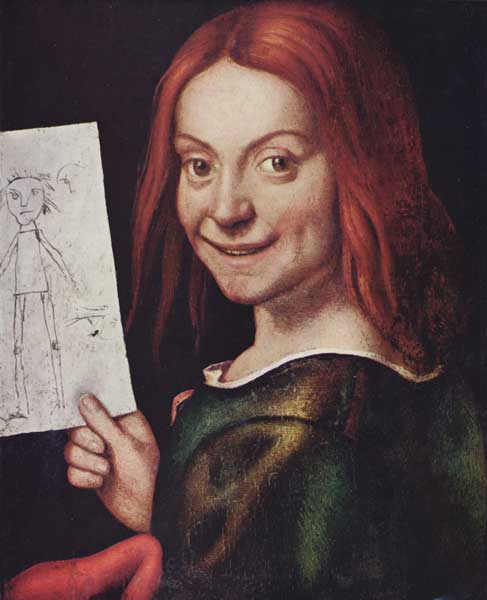
Great Works: Portrait of a Young Boy holding a Child's Drawing (circa 1515), Giovanni Francesco Caroto
Museo di Castelvecchio, Verona
When Picasso went to a show of children's art, he remarked: "When I was their age I could draw like Raphael; but it took me a lifetime to learn to draw like them." He wasn't alone in this ambition. Primitivism was a big thing in modern art; along with tribesmen and the insane, good European children were a model of the primitive. Many 20th century artists tried to draw like kids: Kandinsky, Klee, Miro, Dubuffet...
They didn't always succeed. Partly they didn't want to. Child art was an inspiration, not a template. Most of these artists used it as a resource, combined its naiveties with more sophisticated procedures. But partly, as Picasso pointed out, to really draw like children is very difficult.
Child art has several distinctive aspects. Some can be picked up easily. There is the "conceptual" anatomy, the figure made of definitive bits – head, hairs, body, arms, hands, fingers, each a separate blob or stick. There is the "map-like" view of the world, same-scale figures laid out all over the page, or the "section" view, with a ground-strip at the bottom of the page and a blue sky-strip at the top. There are the fixed angles: trains and horses shown from the side, faces and houses from the front.
But the most telltale characteristic, and by far the hardest to imitate, is simply the quality of a child's drawn line. It's wrong to think of it as wildness. That wouldn't be so tricky. You can lose control and fling your flailing arm at a page at any age.
Child art is not pure wildness. Children are trying to get something right. They want to but they can't. Their drawing desires are ahead of their bodily knacks. And this gap between want and can't – this failure – is the secret of children's drawing. It's where its charm lies. The tension between want and can't is what gives children's lines their electricity. This failure is what taught adults find so hard to imitate.
Once you've been taught – and the teaching involves much more than mere art-teaching, it involves all the physical training you get in childhood, designed to turn you into an operating and coordinated person – your body will never let you down in quite the same way. This know-how is in your muscles. Even useless adult drawers can't draw like children. Give them a drawing task and their age will show. Their bodies can't fail like that now.
To recapture that state hasn't got much to do with innocence or spontaneity. So put aside Primitivism. But any artist might be curious – and basically they have two options. They can try to unlearn what their body has learnt through its upbringing and training. Or they can fake it, using their most perfected skills to copy literally from the real thing.
Around the time when Raphael was at the height of his powers, a minor Veronese painter made his great one-off. Giovanni Francesco Caroto painted the Portrait of a Young Boy Holding a Child's Drawing. The boy's eager, slightly toothsome smile gives this picture a place in the history of portraiture. But the page he holds upstages it. It has the first depiction of child art in a European painting.
Whoever the boy is, this stickman is presumably meant to be his own work, proudly presented. But study the sheet more closely. Lower right, notice the profile eye, drawn with an expert hand. We can imagine the boy hanging around the studio, picking up bits of paper used by the artist or his pupils for sketches, adding his own.
But what of the stickman itself? It's an attempt by an experienced artist to imitate a child's handiwork. It's uneven. The scratchy, wobbly lines are persuasive. Some of the formations seem too complex – see its right eye, constructed from curved eyebrow and eyelid. Indeed the incomplete head in the corner suggests a grown-up approach. Children of this age push ahead, don't have a second try.
And of course, this drawing is not a drawing. It's a painting of a drawing, made in the infinitely correctable medium of oil paint. Caroto has closely observed how children draw. He probably hasn't tried to unteach his own hand. He has faked it. And his careful copying has preserved for us evidence that while art styles change, children 500 years ago failed much as they do today.
Join our commenting forum
Join thought-provoking conversations, follow other Independent readers and see their replies
Comments