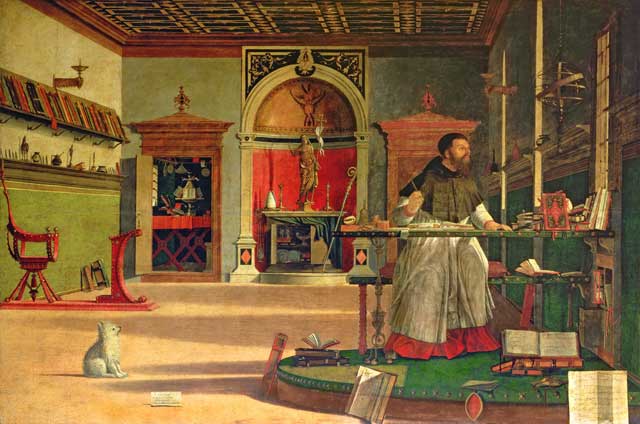
Great Works: St Augustine In His Study (c.1502), Vittore Carpaccio
Scuola di San Giorgio degli Schiavoni, Venice/The Bridgeman Art Library
Viewer? Voyeur? Visionary? One looks out on to something. Another has hidden secrets. Another is granted a revelation. A picture can provide many dramas.
For example, Vermeer's A Lady Writing a Letter with Her Maid shows a woman gazing out of a window. While her lady writes, engrossed, the maid is absent, wholly focused on the daylight outside. Her gaze removes us from the room.
On the other hand, the subject for a voyeur is nearly always visible – imagine Susanna and the Elders by Tintoretto, without Susanna. The men are only there to look at the naked woman, but she, the object, is unaware of this.
But then there is the painting by Caravaggio, The Conversion of St Paul. St Paul is struck to the ground. His arms are open. His eyes are closed. In darkness, Jesus is an implied vision, but nowhere to be seen. All we see is a horse. But some viewers in painting are more puzzling. What are they seeing?
The painter Vittore Carpaccio's own view shows St. Augustine in His Study. His subject is the great North African saint, the Bishop of Hippo, the author of City of God. And first of all our attention is of course upon this chamber. We are invited into his wonderful home. The sight is radiant and detailed. The extraordinary studio is packed with beauty and culture and wealth and religion. This Augustine is not a pauper scribbling in a cell, but a rich man, enjoying the things of the world.
Look at his countless books, a library stocked full for his mind and his pleasures. Look at his symbols of learning, the astrolabe, the figurines in a row, the precious conch, the well-made furniture and the countless ornaments and knick-knacks. Look at his mitre, his crook and his Jesus statue – though these emblems of piety blend in, and don't register to us so significantly in fact, as the rest of the room.
And notice how each detail is picked out by a sure grasp of look, touch, colour. We can fully list the sensations. We can enjoy the separate hues of the room, the rose pinks, deep greens, browns, golds. All these things are acutely observed and given equal weight. The named and numbered objects are presented one thing after another; every exquisite possession and every little piece of observation is carefully itemised. The stage is richly patterned. The Saint owns this luxurious setting.
So we see the inside of his glorious chamber. But then we can also wonder about the possible outside view. His studio is made marvellous for us. But St Augustine himself actually is looking out through the window – what is he? Viewer? Voyeur? Visionary?
The story needs more detail here. St Augustine is writing a letter at his desk. Specifically, he is writing to his fellow scholar, St Jerome (famous for looking after his lion). But in the very moment and action of his communication, he suddenly pauses, looks up, turns round, and learns that Jerome himself is about to announce his death and ascent to Heaven.
In other words, we see the room, but equally strongly we have the off-view, the unseen, implied sight. And this is the central drama of the scene. There is the vision, voice and light, coming from the beyond – and meeting it, Augustine's visible raised face and his hand and pen. The man is still. A direct vertical perspective line descends perfectly through one coffer of the ceiling, and then down through the tip of his pen.
And from elsewhere, both natural day and supernatural clarity fills the room. The light is softly, warmly entering through the slits of the windows. The shadows are sent falling across the chamber, touching its walls, the objects and the things upon the floor. This extraordinary chamber shows inner grandness and outer vision.
And then there is the little loyal dog, a curly-topped Maltese. It is sitting there, behind its owner, motionless, waiting for some signal, a scrap or pat. It seems to be a moment of lightness, a comedy animal in that great space.
But dog and man are clearly unified too. These creatures are both set at a slope. And in the diagonal light, the tip of the dog's shadow, the top of the dog's head, the top of the Saint's head and the top of the window's bay – all lie along the slant of the vision and this commands the whole picture.
ABOUT THE ARTIST
Vittore Carpaccio (1450-1525) is one of the great painters of the human scene. In his scenes every detail is clipped and clear and superbly arranged. His dramas occur in single rooms, among fantasy architecture and realistic street views, in formal processions and killing fields. His greatest works remain in Venice
Join our commenting forum
Join thought-provoking conversations, follow other Independent readers and see their replies
Comments