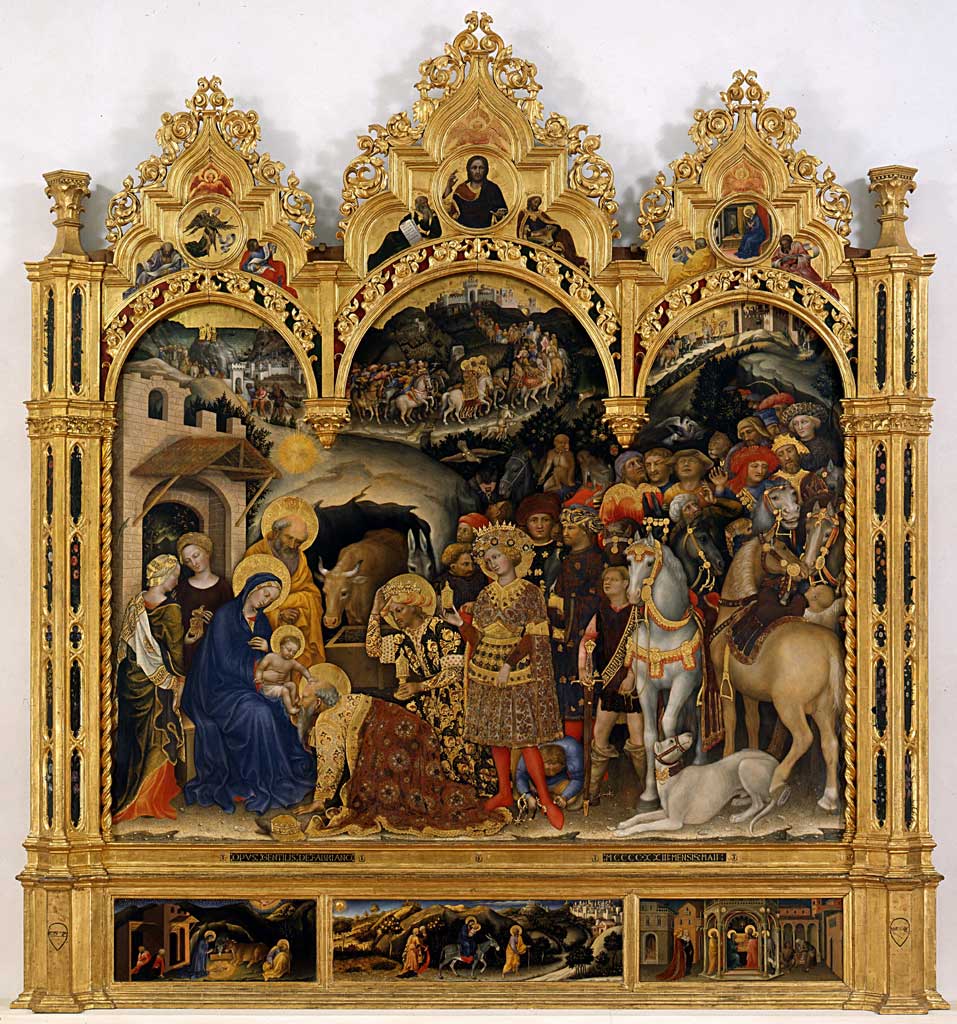
Great Works: The Adoration of the Magi, 1423 (300cm x 282cm), Gentile da Fabriano
Uffizi Gallery, Florence

For free real time breaking news alerts sent straight to your inbox sign up to our breaking news emails
Sign up to our free breaking news emails
We cannot help but feel that there is a gloriously delightful conceit at the heart of this great painting. It was commissioned by an immensely wealthy Florentine banker called Palla Strozzi from an itinerant Italian artist who was practising on the cusp between Late Gothic and Early Renaissance. You can almost regard it as a glorious flourish of decorative exuberance in the Gothic manner.
What is of redeeming fascination here is that the entire visual fanfare of this artwork – when you come upon it in the Uffizi Gallery in Florence, it almost causes you to step back in wonder at its opulence – seems to conceal a story behind the well-known story of its subject matter. It was made for a Florentine church, Santa Trinita, and its subject is one of Christianity's central acts of gift-giving by a group of astrologers, magi, kings – they have been called all these things at different times in the evolution of their identities.
So that act of gift-giving is the central subject of the painting. But what we also feel is that the gift is not so much contained within the narrative itself, as in the gesture of the banker. It is his gift, the sheer, overweening pomp and costliness of it all, that strikes us as extraordinary. In fact, the entire elaborate construct feels like so much more than a painting – well, to begin with it is several paintings in one if we also take into account the stories in the roundels above the central panel (God the Father, Abraham, the Prophet Micah) and in the predella beneath (various scenes from the story of Jesus, beginning, on the left, with his Nativity). So in the sheer comprehensive sweep of its subject matter, it is more a sermon than anything else.
But there is more than that. When we marvel at the gilded intricacy of the quasi-architectural features that have been incorporated into its presentation, we feel that it is more like a shrine that is on the way to becoming a fantasmal building. We feel that it ought to be hovering in the air in front of us, borne up by a brace of angelic studio assistants. Was Strozzi making this gift in order to appease the God that he purported to worship? Perhaps. Then, as now, banking was a morally dubious activity. The church frowned upon it. If you could blame usury on the Jews, those deicides who chose to spare Barabbas, that could be construed as an excuse of a kind. But were not bankers in general, Christian and Jewish, engaged in the business of lending money at interest, of conjuring wealth for themselves from the air? So we can speculate that this painting is an act of giving back to God just a bit of what this banker has snatched.
Frankly, does it not almost stink of luxury? Luxury going hand in hand (and rather uneasily, we feel) with due reverence for the narrative moment, of course, which, we dimly recall from the Biblical account in the Gospel according to Saint Matthew (the only place in the New Testament where this particular scene is described), had at some point to do with the hardships of rejection by the keeper of an inn. (That harder scene, endured perhaps in more inclement weather, is relegated to the bottom left-hand-corner). Is there hardship here in the centre of this glorious polyptych? No. In spite of the fact that we see a gorgeously strokeable cow, there is little that is whiffily stable-like here. The canopied structure behind the virgin looks robust enough. The women who are intent upon their private conversation behind the bending back of the Virgin are usually described by scholars as midwives, but they are midwives with a heightened sense of fashionable courtly dress, especially the one with her back to us, whose tumbling robe – and what a lovely, wayward line it makes as it falls – seems to be worked and hemmed with gold.
And it is not the painting alone that almost smothers us in the gildings of luxury. There is such swagger here, and such an overwhelming narrative abundance, an abundance that takes in much more than the gift-giving might lead us to contemplate. As we roam around, looking at detail after detail, we see two kinds of world. One is sacred and reverential, and it is – embodied in the attitude of the magi themselves, and especially that of the oldest who, having removed his crown, kneels in order to let the infant have a feel of his bald pate. But stray beyond the edges of all this haloed/hallowed gift-giving, and we are plunged into a world of unruliness: wild animals, and even unacceptable behaviour of various kinds (including rank criminality). Still, the treatment does not err quite so far in the direction of breezy irreverence as the painting by Bruegel the Elder that we looked at this time last year. God forbid that a banker should descend into disreputability.
ABOUT THE ARTIST
Born in the Marche, Gentile da Fabriano (1370-1427) worked as an itinerant artist, principally of religious scenes, and mainly in Tuscany. His style is loosely described as International Gothic, but the fact is that he also incorporated stylistic elements of the Florentine Renaissance into his art as a result of working in that city.
Subscribe to Independent Premium to bookmark this article
Want to bookmark your favourite articles and stories to read or reference later? Start your Independent Premium subscription today.
Join our commenting forum
Join thought-provoking conversations, follow other Independent readers and see their replies