Great Works: The Crucifixion 1565 (518cm x 1,224 cm), Tintoretto
Scuola Grande di San Rocco, Venice
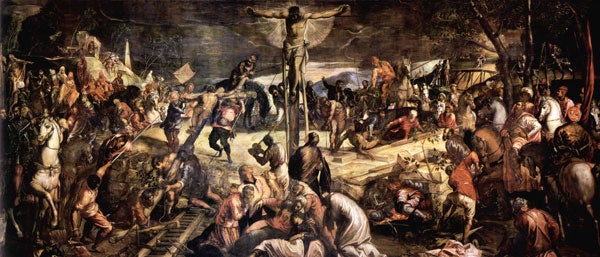
Did Jesus Christ suffer passively when he died on the cross at Calvary? This enormous masterpiece by the Venetian painter Tintoretto, which hangs in the dramatically underlit Sala dell'Albergo just off the central hall on the first floor of the Scuola Grande di San Rocco in Venice, seems to suggest quite the opposite. This is the largest, grandest and most fanfarishly dramatic of an entire patchwork of biblical scenes by the same artist, which adorn the walls and the ceilings of this 16th-century scuola in Venice.
Look at the overall effect to begin with. It is as much a grandiose Covent Garden opera set as a scene on some scrubby hill in Palestine. As so often with Tintoretto, the figures are seemingly larger than life in size, organised in frenetic clusterings. The figures seem edged with light, almost self-illuminated, as if they possess a mystical inner glow. There can be no doubting the scene's point of focal attention. The Man of Sorrows. The arms of the cross itself seem to recede backwards, ever more indistinct, from the very-much-human, muscularly pulsing arms of Christ himself – this god-man appears to be in tremendous physical shape for one who has suffered so much – and to disappear into the blaze of translucent white light that Christ himself is radiating in a miraculously perfect fan shape. That light, which also looks a little like a pair of translucent, diaphanous wings, seems ready, if not poised, to bear him aloft.
The figure itself looks immensely powerful and wilful, youthfully pugnacious, in its attentiveness, almost Samson-like or Herculean in its strength. Had this not happened long before, we could imagine those same great arms dragging down the walls of the temple on to the helpless, hapless Philistines. The arms appear to be twisted back, as if to show off those mighty, fat-rope-like muscles. Rather than lolling back helplessly, appealing to its maker for mercy or deliverance as it had done, so recently, in the Garden of Gethsemane, the head leans down and appears to swivel to the right, as if observing, and perhaps even orchestrating, the particular events that are going on beneath its gaze.
Yes, this head is fully engaged in the scene. It knows exactly what is going on, and why. It knows its own destiny, and it is determined to drive things along to their inevitable, tragic conclusion. Everything is being overlooked by that head from a tremendous height – Christ's head is practically scraping against the gigantic top edge of the canvas, which itself skims the frieze directly beneath the ceiling.
The whole scene is tumultuously colourful, with a cast of countless human beings – we can practically hear its noise, its movement, its ceaseless agitation. So much seems to be on the go here. It is far worse than any motorway pile up. One of the other thieves who is to be raised up beside the Saviour is still on the ground, waiting to be fixed in place. He is sitting up, watching. Another is being raised up on his cross. He is being pulled up from the front and pushed up from behind – it is all hard, physical graft. All this is presented very practically, as if people are doing their gruesome day jobs. These two thieves are not being allowed to play a fuller part in Tintoretto's scene, we idly speculate, because the painter does not want Christ to be seen upright amidst the other crucified ones, as if this were a fairly commonplace method of execution. He wants this particular crucifixion to be recognised by the world as unique. Other human beings – there are so many of them – kneel, stand, stare, dig, point, sleep, sit down, jerk up. The heads of horses, white, brown and grey, butt and swivel and turn. Nothing is tragically calm or serene. All is pelting energy.
We try to take it in all at once, its enormity, its emotional gravity. We try to stand back as far as we can go. We pace from end to end in front of it – it is quite a width – then back again, looking at this, that and the other. But the room, though by no means small, feels a little too straitened to take in the immensity of it all. There is much darkness in this glorious building, much blocking out of the perilous light of the sun. It makes the discovery of these narrative scenes all the more surprising – elsewhere, out in the hall itself, we can look up and see manna falling from heaven, for example. Back again at the Crucifixion, we almost feel that too much is happening all at once. Everything seems uncontainable, like an over-brimming chalice. Partly, this is to do with Christ himself, that grand orchestrator, and the way in which Tintoretto has chosen to paint his cross, and the ladder which leans against it. Why this ladder, though? This is no deposition scene. It is too early for that. We don't need a ladder at this point. The crucifixion is happening before our very eyes, as the title reminds us. This ladder, had it once been needed, could have been removed by now.
In fact, it is still in use. A man is climbing up it. He is receiving a gift of a stick to which a sponge-like shape is attached. He is ready to slake Christ's thirst. And yet these details seem to be receding from us even as we look at the body of Christ himself. Yes, the more we look at Christ's legs, the more we seem to be in the grip of an illusion that the ladder is in fact at the front of the cross, and not behind it. Then we begin to understand why. That ladder is there in order to increase our sense of Christ's potential appetite for dramatic movement. It seems to be carefully wedged between Christ's body and the cross itself, as if Jesus might at any point descend from the cross again, stepping down, left leg to the fore (in spite of that huge, round-headed nail, which has been driven through his feet) in brazen defiance of his captors, and proclaim himself to be the Messiah after all – a touch prematurely perhaps. This is why he leans down, surveying all the possibilities open to him on heaven and earth and perhaps even – who knows? – under the earth.
ABOUT THE ARTIST
Jacopo Robusti Tintoretto (1518-94) was one of the greatest of all Venetian painters, and his vast narrative scenes – full of energy, physical drama and pathos – are often illuminated by an almost mystical light. He often worked on a huge scale – as can be can be seen in his Venetian works, many of which are still in situ. Some of his greatest and most poignant works are to be found at the Scuola Grande di San Rocco in Venice.
Join our commenting forum
Join thought-provoking conversations, follow other Independent readers and see their replies
Comments