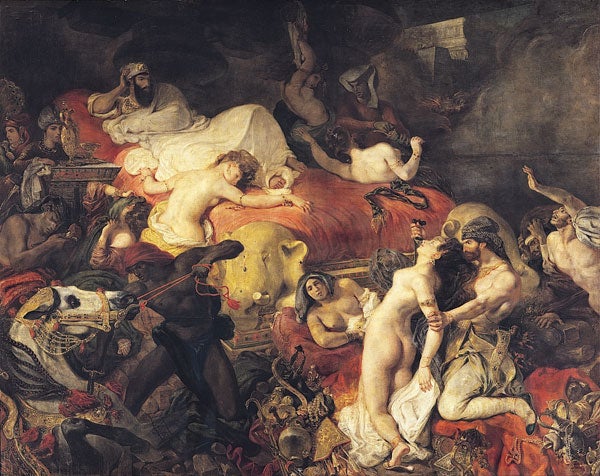
Great Works: The Death of Sardanapalus (1827), Eugène Delacroix
Louvre, Paris
Earthquakes feel like the end of the world. Everything loses their differences. Whatever stood, now falls. The ground opens up and turns over. The distinctions between what moves and what doesn't move are no longer there. Some pictures show things like that.
But in Renaissance views, there can be another world. Everyone is safe, rigid, disciplined. Roads, buildings, doors, walls, towers: these things are squared and ruled. Straight lines and flat surfaces run upright or on level pavements. And the essential point is not simply the clarity of these things. It is the difference between a place and what inhabits this place.
For example, imagine a city and its people. Sometimes there is a very populous scene, but still a sharp division exists between the fixtures and the figures. Or the other hand, sometimes there can be a totally empty space, a townscape deserted – but still there's separation between the place and the implied figures who occupy it. But then, turn to Baroque or Romantic pictures. Worlds have now shifted, and sometimes radically.
There is Eugène Delacroix's The Death of Sardanapalus. It has a story, if you care. Sardanapalus is the last king of Assyria. He has failed in battle. He is about to die. He broods among his intended victims. Around him, his naked slaves are being murdered, and his possessions are being destroyed. At last, his court will be burned. But nobody really cares what this picture is about, beyond a generic scene of Oriental Despotism.
The spectacle is all. The king relishes his sights. In the same way, the painting encourages us to enjoy this scene. This vast canvas is full of beautiful chaos. There is flesh and rich fabric and gorgeous colour. There is turbulence and cruelty – and opulence, ruin, decadence, slaughter, luxury, despair, violation, helplessness, sacrifice, the whole business. The massacre is coming to its finale. One after another, the deeds are falling down.
Meanwhile, the stage itself has lost its limits. Its surroundings are nothing but a total scattering. Its activities exist in an earthquake scenario. The great divan, with its golden elephants, spreads outwards into the crazy pageant. And at the same time, more dense stuff and violence enters from the outside, breaking inward through the edges of the picture. One force is centrifugal. Another force is centripetal. But there is no sustaining structure.
We see the scene is constructed only out of bodies, furnishings and smoke. Where is this horse based, with its plunging hooves? You can't tell. Where do all the legs and cushions lie? They pile up and pile up with no visible foundation. And the whole stage simply drops down below the front. There's nothing more to define or support these elements. There is no ground. There are no bounds. The scene lacks a floor, a wall, a visible level surface, a permanent stay. It has no grip and no hold.
Here everything floats, flows, floods, in flux. Delacroix whips up a wild romp. The whole scene is like a rolling, riding bed. Or like a sea, tossing and turning, surging and lapping, cast on a tide. Or like a sliding earth slip – or even a bouncy castle. It's an unsolid, unsteady, unstable creation. There's no distinction here between the fixed space and its occupants. It is the opposite of a Renaissance location. This scene has lost all definition between a room and bodies. Space has gone haywire. The world dissolves and tumbles.
So it's a world where disorientation has both a spatial and a moral dimension. Nothing and nobody cares about up or down – or right or wrong. There is no difference between killing and being killed, no difference between calm and ecstasy, no difference between animate and inanimate. All the same, these disasters are not too fatal. A universal catastrophe takes the weight out of mere human terrors. It lightens them. Humanity and the world fall together. This busy doom is almost welcoming.
ABOUT THE ARTIST
Eugène Delacroix (1798-1863) was a wild Romantic – and a calculating artist. He revelled in fantasy, indolence, fanaticism, savagery. His 'Liberty Leading the People' is the great revolutionary icon. His famous 'Journal' is full of tips. "Nature is a dictionary," he said, "one draws words from it."
Join our commenting forum
Join thought-provoking conversations, follow other Independent readers and see their replies
Comments