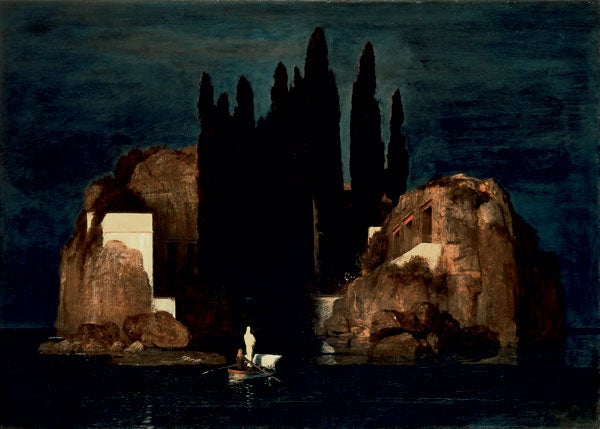
Great Works: The Isle of the Dead (1880), Arnold Böcklin
Kunstmuseum, Basel
In 1945, George Orwell wrote an essay called "Good Bad Books". It was about "a type of book which we hardly seem to produce in these days, but which flowered with great richness in the late nineteenth and early twentieth centuries... that is, the kind of book that has no literary pretensions but which remains readable when more serious productions have perished." A prime example would be the adventures of Sherlock Holmes.
In 2010, Orwell's argument looks a little shaky. Today many of his damn good reads – Uncle Tom's Cabin, for example – aren't read much at all. Conversely, many of his perishable literary books, like Virginia Woolf's, have survived. But his general point holds. "The existence of good bad literature – the fact that one can be amused or excited or even moved by a book that one's intellect simply refuses to take seriously – is a reminder that art is not the same thing as cerebration."
And how about visual art? Is there such a thing as good bad painting? Surely there is. Take Scotland Forever (the Scots Greys at Waterloo, charging towards the viewer) or And when did you last see your father? (a Civil War interrogation scene). Nobody would call them great, but they're proverbial. You might not even be able to name the artists (Elizabeth Butler, William Frederick Yeames), but willy-nilly, these images live in the imagination.
The phenomenon has a history. Good bad painting begins, roughly, in the 19th century, though Henry Fuseli, with his gothic The Nightmare of 1781, is probably the first artist who is both stirring and trashy. Good bad painting has an unquestionable impact, but it has something overt, coercive in its means. The category isn't confined to the heroics, religiosity and melodrama of the Victorians. It could include pictures like Munch's The Scream or Klimt's The Kiss. It might even include – dare one say it? – Picasso's Guernica.
But let's retreat to safer ground. The epitome of the good bad picture is Arnold Böcklin's The Isle of the Dead. Irresistible, ridiculous, it's a painting that would hardly appear in any serious history of art, yet it retains its ability to spook.
Somewhere, in the middle of nowhere, a solitary rock rises straight up from a dead calm sea. This rock has the form of a rounded enclosure, a bay that opens towards us. The inner faces of this rock are cut with oblong portals, suggesting the openings of sepulchres. From the heart of the rock grows a grove of tall cypresses. On the water, a boat with a shrouded figure and a draped coffin is being rowed towards to the island's entrance.
The solemn mystery of this land- and seascape arises from its symmetry and uprightness and containment. Several "unknown effects" – empty water, enclosing rock, impenetrable wood – are fused. It's like a Russian doll, obscurity within obscurity. Or you might borrow Churchill's description of Russia itself: "a riddle wrapped in a mystery inside an enigma". But there is nothing misty in this mystical scene. It's a solid embodiment of the beyond, a lonely tomb-altar in the sea.
On the other hand, The Isle of the Dead must be the most straightfaced picture ever made. It is a world of unrelieved symbolism. Everything in it is dedicated to conjuring up a single,sombre atmosphere. And if (under the strain) its spell should break, the scene is likely to come apart and reveal itself as a series of ingredients. Sea, rock, trees: they are all props whose function is solely to make mood. Real myths have practicalities, particulars. This is a phoney myth world.
It has same weakness that Gerard Manley Hopkins criticised in an early poem by Yeats. "It was a strained and unworkable allegory about a young man and a sphinx on a rock on the sea – how did they get there? what did they eat? and so on: people think such criticisms very prosaic; but common sense is never out of place anywhere..."
The Isle of the Dead is another work set on a rock in the sea, another allegory devoid of common sense. There is one betraying detail. Look at the funerary party approaching the island. The oarsman has his back to us. He is rowing in the wrong direction. But of course! Any figure in this picture must be faceless. The unknown, the mysterious must prevail. The sight of a human face would break the atmosphere. And if that means the rower rows the wrong way, too bad.
Or too bad for people who make a fuss about such details. The good bad painting doesn't care. It just wants to get you going. And – like it or not – it does.
About the artist
Arnold Böcklin (1827-1901) spent a lot of his creative energies on trying to invent and finance a flying machine. He also became, late in his life, the leading Swiss painter of the 19th century. His subjects were largely symbolic and mythological: sporting mermaids, fighting centaurs, bat-winged apocalyptic creatures – in painting, the power of flight was freely available. Out of this romantic gallimaufry, only one painting has really survived, his late dream vision 'The Isle of the Dead'. It has proved enormously popular. Freud had a reproduction in his office, so did Lenin. Strindberg used it as the final image of his play 'Ghost Sonata'. The Surrealists admired it. And Hitler owned a later version. Böcklin painted five in all.
Join our commenting forum
Join thought-provoking conversations, follow other Independent readers and see their replies
Comments