Great Works: The Living Mirror, René Magritte (1928)
Private collection

For free real time breaking news alerts sent straight to your inbox sign up to our breaking news emails
Sign up to our free breaking news emails
"In the beginning was the word," says the gospel of St John. "In the beginning was the deed," replies Goethe's Faust. But if those prophets had been image-makers, they might have seen things differently: in the beginning was the blob.
The blob is the most primitive form of depiction. It may look like nothing, but it establishes a something as opposed to nothing. An enclosing outline or contour, however non-specific, marks the border between an entity and its environs. It creates a shape, a proto-figure.
Historically humans may not have begun by painting blobs. We can't know. The blob is primitive in the sense that it is basic. It does what every figure does (except the pin man). Historically, in fact, it's modern art that has taken a special interest in the blob. René Magritte was a great blobbist.
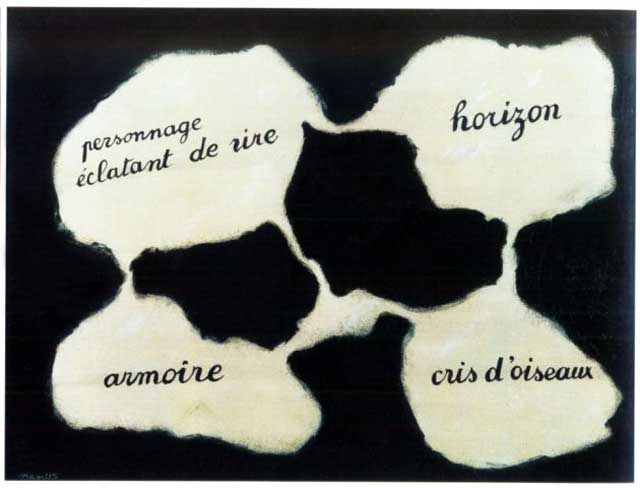
Magritte's The Living Mirror is one of his sparest works. A black field; four large splodges of white, with trailing connections between them; black writing within each splodge: that would be a rough description. It is hard to be much more committal.
Perhaps these white areas stand against a black background. Perhaps they're islands set in black surroundings. Perhaps they're hollows, opening out in blackness. Or perhaps they have no bodily/spatial existence at all. This could be a purely two-dimensional layout, with no solidity, no depth, like the elements of a diagram.
There is the writing too, of course. This is one of those Magrittes where things are given the wrong names, where there's a mismatch of images and words. Sometimes these pictures play their game with household objects. A bowler hat is called "snow". A shoe is called "the moon". A pipe is called "not a pipe". These blank estrangements are performed with textbook illustrations, in copperplate handwriting.
But sometimes these word-image games use what Magritte called quelconques formes – any old forms, non- descript forms, unidentifiable things where any name would be strange. They might be lumps, a bit like stones. They might be a kind of tray, irregularly shaped. And it's certainly strange when they get themselves labelled "human body" or "sad woman".
Still, what we see can be described. They may be unidentifiable, unnameable, but these quelconques formes are clear and solid and tangible enough. They are three-dimensional objects. You could imagine making a model of them, from stone or wood or clay.
And then there is a world like The Living Mirror's. What's happening here? There seems to be the same incongruity joke: the words don't fit the things. But here the misfit is radical. For one thing, the names don't fit each other at all.
"Person bursting with laughter." "Horizon." "Wardrobe." "Cries of birds." The four rather similar splodges are identified as four very different kinds of things: an action, a visual phenomenon, an object, a sound. What category might embrace those four things?
Which only brings a further puzzle: what kind of beings are these splodges in themselves? They have no certain visible character. All you can say is that they fulfil the basic requirement of being an individual entity: they enclose a space. They put a border round some bit of the universe. They come to an edge, a stop. There's a division between what's them (inside this limit) and what's not (outside it). They are basic blobs.
But even their blob status is unsure. Each of these enclosures is starting to blur at the edges into the black environs. Perhaps they are porous. Perhaps they are dissolving or expanding forms, and their present form is temporary.
Then there's the relationship between the blobs. Are they so separate? They seem to be individuals, linked by connecting channels, but things might be less stable. Junctions might become mergers. Connections might swell to become new blobs. Perhaps we can see this happening now, where three links meet. Or perhaps it is a single system?
Magritte keeps these possibilities open by keeping his hand vague. His forms are neither too definite nor too indefinite. There are things you might think of: wisps of smoke, thought bubbles, waterways, caves, cows' stomachs – but no likeness is affirmed.
The picture simply keeps you thinking about how entities exist in our universe. Its four or maybe more blobs are an exercise in mysterious ontology. It hardly needs its misleading words. It shows a world prior to things and names. It's about the most basic categories of existence: about separation and relation, division and oneness, limit and flux.
About the artist
René Magritte (1898-1967) is of course a paradox. A Belgian surrealist, popular and avant-garde, he's the straight man who painted bizarre scenes in a deadpan manner. But he makes sense. He couldn't paint very well, but his work is a sustained exploration of the language of images. With a vocabulary of brick walls, woodwork, clouds, apples, nudes, eyes, rocks, bowler-hats and handwriting, he's always making a point about how pictures work and how strange they are. He plays with scale, perspective, shadow, illusion. He revels in metamorphosis, in the weightlessness of the pictured world, the way you can never know what's behind something, in the possibility of unidentifiable things. With Magritte, a picture becomes a place where everything is trapped and anything is possible.
Subscribe to Independent Premium to bookmark this article
Want to bookmark your favourite articles and stories to read or reference later? Start your Independent Premium subscription today.
Join our commenting forum
Join thought-provoking conversations, follow other Independent readers and see their replies