Great Works: The Stolen Kiss (1780s), Jean Honoré Fragonard
Hermitage Museum, St Petersburg
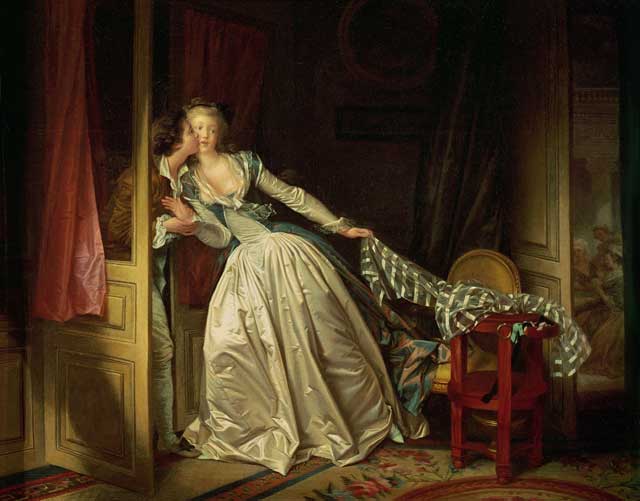
There are grand acts of heroism in the art of painting. Protagonists emerge from mythology and history, striking deeds, suffering torments, bound to doom. There is plenty of murder, and plenty of slaughter. But the heroic body is also stuck in one particular situation. It is torn, tugged this way and that, involved in conflicts and choices. It shows no flesh wounds. It is in the pull of a deep dilemma.
Or take another pull. Fragonard's The Stolen Kiss is an innocent tale of teen love. A boy, a girl: it could easily be Cherubino and Barbarina from Mozart's The Marriage of Figaro. As in the opera, this boy looks like a "breeches" role, offering the most tempting kiss, pressing the softest cheek to cheek. And it's a seduction that holds a sudden climax: his brief clasp, her possible retreat. The story implies a quick event.
But look at that the picture as a whole. This seduction contains a lot of business. It's a matter of structure and packed with telling details. The moral dilemma of her kiss – will she, won't she? – is theatrically acted out. She plays the picture's hero. Her position is torn.
This is one of those scenes with a crucial choice, and even though the subject has the lightest and most comic fate, it is a fate all the same. The main drama is laid out across the entire width of the canvas. It follows a trail, a journey, a delay. This girl's life is given a slow-motion distance, from one side of the picture to the other. This amorous episode lasts a second. It feels like forever.
The stage, for example, is set between two doors. Both doors appear with echoing openings. One stands at the left and the other stands at the right. The girl stands between them – her dilemma pulling between risk and safety. There is that saucy pink curtain, admitting the boy, his knee just pushing in, and with his foot discretely trapping the bottom of this girl's dress.
And then, through the other door, there is a view to a room beyond. A sociable group of matronly figures are together, assembled at a game of cards. She should be one of them. But she is here, briefly escaping from their control. This is one of the ways the picture is stretched out.
But there is a more intimate journey, moving along her own self. It begins from the start of her kiss; it concludes at the end of her wrap. It establishes a very long diagonal and continuous gesture of both body and fabric. It is her dominant story, and it shows us how her conscience operates under pressure.
Look at that straight, firm arm between shoulder and wrist. It looks almost like determination. The boy may be held out again him. Her face is turning away. This kiss may be resisted. But then there is the distance between that wrist and the end of that wrap – and the story begins to unravel and finally fizzle out.
It is her gauzy garment, and it is held in her narrow and tenuous grip, in her delicate hand. It travels, first in droops, then in falling knots and waves. It is borne along in gossamer lightness, and is supported for a while on this red solid wooden table. But at last it drops, in a flimsy, floppy, flaccid wisp, in mid-air. (Its hem just overlaps the room beyond – indicating the place where she could be.)
So this picture traces a long meandering precarious strung-out line, like a path or a rivulet. And in this unfolding gesture, the figure's moral shakiness is drawn out too – from almost resistance to almost surrender. Maybe she will drop that wrap. Maybe she won't. Her body, anyway, is pulled right over towards the boy.
But she still stands there, holding her potential balanced position. Her feet remain, staying in the middle of the floor. She might lean back away. So again her choice is not wholly lost, and she is not wholly victim. She is full of weakness, daring, tremors, pleasures, possibilities. She is a hero, decided between this way and that way, and tugged this way and that way. This complicated story tells her psychology.
Her body shows us something else, though, which upstages all choice and all uncertainty. It is her spectacular blazing centre. Look at her hips, thighs, open, wide, with their great rising curve. Look at the silk of her dress, with it bright highlights and its rich folds.
This is her sure unavoidable sexual focus. And whatever she might imagine, The Stolen Kiss insists on more. She is beyond heroism. Her dilemma may rock her from side to side. But her exposing desire burns out.
ABOUT THE ARTIST
Jean Honoré Fragonard (1732-1806) painted a picture more famous than his name – 'The Swing'. His range is quite wide: nymphs, light pornography, portraiture, a fantastic white bull, in beautiful brushwork. He escaped the guillotine, but the French Revolution was the end of his career.
Join our commenting forum
Join thought-provoking conversations, follow other Independent readers and see their replies
Comments