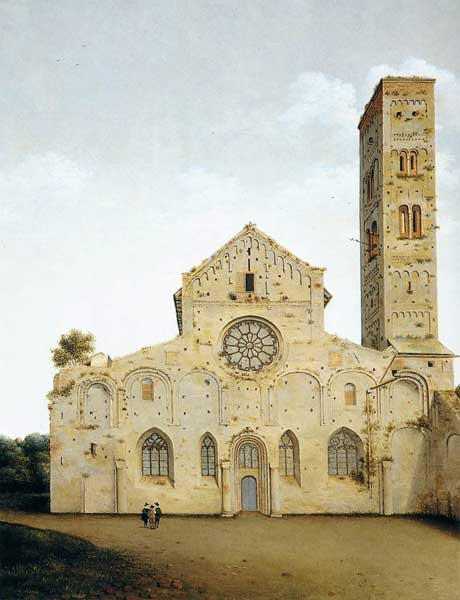
Great Works: The West Front of the Sint-Mariakerk, Utrecht (1662), Pieter Jansz. Saenredam
Museo Thyssen-Bornemisza, Madrid

For free real time breaking news alerts sent straight to your inbox sign up to our breaking news emails
Sign up to our free breaking news emails
Cubes, rectangles, triangles, rounds, arches, cylinders: these are the components of children's bricks, and sometimes they can be made in nothing more than the simplest ways. There is the homemade cardboard practice, derived from cornflakes boxes and toilet rolls, from Blue Peter and Vision On. There is the growing plastic empire of Lego, invented by the Dane, Ole Kirk Christiansen, in the 1940s. There is the traditional wooden block, centuries old.
Of course, some of these bricks are destined to become a form of design and construction. Nursery creates building. These elementary shapes propose an agenda for a living structure. But some of them go in the opposite way: architecture is moving towards play. Post-modern dwellings, for instance, can almost become toys. And there are more ancient examples.
Look at Pieter Jansz. Saenredam and The West Front of the Sint-Mariakerk, Utrecht. This is a Romanesque masterpiece, painted by the great Dutch church artist. But unlike most of his paintings, where his specialism is in interiors, this is one of his few landscapes. His normal enthusiasm is for spaces, containments, ceilings, arches, pillars, banners. Here we see a very stark facade and a very empty sky with a scattering of birds. It offers the most obvious difference between any two views: the inside and the outside.
He shows this church with its lambent walls, and his cool colours are far from any toy-like vision. But this building seems to have been somewhat changed by the artist. He has made it (in the gable) broader, and (in the tower) higher than it is in reality. More than that, it is generally made regular. And this is the thing that makes it a form of play.
True, in one way, this church is still clearly a piece of architecture. But on the other hand, it is nothing but a simple block. It contains component bricks. Its stress is upon its geometrical volumes. It consists of a strict repertoire – corners, planes, verticals, slants and a rectilinear tower. It asserts itself in its pure shapes.
For one thing, the Sint-Mariakerk is presented as a single near-detached entity. It is rare for a building to exist among no other buildings. But this one is isolated, separated, and seemingly with no context. Nothing else hems it in, except a little foliage. It appears before us almost whole. There is only one sloping buttress that is cut off at the frame. So this enclosed structure makes it a solid unit.
And it has other visible roles. For example, the picture shows the church in a totally face-on approach. This flat front, and the abrupt side of the tower, give the structure its very tangible volume. Or again, there is the clarity and openness of the stone ground, and the way the structure is placed upon this floor, marking emphatically its presence. It is like an object carefully stood up. It is like something piled, piece on piece, by hand.
In other words, it is made of composed elements, compact, put together. It is like something assembled from a toy-box. It is like a little model. This church and this painting suggest child's play.
ABOUT THE ARTIST
Pieter Jansz. Saenredam (1597-1665) was known as “the first portraitist of architecture”. He made his name with soaring interiors of Dutch churches, coolly often removing people and clutter. He was based in Haarlem and his focus was on real buildings, working from precise, measured drawings. Saenredam was a hunchback and a recluse.
Subscribe to Independent Premium to bookmark this article
Want to bookmark your favourite articles and stories to read or reference later? Start your Independent Premium subscription today.
Join our commenting forum
Join thought-provoking conversations, follow other Independent readers and see their replies