Great Works: View of Haarlem (with bleaching fields) (c1670) by Jacob van Ruisdael
Kunsthaus, Zurich
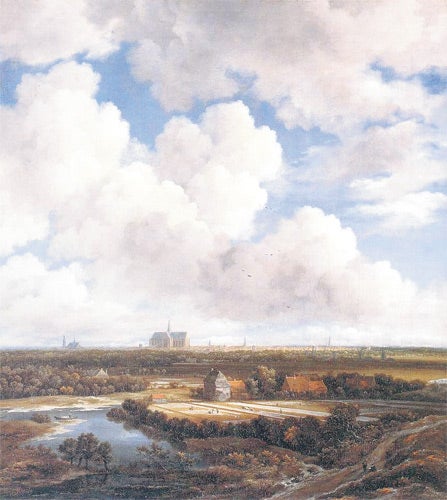
Very flat, the Netherlands. And the horizon of this landscape is an almost perfect horizontal. In the dark foreground the land rises, offering a vantage point, from where we look down upon the scene. But in the distance, where the sky and the earth meet, a straight and level line cuts through the view.
Jacob van Ruisdael's View of Haarlem has an industrial subject. Its fields here are filled with the business of bleaching. Its flat bright white strips of linen are visible in the vicinity of the city. It was one of Haarlem's specialisations, and one of Ruisdael's specialisations too. His perspectival angular views of the pegged-out cloth emphasises in another way our awareness of the ground. In the fields, as on the horizon, flatness dominates this world.
The land is flat, then. It is also quite low. The proportions of sky to earth in this picture are about two to one. And though the bleaching area has one major highlight, the main contrast is between bright sky and dark earth. Bright and dark meet in two pronounced bands, and are sharply defined by their boundary. It's like a demonstrative chart. This dramatic visual effect makes it clear how the land lies low.
True, the cathedral of St Bavo in Haarlem rises above the city. It is the main feature here that breaks the line of the far horizon, and it pierces it with its spire. But this human tiny effort is upstaged and overawed by the sky itself. Its vast cloud formation floats calmly above, in a gradual diagonal of cumulus.
Now these sky-earth proportions are not in themselves so important. A landscape might have the same proportions, but with a wide panoramic view. And there are Ruisdael landscapes where the flat ground is actually shallower than here, but the view is wider; in that case, the weight and the force of the sky are neutralised.
The important thing in this landscape is its upright format, its shape that is higher than broad. It's a question of how the scene is experienced. A horizontal format creates a spreading, sideways, earth-bound view. But a vertical format – this rare narrow view – gives it an up and down orientation, descending and ascending. This is what abases the land, and makes the sky rise above it and press down upon it.
The cathedral is only a minor factor in comparison to the relationship of sky and earth. It is like a secular vision. It could be a symbol. The lowness and the flatness of the land stress the humility of humanity. And in the middle of the ground there is a building by the bleaching fields; with its pitched roof it's like an arrow, pointing upwards.
Or it could be an imagined apocalypse. The space of this sky might accommodate a large hovering saint, close up to the viewer, caught up to heaven in an act of levitation. It might even hold – in the midst of this Dutch productive and present-tense landscape – a hint of the end of the world. Jesus is asked: "Are you the Christ, the Son of the Blessed One?" "I am," said Jesus. "And you will see the Son of Man sitting at the right hand of Power and coming on the clouds of heaven."
ABOUT THE ARTIST
Jacob van Ruisdael (1628-82) was a most versatile Dutch landscape painter. His subjects are by no means flat. He deals in storm-tossed waves, turbulent rivers, broken tree trunks, dark forests, as well as his serene views, set around his local Haarlem. His most atmospheric and romantic subject is 'The Jewish Cemetery'.
Join our commenting forum
Join thought-provoking conversations, follow other Independent readers and see their replies
Comments
Bookmark popover
Removed from bookmarks