Leighton, Frederic: Flaming June (1895)
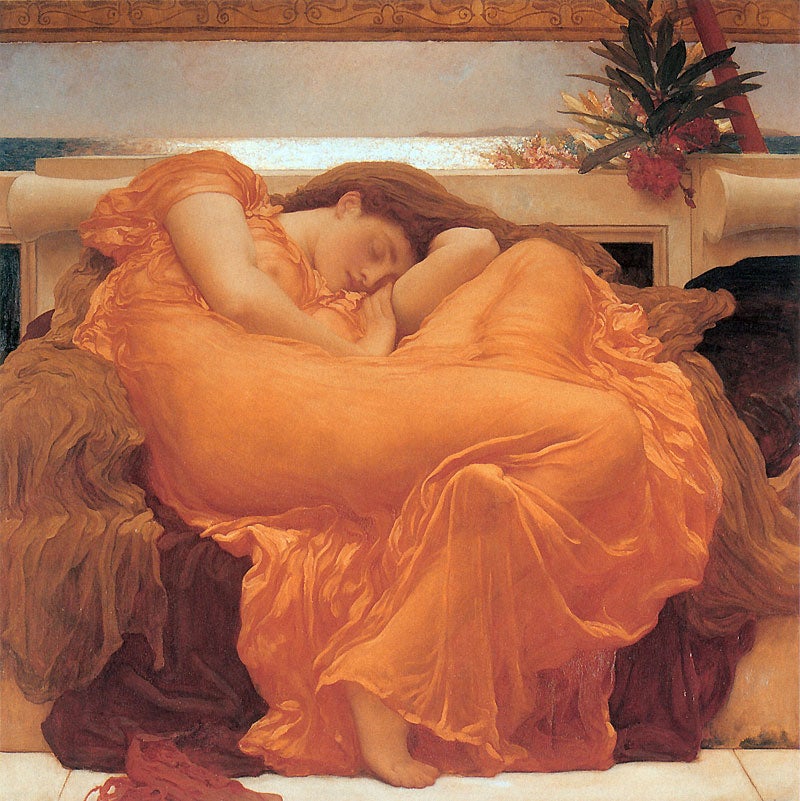
But is it great? It's famous all right, one of the most familiar works of late Victorian art, probably better known than its artist. It's a big favourite, too, featured on countless posters, in countless homes and waiting rooms.
You might even call Frederic Leighton's Flaming June a controversial painting. Opinion is certainly divided. Some people adore it. Some dismiss it as a laughable piece of kitsch. But those two constituencies seldom talk to one another.
What's more, they seldom see the picture itself. This English icon belongs to the Museo de Arte de Ponce in Puerto Rico. It tends to be loved or loathed in reproduction. For the next year, though, it's at Tate Britain.
So now we can see it, let's have the argument out. Let's try and articulate a persuasive case – the case against Flaming June. That will also involve imagining the case for Flaming June. To argue against it, you need to understand its appeal.
If you like Flaming June, what do you like? At a guess, the exquisitely sensitive painting of the gauze shift, its gossamer transparencies and rippling folds; the elegantly curled up pose of the sleeping woman, configured into a rounded, rose-like form; the orange glow that envelops her, radiating from her dress into the reddish tints of her arms and cheeks; the overall feeling of irresistible dreamy languor, on a sultry evening, on the shores of the ancient Med.
And put like that, one line of attack seems obvious. Flaming June is a travel brochure. It offers an "away-from-it-all" fantasy. You've got indolence, luxury, mild eroticism (the see-through costume, the peeping nipple) and a warm climate – with a classical setting, to add extra romance plus cultural respectability. You could put a caption along the bottom, saying something like "THIS SUMMER... DREAM OF CYPRUS", and you wouldn't be falsifying the picture's appeal.
But an artwork's overt message of is only one aspect. A picture could hold these corny ideals, and still be worth looking at. A sleeping body can be a dramatic subject. A body dissolving into a pool of sensual semi-consciousness can make an exciting, even alarming image. It depends how it's painted. What's bad about Flaming June is that the way it's painted does nothing to intensify or complicate its touristic agenda.
It is a thoroughly evasive bit of work. The treatment of the dress, for instance, is not exquisitely sensitive. It's a fudge. It's painted with neither high accuracy (too arduous), nor dashing freedom (too daring). It's painted with just enough looseness to blur the issue of what this garment is actually made of – but not enough looseness to put any risk into its depiction.
If you want to see perfect definition gauze painting, try Ingres. If you want to see it done with a bold, shimmering flick of a brush, try Manet. Leighton's fabric isn't made of any particular stuff. In the rumpled bits around the edge of the figure, the supposedly sheer material becomes thick and opaque. And the rumples themselves are phoney. They're not how any cloth would really fold and gather. They've just got a token crinkliness to them.
The shape and structure of the figure are fudged, too. Leighton contrives a highly elaborate pose, then smoothly obscures the question of whether the pose is believable or not. He plays the safe "neither-nor" trick again.
He avoids palpable anatomical clarity, which would let you sense how truly extreme this pose was (for that, see Courbet). Equally he avoids the kind of explicit artifice that revels in wilfully redesigning the human body so as to fit it into a pattern (for that, see Klimt). Leighton's purpose is that nothing should be seen clearly or felt keenly.
However you approach this picture, you find that it retreats from making any definite statement or gesture. Its world isn't quite solid – and it isn't quite ethereal. Things aren't observed in particular detail – nor transformed into classical anonymity. Every possible form of tension, precision, pictorial adventure, is shied away from.
Maybe this is because Leighton can't manage anything more definite. Maybe it's because he prefers it that way, or knows his viewers will. This is MOR painting – and for MOR there's always an audience.
Which is where argument ends. You can explain that Flaming June is an object lesson in lukewarmness and pussyfooting. Some people will be convinced. But others will just reply: "Well, yes, that's why we like it." And besides (which you can't say for many paintings), it is extremely orange.
The artist
Frederic, Lord Leighton (1830-96) was one of the leading artists of his age. He was a painter sculptor and man about town. He belonged to the "aesthetic" movement. He specialised in mythological subjects where mood and physical beauty and colour took precedence over story or moralising. "Art is the utterance of our delight in the phenomena of Life and Nature and an endeavour to communicate to others and perpetuate that delight." The delight comes through rather tepidly now, but in his time he was compared to Michelangelo.
Join our commenting forum
Join thought-provoking conversations, follow other Independent readers and see their replies
Comments
Bookmark popover
Removed from bookmarks