View of Delft (1660) By Johannes Vermeer
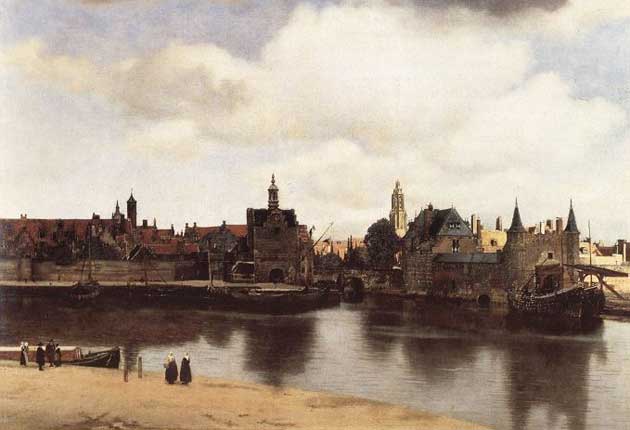
There are works in which a single detail steals the show. Leonardo's Mona Lisa is famous for that smile. Michelangelo's The Creation of Adam is famous for those hands. And Vermeer's View of Delft – well, not quite so famous. But among readers of Proust, at least, the painting can't be recalled without a mention of one particular bit.
It's a picture you might not expect to break down into bits. It seems so seamlessly photographic. But on a closer look, Vermeer's paint surface separates out into a pattern of light-readings, into dots and dabs and patches of colour. It's one of those.
In volume five of A la recherche du temps perdu, the novelist Bergotte dies. He dies in a gallery, at an exhibition of Dutch paintings, in front of Vermeer's View of Delft. He fixes his last living look on that picture, homing in on a detail of it, which had been pointed out by a critic in a newspaper:
"At last he came to the Vermeer, which he remembered as more striking, more different from anything else he knew, but in which, thanks to the critic's article, he noticed for the first time some small figures in blue, that the sand was pink, and, finally, the precious substance of the tiny patch of yellow wall. His dizziness increased; he fixed his gaze, like a child upon a yellow butterfly that it wants to catch, on the precious little patch of wall. 'That's how I ought to have written,' he said. 'My last books are too dry, I ought to have gone over them with a few layers of colour, made my language precious in itself, like this little patch of yellow wall...' He repeated to himself: 'Little patch of yellow wall, with a sloping roof, little patch of yellow wall...'"
"Le petit pan de mur jaune..." Which patch is it, though?
The point is disputed. There are several possibilities in the cluster of buildings at the right end of the far shore. The most obvious is the glimpse of yellow roof (not wall) to the left of the turreted building. The next is the strip of bright wall (not especially yellow) to the right of the turreted building. When he wrote, Proust was probably working from memory – or a black- and-white reproduction.
But let's assume it's the oblong of roof. There's a question you can ask about any famous detail. Does it work by itself, or does it only work in the context of the whole picture? If you extracted the detail, would it be a strong picture in its own right, or would it be hard to see what the fuss was about?
The passage suggests that the little patch all by itself, the sheer precious substance of its painting, so dense and luminous, is what transfixes Bergotte. But the picture suggests otherwise. It's only within the whole view that this patch – suddenly brighter and purer than you'd expect, and with its yellow animated by the adjacent reds and blues (Vermeer always a great one for the primaries) – blazes out. It's not a self-sufficient and extractable gem. It's an integrated effect, a climactic note.
In other words, Bergotte dies under an illusion. His illusion is normal enough. With any climactic note, we tend to feel that it can be isolated and extracted – that its power and preciousness lie somehow within itself, rather than depending on that to which it is a climax.
But this is why it's such a good image of the man's fading consciousness and will to live. Bergotte wants to see this detail as a separately precious thing, something he can isolate and grasp in his hand. Yet he can't – any more than can hold on to this last precious moment of his life.
About the artistJohannes Vermeer (1632-75) remains a mystery. The "Sphinx of Delft" was rediscovered in the 19th century; in the 20th, his work was seen as the epitome of artistic perfection. Its watchwords are stillness, silence, containment, privacy, meditation, illumination. About 35 pictures survive, mainly interiors. There's no certain self-portrait – in his painting of an artist at work, the painter's back is firmly turned.
Join our commenting forum
Join thought-provoking conversations, follow other Independent readers and see their replies
Comments