Blitzed Paul Delaroche artwork restored for show
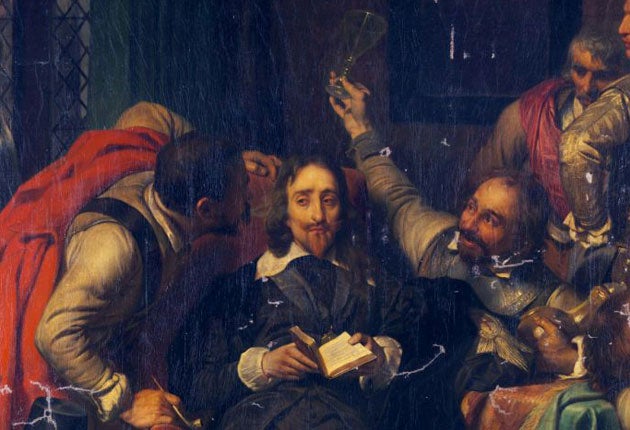
Wartime curators bemoaned the loss of a great work when they rolled up the remains of Delaroche’s monumental painting, ‘Charles I Insulted by Cromwell’s Soldiers’ that had been pounded by shrapnel after a lethal bombing raid during the Blitz in 1941 which left the Bridgwater House – where the work had hung – decimated.
The pockmarked canvas, owned by the Duke of Sutherland, had lain forgotten in a vault for nearly 70 years, believed irreparably damaged, or even destroyed, until a group of National Gallery curators inquired after its whereabouts.
It was only when they located it in the bowels of Merton House – the Duke’s personal residence on the Scottish borders - and unfurled the painting on 7 June this year, that they realised to their astonishment, that it was still in tact.
The National Gallery is now preparing to display the magnificent work in public for the first time since it was furtively stored away during the Blitz. It will be unveiled with its shrapnel wounds on 24 February 2010 as part of a major exhibition at the gallery, Painting History, which will re-appraise the achievements of the French painter, Delaroche.
On 11 May 1941, Bridgewater House was hit by a German bombing raid, and a crater, ten feet deep, opened up in the street. Delaroche’s monumental painting, then hanging in the dining room, received extensive shrapnel damage. When it was rediscovered this year, conservators counted around 200 tears to the canvas. Traces of plaster dust from shattered walls were also found on the picture surface, blown there by the force of the explosion.
Nicholas Penny, director of the National Gallery, said its re-discovery from the vaults – and its first unveiling – will mark a historic moment.
“We think it will create quite a sensation when it is shown in Room 1 of the gallery.
“Among the paintings thought to have been previously destroyed was this painting of Charles I. It was unrolled in June for the first time since being rolled up after the bomb damage. It is a one of the great French paintings of the 19th century which depicts a scene from British history, and it is completely legible. We can still see the damage from the explosion and we can even tell which direction the debris was shot onto the canvas,” he said.
Despite this damage, the picture was discovered to be almost entirely legible and has lost none of its intensity. Featuring Charles I as a Christ-like figure who is being taunted by Cromwell’s defiant troops, who blow smoke into his face moments before his execution in 1649, it is regarded as one of Delaroche’s most powerful pieces. The gallery hopes to fully restore the work after the exhibition. It has not yet been decided where it will hang.
The painting, to be hung in its own separate room, was originally displayed at the Paris Salon of 1837. It was commissioned by Lord Francis Egerton, the future 1st Earl of Ellesmere, at the height of Delaroche’s fame. For decades, it hung among the collection of paintings at Bridgewater House, in London.
The exhibition will also feature ‘The Execution of Lady Jane Grey’, painted by Delaroche in 1833, which was also believed to have been damaged beyond repair in the 1928 flooding of Tate Gallery’s basement and was rolled away and forgotten until 1973 when curators realised it was salvageable. It has undergone major restoration work since then.
Dr Penny said the exhibition would endeavour to re-assess the works of Delaroche – who fell out of fashion during the early 20th century – but who the director credited with “inventing a new kind of painting” that combined aspects of theatricality with realism that gave an edge to the ‘heroic narratives’ in history paintings.
Join our commenting forum
Join thought-provoking conversations, follow other Independent readers and see their replies
Comments
Bookmark popover
Removed from bookmarks