Is Goya masterpiece just a colossal mistake?
The Prado has pulled one of Goya's best-known masterpieces from a new exhibition, citing doubts about its provenance. The move provoked uproar in the art world, reports Elizabeth Nash
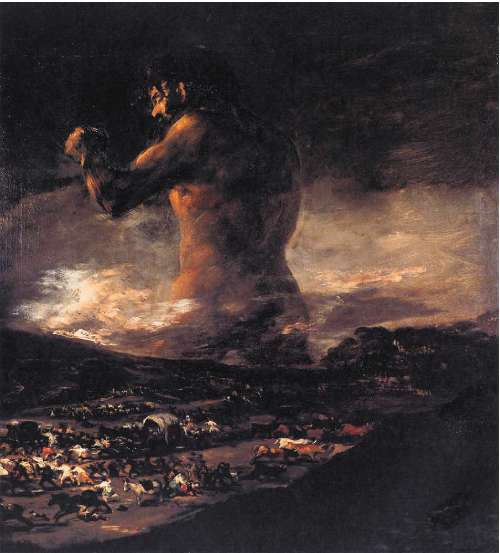
Francisco de Goya's dark and brooding masterpiece El Coloso (The Colossus), has long been hailed as one of the Spanish master's most dramatic portrayals of the horrors of war. The celebrated work shows a giant naked figure, his eyes shut and fists clenched, rising above a sombre mountainous landscape from which people and animals flee in a terrified stampede.
Hailed by the French poet Charles Baudelaire as "giving the monstrosity the ring of truth", the work painted in 1808, or soon after, is widely considered as epitomising the artist's dark presentiment of war and social chaos unleashed upon Spaniards by Napoleon's invading army.
But this powerful work owned by Madrid's Prado museum, which packs an emotional punch that transcends the moment it was executed, has been controversially excluded from a new blockbuster show because of suspicions it was not painted by Goya after all.
The Prado's exhibition Goya In Times Of War, which opens tomorrow, contains 200 paintings, drawings and engravings that mark Spain's war against the French, including many works borrowed from private collections that have never before been seen in public. The show marks the 200th anniversary of a conflict that ripped Spanish society apart and which Goya observed at close quarters, keeping war diaries of the savagery he witnessed.
But El Coloso, which has formed part of the Prado's permanent collection for nearly 80 years, has rather mysteriously been excluded from the museum's new blockbuster show. "Our knowledge of Goya's work has advanced greatly in recent years, and doubts over the attribution of El Coloso are widely accepted by the museum's scientific team," the Prado's director, Miguel Zugaza, told the Madrid daily ABC on Friday.
The Prado's director promises that the evidence that persuaded the museum to keep El Coloso out of sight will be made public eventually. "A study is being concluded that we will make known in a few months' time – in the first instance to the scientific community, which we respect above everybody – through the museum's official bulletin," Mr Zugaza said.
Faced with past disputes over attribution, the Prado has been scrupulous in keeping works of doubtful authenticity out of the public eye. Controversy has surrounded this particular painting for some time in artistic circles, but news that El Coloso was not painted by Goya is bound to come as something of a bombshell to the wider public.
Doubts were first cast on El Coloso's authenticity – and that of another celebrated Goya work, La Lechera de Burdeos (The milkmaid of Bordeaux) – by the British Goya specialist Juliet Wilson-Barreau, a member of the scientific committee that organised the Prado's new exhibition.
"The works lack energy and a good display within the framework of the painting, faults that are completely abnormal in the trajectory of Goya," Ms Wilson-Barreau wrote in Spain's art review El Periodico del Arte in April 2001. Giving El Coloso the definitive thumbs down, she added: "Almost all the specialists are in agreement that it is not by Goya." Ms Wilson-Barreau's doubts were shared by Manuela Mena, the Prado's senior Goya expert and curator of the show which opens tomorrow.
However, they were furiously dismissed at the time by the Prado's then director, Fernando Checa, who insisted both works were authentic. A year later, Nigel Glendinning, professor of art history at London University, wrote an academic study robustly defending the painting's authenticity. Almost nothing further was heard about the disputed El Coloso until this week, when it emerged that the canvas was excluded from the forthcoming celebration of Goya's war paintings.
"To remove this painting from view and put it out of sight, in limbo, is grossly unfair to the public," says Professor Glendinning. "If the museum doesn't like it, they should tell us why."
Senior staff at the Prado told the professor last week that they had decided not to put the painting in the exhibition because they didn't think Goya had painted it. "They could have put it in a section apart, with some discussion of their reasons for doubt, rather than withhold an extremely well-known, well-loved painting from view without public explanation," Professor Glendinning said.
In a public lecture in Madrid tomorrow, he will restate his conviction that El Coloso is not only an authentic Goya, but is revolutionary in its composition. "Everything flows away from the centre. This is precisely what Goya does in his drawings and engravings Disasters of War, and especially in his great painting The Second of May [El Dos de Mayo], where everything flies about in all directions, and Goya masters diagonals and pyramids to convey dynamism and chaos."
There is also documentary evidence to support the painting's authenticity. El Coloso (a modern title) has long been identified as the painting catalogued by Goya's son, Javier, in an 1812 inventory of the artist's possessions, as Number 18 Un Gigante (A Giant). This is the attribution given in the Prado's catalogue of its last big Goya exhibition, in 1996, marking the 250th anniversary of the artist's birth. "This supports the theory that the terror emanating from the image is none other than the consequence of the War of Independence," the catalogue entry adds.
A further inventory in 1874, published by the Prado in 1996, lists paintings belonging to the Marquise of Perales y Tolosa. Painting number 89 of the marquise's holdings is described as "a prophetic allegory of the misfortunes that occurred during the War of Independence, original of Goya." The Prado acquired the painting in 1931.
If, as has been accepted, the work was painted around 1808, it coincided with the publication of patriotic verses published anonymously by Juan Bautista Arriaza. The poet's allegory evokes the idea "of a giant force that rises up against the tyranny of war, a literary source that shows great similarities with this painting," according to the Prado's own 1995 catalogue entry on El Coloso. Arriaza's verses were on everyone's lips at the time, and formed part of the popular context in which the work was painted, Professor Glendinning insisted.
Even the delicate state of the canvas supports the authenticity of the work, he said, as it might have been put on public display, and suffered accordingly. It might have formed a pair with a work by Goya of the same size of an eagle soaring over a terrified Spanish populace, which was brought to England and subsequently lost. "They might have been shown together in public, which would explain its poor state. And in times of war you would expect poor canvas and materials."
Photographs of El Coloso from the 1940s reveal in one corner, beneath subsequent patina, what may be the crucial "no 18" of Javier Goya's original inventory. "A Prado curator told me there were some numbers on the painting but they couldn't be sure what they were," Professor Glendinning said. "I have no objection to authenticity being challenged, but we need clear arguments backed up by facts, not just opinion."
One art specialist quoted anonymously in ABC grumbled: "It's a bit much for the scientific community to have to wait for the official museum bulletin for this kind of news." Another complained: "They haven't even announced when the results of their study will be published. It would have been much more respectful to consult the wider scientific community, or at least present a serious debate, before inflicting irreparable damage on the reputation of the painting."
In El Coloso's absence, the highlight of the exhibition is likely to be Goya's restored Le Dos de Mayo, portraying the uprising of the people of Madrid against Napoleon's troops, which has been long disfigured by russet patches covering gashes inflicted during the Spanish Civil War. The masterpiece was taken from Madrid to Valencia, then Barcelona, to protect it from Franco's bombardments in 1938, but fell off the lorry en route and was torn in several places.
Months of painstaking work have reconstructed the missing work from preliminary sketches and copies of the original. The restored canvas goes on show tomorrow in a condition as fresh as when Goya painted it in 1814.
Join our commenting forum
Join thought-provoking conversations, follow other Independent readers and see their replies
Comments
Bookmark popover
Removed from bookmarks