Leibovitz pawns her life's work to raise $16m
Portrait photographer forced to mortgage rights to her art as financial turmoil takes its toll
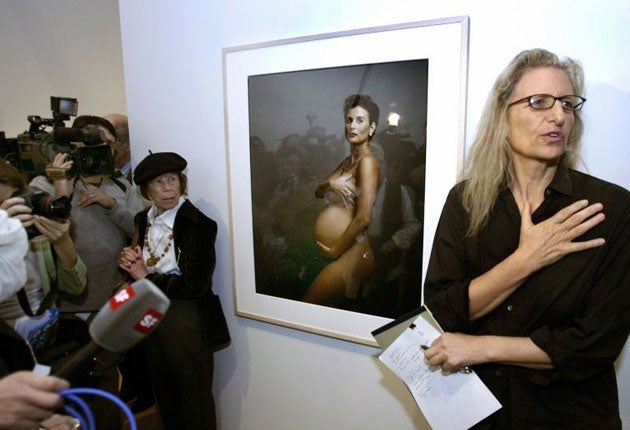
Pity the struggling rich who find that their swaggering homes no longer have the value necessary to help them raise more cash when suddenly they need it. But for some there is salvation. There are certain institutions out there interested in taking something else as collateral for new loans: art.
You are particularly blessed if you not only collect important art – it has to be good stuff, not your great aunt's oils languishing in the attic – but are the creator of it. Just ask Annie Leibovitz, the portrait photographer whose clients have included Walt Disney and Vanity Fair, but who has apparently hit the financial shoals.
She may be one of the most successful commercial photographers of her time but, over the past several months, Leibovitz has reportedly gone to an institution called Art Capital in Manhattan for loans totalling no less than $15.5m (£10.8m). Whatever outstanding bills she has, they are apparently considerable.
It is the nature of her loan agreement that will get the art world all a-twitter, however. For sure, she began by doing the traditional thing, offering properties as collateral, including her country home in upstate New York as well as town houses in Greenwich Village. But then she was forced to mortgage something else – at least for the life of the loans – all the rights to her photographs, those already taken and even those she will take in the future.
The loans-for-art market is not one that is widely known about beyond tight circles. "It's very discreet," Ian Peck, co-owner of Art Capital, told The New York Times, which published an exposé yesterday. Another prominent New Yorker who has resorted to pawning his artworks is the film director and property developer Julian Schnabel, who has stretched his own resources building a gaudy-pink apartment complex in the West Village known as Palazzo Chupi.
That art – some art, at least – is retaining its value where other commodities, including bricks and mortar, are not, has been confirmed, at least so far, by this week's auction in Paris of the Yves Saint Laurent collection. Takings on the first night were €206m (£183m). Elsewhere, however, there are fears that sudden dispersals of collections by cash-hungry galleries and museums could depress values in this market also.
For now, though, business is good at Art Capital, which expects to make art-secured loans of about $120m this year, compared with $80m last year. It has rivals who also report good times. At Art Finance Partners, also in Manhattan, there has been a 40 per jump in loan requests in the past six months.
Think of the art market and revered names such as Sotheby's and Christies come up. But where Leibovitz and Mr Schnabel have chosen to tread is a good deal less genteel. These institutions are entirely legitimate, but some might call them loan sharks, or if not that glorified pawn shops. Art Capital, for example, will make loans of $500,000 or more at interest rates of between 6 per cent and 16 per cent.
Most important to remember is this: default on your payments and those precious masterpieces – or, in the case of Leibovitz, those famous photographs (including, one assumes, some of the Queen) – will no longer belong to you. Indeed, the offices of Art Capital are hung with canvasses that clients have been forced to surrender and are now subject to sale. A Rubens here, two Warhols there and, around the corner, one Rodriguez.
Reporting Leibovitz's dealings with Art Capital, The New York Times quotes loan documents filed at the City Register's Office saying that she had signed over "copyrights ... photographic negatives ... contract rights" existing or to be created in the future, to secure loans first of $5m last autumn and then a second $10.5m tranche in December. The money will in part go towards consolidating existing mortgages on her city homes.
The news of her dealings appeared to confirm rumours that Leibovitz was on the financial ropes.
Recent stresses for the photographer have included huge costs associated with an elaborate studio in Chelsea, Manhattan, that she has since relinquished, and the death of her former partner, Susan Sontag, and the responsibilities of raising her children. She has also had to deal with lawsuits filed against her by a lighting company and stylist for about $700,000.
Artists on the breadline
Rembrandt van Rijn
The Dutch master declared himself bankrupt in 1656, when he was left with enormous debts after years of living beyond his means. He was forced to sell his house in Amsterdam and move to a more modest part of the city and his family opened an art shop to fend off his creditors. During these dark years, he painted numerous self portraits in which he depicted himself as a man racked by sadness and pain.
James Whistler
After the critic John Ruskin publicly denounced Whistler's Nocturne in Black and Gold in 1877, the artist sued him for libel. He won the action but was only awarded one farthing in compensation, a decision that appeared to vindicate Ruskin. The court costs combined with the damage done to Whistler's reputation – which drove away potential patrons – was enough to ruin him financially and he declared himself bankrupt in 1879, selling his London house and moving to Venice.
Lionel Bart
At the peak of his success, the composer, below, owned five houses, including a 27-room castle in Tangier and a flat in New York. However, he was forced to sell them all after signing away the rights to Oliver!, his most popular work, a decision which is said to have cost him up to £100m in lost earnings. The composer declared himself bankrupt in 1972 and slid into depression and alcoholism but slowly rebuilt his fortune during the 1990s through other royalties. He once said: "I hated money. I had no respect for it. My attitude was to spend it as I got it."
Join our commenting forum
Join thought-provoking conversations, follow other Independent readers and see their replies
Comments