Byzantium 330-1453, Royal Academy, London
The Royal Academy is showing a stunning array of Byzantine icons - but do they enlighten, or merely dazzle?
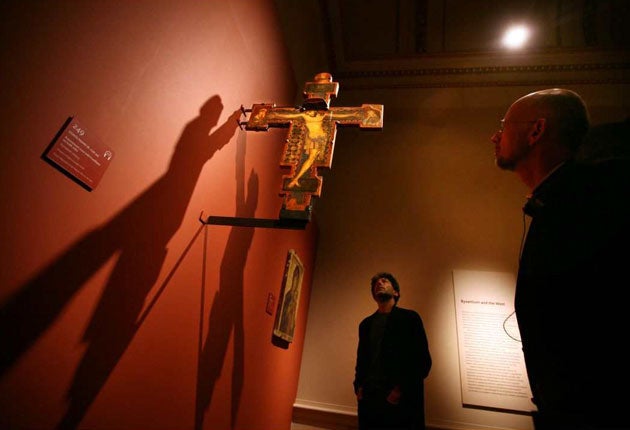
To the inexpert eye, there is little to differentiate the work numbered 252 in the Royal Academy's show, Byzantium, from others in a previous room devoted to icons.
Like most of those, this small-scale image of the Virgin and Child is painted in tempera on gold which has been applied to a wooden panel. Like the other, anonymous, icons, No 252 adheres to a strict formula. Its picture-space is flattened rather than illusionistic; the drapery of the Virgin's robe falls into stylised patterns instead of articulating the body beneath; the hands and faces of mother and child are metaphors of emotion rather than reproductions of it. What makes this achingly pathetic image different from the icons we've already seen is where it was painted, which was in Italy.
The Fall of Rome to the Vandals in AD476 left Constantine's newly-minted Eastern Empire, Byzantium, as the defender of European Christian culture. The reconquest of the Western Empire by the Byzantine emperor Justinian, in AD522, put the Roman boot on the other foot. Now, it was the East that called the shots in what became Italy, a fact most famously attested to by the mosaics at the church of San Vitale in Ravenna. For the next 750 years, Italian art was, broadly speaking, Byzantine art, so that No 252, for all its apparent Greek-ness, came to be made in mid-13th-century Pisa. It explains why my description of this lovely little icon has dwelt almost entirely on the things it is not, which is to say, perspectival and naturalistic.
For us in the non-Orthodox West, Italian – thus European – art starts with the Renaissance, which kicks off just after No252 was painted. The Renaissance has tended to be seen as a rejection of such earlier, less satisfactory modes of art-making as the Gothic and Byzantine. Vasari, as ever a mine of misinformation, fosters this view by championing Cimabue as the father of the Renaissance, his paternity lying precisely in his rejection of the Greci vecchi – i.e. Byzantine-style – painters who dominated Florence in the mid-13th century. A curious result of all this is that, while we can look at, say, Indian or African art with the impassive eye of aliens, the art of Byzantium seems archaic: the relic of a civilisation we long ago outgrew, a thing all the more foreign for being inexplicably found in Ravenna and Cordoba and Berzé-la-Ville.
The word "byzantine" has lived on in the West as a synonym for complexity, and the art that was European art for much of the millennium from the founding of Constantinople to its loss to the Ottomans in 1453 strikes us as mystifyingly complex. It isn't just about flatness and a lack of naturalism. We expect art to be novel, and Byzantine art abjures novelty. We look for signatures and, as with the work of the Gothic artists, there are none.
Byzantium is a wonderful show, full of things to stop you in your tracks: a fiery icon of St Demetrios from Moravia; ceramics, ivories, illuminated manuscripts; an astonishing micromosaic diptych from 14th-century Constantinople that may make you believe, as Orthodoxy teaches, that the Church is heaven on earth. Two of the oldest extant Byzantine icons, from the Holy Monastery of Saint Catherine on Sinai, have made the trip from Kiev, where they were taken by a thieving Ukrainian priest in the 19th century.
All of which is to say that the Royal Academy's show is delightful and unmissable, but I have a problem with it. Byzantium passes up the chance to address our difficulties with looking at its subject matter. It is easy to be seduced by intricacy and gold leaf, by the stylised agony of a mother's face, the fingers of her under-sized baby. It is harder, though, to understand how all those things fit into the story of our own art, an understanding that would make these works real rather than just lovely. The material for teaching us this is all there on the walls; but the show never quite gets around to using it.
Royal Academy of Arts, London W1 (020-7300 8000) to 22 Mar 2009
Join our commenting forum
Join thought-provoking conversations, follow other Independent readers and see their replies
Comments