Craftivism, Arnolfini, Bristol
If you long for a dose of revivalist moral rectitude, talk to the hand
When Eric Gill set out to become a socialist, he did not commit Das Kapital to memory or sculpt heroic tractor drivers: he took to working straight on to stone.
In Marxist terms, direct carving bridges the gap between labour and commodity. Since the 1980s – the decade of Thatcherism – British art has gone the other way. Much of the aesthetic punch of Damien Hirst's pickled shark, the iconic artwork of its day, lay in Hirst having not caught the fish himself, nor built his own tank nor brewed his own formalin. By the 1990s, labour and product were different things, inimical to each other. Art was of the head, not the hand. The hand made something called "craft", usually with a curl of the lip.
So a show called Craftivism at the Arnolfini in Bristol is timely. In the past few years, there has been a Ruskinian resurgence of hand-making in post-Brit Art British art. The most startling evidence of this is that Hirst himself, once the high priest of the hands-off, has begun to paint: badly, it is true, but to paint none the less. The work of the latest Turner prize-winner, Richard Wright, is all about the hand – its intimacy, its secrecy and, most subversively, its skill. ("Well-made" has long been a term of abuse in British art schools.) And beyond this pair lies a whole hinterland of artists for whom craft is not just an unhappy necessity but a badge of honour: potters, embroiderers, bookbinders, weavers and wood turners. This change is bound up with 21st-century politics, in particular with an anti-globalist mood which expresses itself in a taste for the local and hewn.
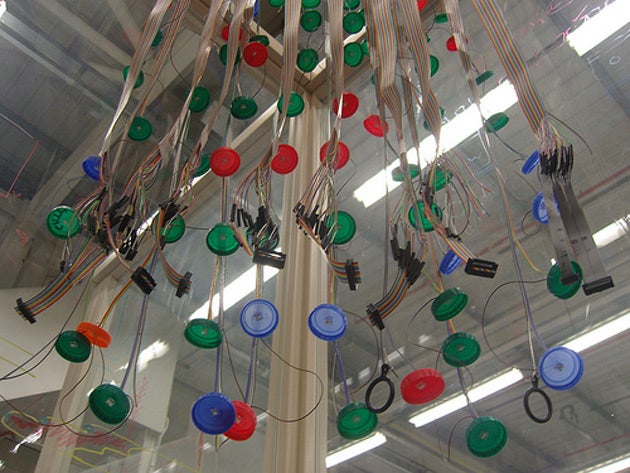
And thus craftivism – a word coined by the knitter, Betsy Greer, to describe the overlap of political activism and craft. Thus, too, Craftivism, a show of the kind of work that comes from this process. As with Eric Gill, the point is to elide labour with product, cutting out the middleman (particularly if that middleman is in a Laotian sweatshop). But craftivists go further than Gill. For all the simplicity of his sculptures, they were commodities – luxury goods, made and appreciated by an elite, and affordable only to them. At its purest, craftivist work can be made by pretty well anyone, and consumed likewise. Thus Stephanie Syjuco's Anti-Factory, in which visitors recycle used clothes as hoods, or Christine and Irene Hohenbüchler's bau-Stelle (Building Site), a vast assemblage of Meccano-ish wooden struts which anyone can bolt together in any way they choose.
Now, the moral rectitude of all this seems to me beyond doubt: the more specific question, though, is whether craftivism is art. It is arguable – I would certainly argue it – that artworks have also to be commodities. Piero Manzoni may have tinned his own shit, but he did so in the knowledge that Merda d'Artista would fetch art prices: in 2007, a can of Manzoni's poo sold at auction for £80,000. Art may do good things politically, but it does so by sleight of hand rather than making by hand.
I feel curmudgeonly for saying this, particularly given that visitors to Craftivism on the day I went included the young, the apparently underprivileged, and the disabled. I bolted together a bit of bau-Stelle and felt the faint warmth that comes with taking part. I thought how well Trevor Pitt's communally knitted slip cover, Salon Bench: Knowle West – its knits and purls credited to Eunice, Beryl and Adele – would sell in the Conran Shop. But I left with the sense of having been to a revivalist meeting rather than an art exhibition; or, come to that, to a craft show. Taking the name of art in vain is fair enough, given artists have spent much of the past century doing just that. But hijacking craft – a word that has, surely, to encompass skill and experience and tradition – is another thing again.
To 14 Feb (0117 917 2300)
Tips for 2010
By Richard Cork
The Real Van Gogh: Haunted by suicidal sadness yet blazing with vitality, the painter's life and work are explored through major paintings, drawings and superbly illustrated letters. Royal Academy (020-7300 8000), 23 Jan to 18 Apr.
Henry Moore: From early carvings in stone through to the monumental bronzes, this big show promises to explain how Moore came to be such a dominant force in European sculpture. Tate Britain (020-7887 8888), 24 Feb to 15 Aug.
Michelangelo's Dream: Focusing on the "presentation drawings" he gave to friends, the show explores his prowess as a draughtsman. Courtauld Gallery (020-7848 2526), 18 Feb to 16 May.
Artist to watch:
David Nash, tree-carver supreme, gets a big summer showing at Yorkshire Sculpture Park (01924 832 631).
Join our commenting forum
Join thought-provoking conversations, follow other Independent readers and see their replies
Comments