David Hockney: Just Nature, Museum Wurth, Swabisch Hall, Germany
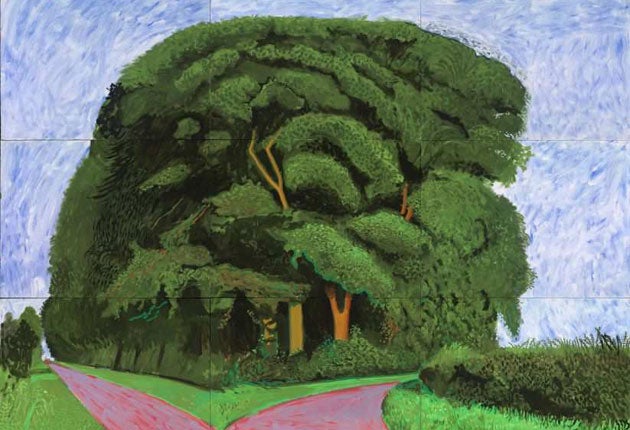
Now here's a curious fact. If you want to really understand what David Hockney has been pouring his energies into these past several years, you need to visit a museum in a small, medieval town in Swabia. Why could this not have happened in England? The question hangs in the air, waiting for a collective response from the curators of England's great cultural institutions.
It has to be said that Hockney seemed, for large tracts of time, to be off the boil during the 80s and 90s – think of those dreadfully garish, sub-Picasso abstracts, or the cringing, chocolatey paintings of his beloved dogs. There's been a dramatic change in recent years, though. A change of subject matter. And a change of location. The name Hockney no longer means the heat-struck languors of Southern California.
Hockney's now back living in Yorkshire, and he's painting the East Yorkshire landscape en plein air just like those Impressionists used to do. He's out at the crack of dawn, when the light's at its best and the shadows at their longest, pootling along narrow, deserted, twisty country lanes in his old car. He's living in the house in Bridlington which he once bought for his mother and sister, and he's wrestling with his new theme with tremendous energy and gusto – especially for a man of 72.
When you walk around this exhibition, you are astonished by how much work he's painted over such a relatively short span of time. And it's not only the works themselves, it is also their scale – many of these paintings are multi-panelled. Some consist of six panels; the largest (which had an airing at the Royal Academy's summer show two years ago) is made up of 50 – 50! – panels. For Hockney, painting a single canvas on this kind of scale is out of the question because once you're up a ladder, you can't get the same flexibility of handling. You're always considering issues such as balance. So – ever technologically astute – he makes a mock- up of the finished multi-panelled painting on the computer screen, but only ever works on discrete bits of it. Then the whole thing gets assembled.
The tragedy about the hanging of this particular work here – and it is in fact an ink-jet reproduction of the work we saw at the Royal Academy, and not the thing itself – is that it is hung at the bottom of a stairwell, which partially obscures it from view. What also troubles us is the fact that it seems neither better nor worse in reproduction.
Like the Impressionists also, Hockney wants to chart the changing of the seasons, and so we see different views of the same triumvirate of trees or of the same rutty track, canopied like a chapel. Last Friday afternoon, he said how eager he was to get back to nature as quickly as possible. "It's action time," he said, with some evident frustration that he was stuck indoors in a smart grey suit. Then he went back to drawing on his iPhone – as he's wont to do when faced by interminable questions from earnest German journalists.
But how good are these paintings? Has Hockney brought something distinctive to this hoary old subject? Yes and no. The paintings are at their best when seen from a considerable distance – say, about 40ft away. Then you grasp the way in which he has dealt with space, and don't get tangled up in too much detail. You see how much he is enjoying the theatricality of nature, her tricksy habits. Close up, the brush work can look a bit globby and laboured and clotted and crude. He is brilliant when he is being most rash with his colour contrasts, when he seems to be transforming the countryside into some tremendous set for the Metropolitan Opera, when he's erring on the side of the Fauvishly fanciful. Some of his brashest and most successful paintings are of felled trees and tree stumps. Totem Tree, for example, looks like a stubby, indomitable sacred symbol. It's painted in a glorious, full-frontally naïve manner, vividly anti-naturalistic, and not wholly unlike Van Gogh.
This curmudgeonly Yorkshireman is going to slosh on the paint till he drops.
Until 27 September 2009
Join our commenting forum
Join thought-provoking conversations, follow other Independent readers and see their replies
Comments