Edinburgh Art Festival, various venues, Edinburgh
Sleeping, working, sitting on the lav, Roth recorded his every living moment – but failed to capture the whole story. This year, that seems to be a theme ...
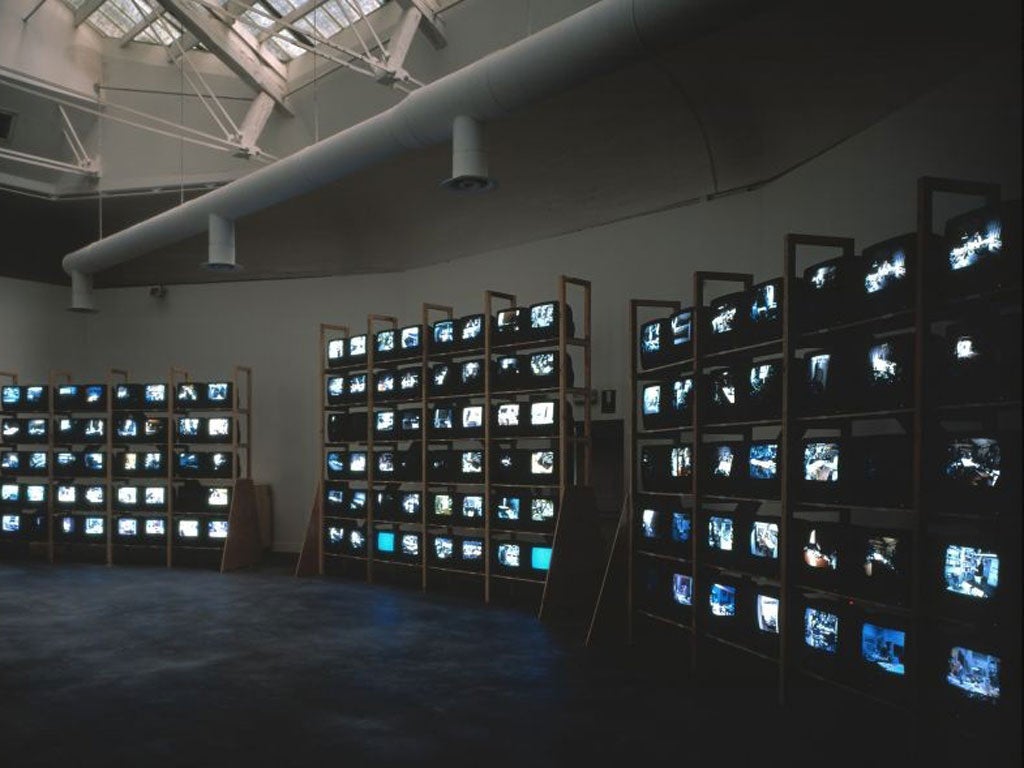
In 1998, Dieter Roth did two things: he finished his vast video installation, Solo Szenen (Solo Scenes), and died. The events were not unconnected. For 20 years or so, Roth had made art from the detritus of his life, imposing on the least of his throwings-away – bottle tops, luggage labels, fag packets – an archivist's scrupulous order.
You can see the result of this at the Fruitmarket in Edinburgh, in a work called Flat Waste. For one year, 1976, Roth catalogued all his rubbish less than 1mm thick in ring-binders. These are arranged on library shelves with lecterns and reading lamps. The story they tell of Roth – he sometimes called himself "Rot" – is a sad one. For all his attempts at completeness, the work is, and could only ever have been, incomplete. Flat Waste isn't a total artwork, because artworks, like life, never are.
When he knew he was dying of drink, Roth had one last go. Solo Szenen consists of 148 monitors, arranged in three banks and each playing a video from cameras set up around the artist's studios in Switzerland, Germany and his native Iceland. These record Roth's every living moment – sleeping, working, cooking, sitting on the lav. And yet even this is not his whole story.
It is not an upbeat start to the Edinburgh Art Festival, but then this year's Festival seems tired of upbeat-ness, and perhaps even of Edinburgh. In St Andrew's Square, the latest EAF pavilion, The Waiting Place, is by Andrew Miller. Miller has modelled his stained-wood shack on unalike structures, beach huts in Trinidad and the Finnish summer houses of Alvar Aalto. The work's point is its reticence. With a tree growing through its roof, The Waiting Place is hardly there, serves no clear purpose. "Everything is so in your face in Edinburgh during the Festival," Miller says. "I wanted something that would step back."
In the same vein, Anthony Schrag treats Edinburgh as an obstacle to be parkoured over rather than a monument to be admired. Dubbed Tourist in Residence, the limber performance artist takes visitors on walks designed to erase the city. In one, Schrag encourages them to play football down Rose Street. In another, he blindfolds participants, then ties them together, then makes them wear earplugs. Edinburgh, shorn of its Enlightenment certainties, becomes a place of instinct.
Susan Philipsz, too, sees the city as something to be written over rather than read. Her Timeline typically consists of the harmonised sound of her own Turner prize-winning voice, broadcast by six speakers set up across the city.
In response to Edinburgh's famous One O'Clock Gun, these, in more senses than one, play a siren song. They sound like the kind of call that lured Homeric sailors on to rocks, but also like the ones that warn of air raids – aptly, since mechanical sirens were invented by an Edinburgh physicist, John Robison. As with Roth's video monitors, it is impossible to hear Philipsz's story whole. Standing under the Timeline speaker in Old Calton cemetery at 1pm, there is only a thin wailing, a sole voice calling out to other, unheard voices across the city like a Scots muezzin.
If Philipsz's work is about uncertainty, then Roderick Buchanan's Legacy at the Scottish National Portrait Gallery apparently deals with its opposite. Mirroring the sectarian divide in Northern Ireland, Glasgow's flute bands, the subjects of Buchanan's work, are devoutly Loyalist or Republican.
At first, the photographs of men in the Parkhead and Black Skull bands seem to be of two distinct species, one black-coated and the other red. Time spent studying the bandsmen shows something less clear. While many of the Parkhead members have predictably Catholic names – Liam Gilmartin, Kieran Docherty – one is called Gary Goldstein. Hair colour and facial type transcend social division; so, too, does a palpable air of poverty.
The men's rituals, played out in a two-screen cinematic face-off, seem equally opaque, and equally silly. The more you watch, the less you understand.
There are nearly 50 shows in this year's EAF, and reviewing them all would reduce this column to a listings page. There are things I didn't see and would have liked to, things I saw and didn't like. Much of the work this year is about incompleteness: so is this review.
If you're in the mood for something edgy, then stop by Mick Peter's show at the Collective Gallery on Cockburn Street. Picking up on the belief of the cult novelist B S Johnson that all fiction is lying, Peter plays off sculptures of his own drawings against a formal, Constructivist space.
The disjunct is oddly jarring. It's meant to be.
Critic's Choice
Sarah Lucas’s new show Ordinary Things reveals her more serious, classical qualities as an artist, at the Henry Moore Institute in Leeds until 21 Oct. Kew Gardens in west London has been infiltrated by the sculptures of David Nash. You can afford to wait for a sunny day, too – his large wood carvings will be there until April 2013.
Join our commenting forum
Join thought-provoking conversations, follow other Independent readers and see their replies
Comments