Harrier and Jaguar, Tate Britain, London
An installation by Fiona Banner is more politically subversive than headline-grabbing, anti-BP demos
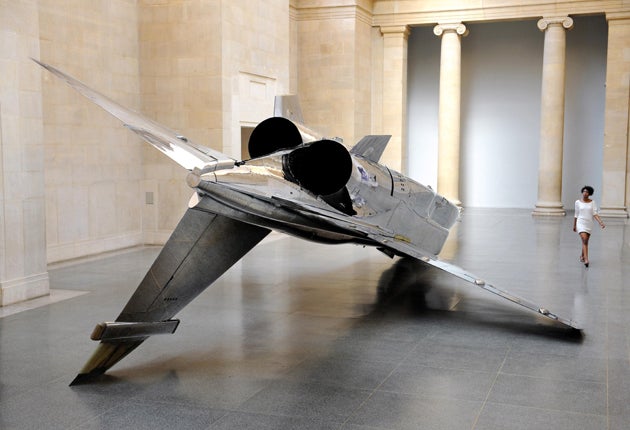
There was, alas, no label that I could find for Fiona Banner's new Duveens Commission at Tate Britain, so I'm unable to tell you how its materials are described there.
"Mixed media" would broadly fit the bill, Banner's installation being made up, as its name suggests, of two. The work is called Harrier and Jaguar.
Which is to say that the Tate will be home, for the next six months, to a brace of fighter aircraft: a Sepecat Jaguar and a British Aerospace Sea Harrier. In last year's Turner Prize show, Roger Hiorns made a floor piece out of an atomised jet engine, but Banner has gone several better by leaving her aeroplanes whole and doubling their number. The Harrier she has had suspended nose-down from the vault of the South Duveen gallery, the effect being of a crucifix or of a pheasant left to hang or, perhaps, of both. (I found Banner's jet reminding me of Chardin's odd Christ-as-a-fish, La Raie.) In the North Duveen, meanwhile, the one-time Turner shortlistee has had a Jaguar fighter scrubbed of its paint, and its silvered fuselage left upside-down on the floor. Harrier and Jaguar sounds like the title of one of those French Rococo game paintings – an Oudry, maybe – and Banner's wonderful installation has something of that feel, of things wild and powerful laid low, left to lie in the vast, marbled larder of the Duveens.
The difference, of course, is of scale and dimension. Even plucked and drawn, Banner's jets have a capacity to scare. Before going upstairs to see Harrier and Jaguar, I dropped in to look at Henry Moore's wartime Shelter Drawings in the Tate's basement. The effect was of coming up from below ground to find the aftermath of a war fought overhead. Good artists respond well to the immensity of the Duveens, Martin Creed's Work No. 850 using them to reduce the heroism of runners to something small and vulnerable. More complex still, Banner's jets fight a double war with the space, dwarfing it at the same time as being dwarfed by it. The twin subjects of her nature morte feel dormant rather than extinct, as though the Tate might be their lair rather than their larder, as though they might suddenly stir. And what then? It is all too easy to picture Harrier and Jaguar roaring down the vast airspace of the Duveen Galleries, to imagine all that marble left in ruins.
Which is to say that, while Banner's work is resolutely modern – you might think of it in the same breath as Roy Lichtenstein's Whaam! in Tate Modern – it taps into that venerable thing known as the Sublime, found in the work of painters such as Turner. Jet fighters are beautiful because they are streamlined and shiny, but they are also beautiful because they are horrifying (and, perhaps, vice versa). In a day when we are encouraged to acknowledge the overlap between art and design, it mightn't come as a particular surprise to find a pair of jets in a gallery. Banner's aren't there because they are well made, though, but because, however much they may repel, Harriers and Jaguars also attract.
All of which makes these machines of war very vexing things indeed. On the night of the opening of Harrier and Jaguar, protesters, angry at the Tate's sponsorship by BP, splattered the floor of the Duveen Galleries with molasses. This seemed a faintly cynical thing to do – BP has been funding the Tate for 20 years, so what's the point of objecting now? – but also rather a stupid one.
Whatever else it might be, Harrier and Jaguar is a political work, just as Mark Wallinger's 2007 Duveens Commission, State Britain, was a political work.
To acknowledge the sulphurous beauty of war is not to endorse it: it is to alert us to contradictions in ourselves. That alone would make Banner's installation subversive, but, quietly and eloquently, it teases on another level as well. Both of the fighters in her installation are ex-RAF, and the RAF is fuelled by Air BP. In a roundabout way, Banner has managed to make one part of what we Sixties folk called the military-industrial complex question the morality of another. It's a shame that, on the night of its maximum publicity, attention was drawn away from Harrier and Jaguar by a piece of shameless headline-grabbing. Fiona Banner is a very clever artist. The people who stole her thunder were not.
Tate Britain, London SW1 (020-7887 8000) to 3 Jan 2011
Next Week:
Charles Darwent sees stark portraits of edgy New Yorkers in Alice Neel: Painted Truths, at the Whitechapel
Join our commenting forum
Join thought-provoking conversations, follow other Independent readers and see their replies
Comments
Bookmark popover
Removed from bookmarks