I, Impostor, British Pavilion, Venice
Mike Nelson has done rooms within rooms before – but here the result is scary, apocalyptic, and one of the triumphs of this year's Venice Biennale
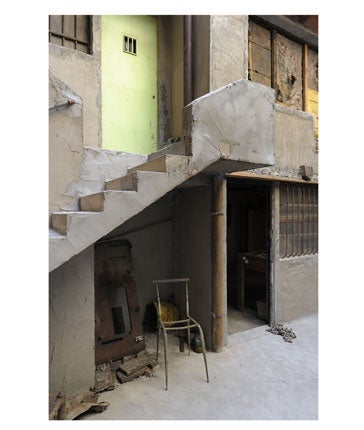
There's always a worry with Mike Nelson, brought on by his always doing the same thing. Artists nowadays are multi-skilled, if only in choosing who makes their art for them.
Tracey Emin, last-but-one occupant of the British Pavilion at the the Venice Biennale, is a case in point. Emin filled the former tea-house with media – from memory, textile works, drawings, shards of wood, maybe a film – so that it looked like a duty-free shop for Britart. Nelson, by contrast, has done the thing he does: i.e. he has filled the space with another space, remaking the pavilion as his own.
When I think of the fictive Nelson-spaces I've stood in – there have been a number – they all blend into one: a room in a series of rooms, also, I think, in Venice, and made to look like a minicab office. That, in a nutshell, is Nelson. He inserts spaces into spaces, the new ones being Mary Celeste-ish. They feel as though they've been lately abandoned by someone who leads the sort of life you and I are happy not to lead – an economic migrant, one of those people who ends up driving minicabs. They are the victims of capitalism and history, driven this way or that by the push and pull of trade. Nowhere has that pull and push been more tidal than in Venice, which you'd think would have made life easy for Nelson when it came to choosing what to insert as his Biennale work, I, Impostor.
But no. Or, but no, maybe. In any Nelson space, there are two anxieties jostling each other: one to do with the once-familiar – didn't this used to be the British Pavilion? – the other with choosing which of the room's several doors to escape through, and what might lie beyond it. Nelson's genius lies in his understanding of the anonymity of poverty, of the luxury of geography: that people on the move have no need for fixed points, or maybe no time or money.
Desperate for something to navigate by, your eye looks around I, Impostor, finds clues in its whitewashed walls, cupolas and carved wood doors and gasps, "Phew, Venice". But it is wrong. A small glazed sign in a doorway reads Hurda altin gümüs alinir, which tells you that you are not in Italy, but in somewhere that isn't German-speaking but which nonetheless likes umlauts. A red-and-white crescent flag, crumpled on a worktable a few rooms in, identifies this place as Turkey. But why?
Now here's a problem. As I've said, Nelson has made his world in that non-world of global trade and migration – not the sharp horrors of starvation, but the dull ones of lives endlessly transient, featureless. To try to tie that world down is to spoil its joke, if that is the word. The truth of I, Impostor is that it started life at another biennial, in Istanbul in 2003. There, it would presumably have had a local significance. But Istanbul, like Venice, has always been an entrepôt of trade and culture. Both cities have Byzantium at their core, cupolas and carved doors, mosaics. Your eye isn't entirely stupid for having hit on Venice for I, Impostor's location, because it easily might have been. It is in the nature of Istanbul to have exported the work, of Venice to have imported it.
That, though, is to do precisely what we mustn't do with Nelson's work, which is to explain it. The real thing about his spaces is the urgency they inspire in you to leave them. This isn't merely because they are windowless and grubby. What worries about the transience they evoke is the feeling that it might move on to you.
The things left deserted in I, Impostor evoke a culture that looks almost viable, but not quite. Some of the tools – hammers, adzes – could still be used, ditto an elderly and hissing black-and-white TV. There are bits of loom with spools still intact. The end has been recent and quick, if the decline long and slow. What does all of this mean, and what is it doing here in Venice, this glorious, trading, sinking city?
Unusually for Nelson, he has changed the existing structure of the British Pavilion to insert his new one into it: walk through one door and you find yourself in a dingy courtyard, looking up at the sky where the pavilion's roof used to be. This is the Nelson we're used to, but also a Nelson we're not – harder, more urgent, a bit apocalyptic. I, Impostor is a frightening work and a frighteningly clever one, one of the best things in this year's Biennale.
Venice Biennale 2011, to 27 Nov
Next Week:
Charles Darwent wades through the rest of the Venice Biennale
Art Choice
The US photographer Taryn Simon gets a solo show at Tate Modern. In A Living Man Declared Dead and Other Chapters, her tiny portraits of the members of 18 sets of family trees are both intriguing and unsettling (until 6 Nov). Or rediscover Salisbury as Constable country, with an exhibition of his paintings at the city's museum (to 25 Sep).
Join our commenting forum
Join thought-provoking conversations, follow other Independent readers and see their replies
Comments