Mythologies, Haunch of Venison, London
Natural selections from far and wide

For free real time breaking news alerts sent straight to your inbox sign up to our breaking news emails
Sign up to our free breaking news emails
It is 10 years since the Museum of Mankind in Burlington Gardens, that fabulous cabinet of curiosities which had served for almost 30 years as the repository of the British Museum's extensive collection of ethnographical objects, closed its doors. Now they are open again, and, wow, the space has been brilliantly refurbished.
Something unusual has happened here. A private gallery called Haunch of Venison has taken over the space – 10 large galleries – in its entirety, and it is showing about one hundred works by a range of modern artists from all over the world. Some of them are very well known – Sophie Calle, Damien Hirst and Tony Cragg, for example – others less so. The small boys profit by being able to stand on the shoulders of their elders. It's a cunningly curated show, too, in so far as it extends the conversation about the nature and purpose of ethnographical objects that visitors to the old Museum of Mankind would have been having with each other.
When you conduct the refurbishment of a space on this lavish scale, not only restoring the detailing of a fine historic building, but also putting in a great deal of additional gallery paraphernalia – false walls, well hung lights, plus a great deal of hard thinking about colour, darkness, the importance of sudden moments of illumination – you raise the value of the objects that are on show. In fact, you museum-ify them if you like. Why not though? This is a private gallery after all, even though it may look like a museum. Big collectors get a buzz out of such things.
This is exactly what has happened here. So the key question is: once you have set aside the brilliant seductiveness of its staging and setting, how good is the work which is on display here?
Some of it is not very good – we yawn over Hirst's two skull panels (how many more skulls can we bear to see from Hirst before we ourselves are but skulls out of sheer boredom?); Tony Cragg's African Culture Myth a huge, wall-hung fabrication of an African figure, made out of all sorts of broken bits of detritus, looks and feels unconvincing.
Some of the less-well-known artists, on the other hand, have made some very thought provoking pieces. Look out, in Gallery Ten, for a table full of haunting, voodoo-like sculptures, all very crude looking, made from scavenged bits and pieces of wood and metal from goodness knows where, by Haitian artist, Jean Herard Celeur.
Cragg's piece hangs on the wall very near to this table. Glance from one to the other. Cragg's work looks as if he is faking something, as if, as its title suggests, he is satisfied with something which looks vaguely generic – and nothing more. Celeur is right inside his work, digging ever deeper.
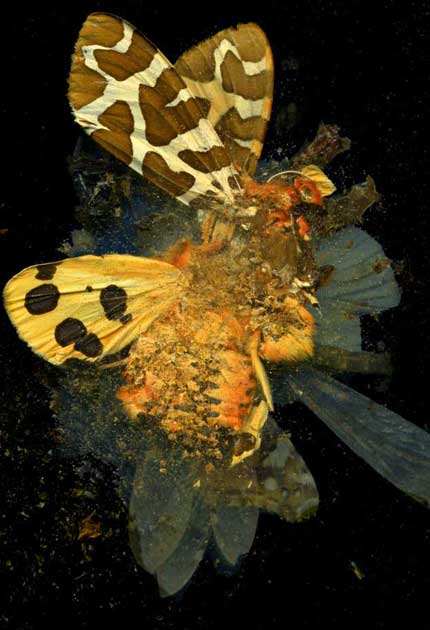
The further you go into the building, the better the show gets, and it reaches its high point with a series of cunningly manipulated photographs of what look like brilliantly colourful, nastily pinioned butterfly parts by Mat Collishaw at the very end of a gallery devoted to a prolonged meditation upon the unnaturalness of nature.
In fact – and this is a serious planning error – the only serious one, as far as I can see, the only point where the masterplan fails is as we enter the building. The works which face us in the lobby as we sweep up the steps from the street need to make a tremendous impact. They need to say: this is what this show is all about, and this is as good as it will get. They fail miserably at this task. They feel too small, too insignificant, too imaginatively impoverished. In fact, their impact is wholly undermined by the splendour of the newly furbished entrance, with its sweeping double staircase.
Yes, an historic building can be potentially good for business – but it can also possess a donkey's kick if you don't stroke it in quite the right way.
To 25 April (020-7495 5050)
Subscribe to Independent Premium to bookmark this article
Want to bookmark your favourite articles and stories to read or reference later? Start your Independent Premium subscription today.
Join our commenting forum
Join thought-provoking conversations, follow other Independent readers and see their replies