Paul Nash: The Elements, Dulwich Picture Gallery, London
Paul Nash, the celebrated war artist, could see conflict in everyday objects, even on the Sussex Downs
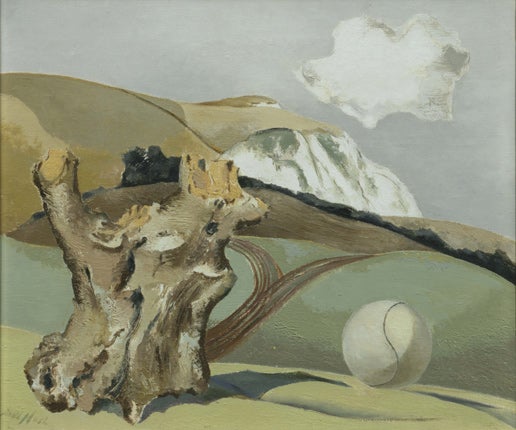
If you have an image of Paul Nash in your mind then it is probably as a war artist, a painter of shelled woods in the Ypres Salient or crashed German bombers on the Sussex Downs.
And that's fair enough, since Nash was the battle painter par excellence, covering both world wars – and, apart from William Rothenstein, the only Briton I can think of who did so. As a well-argued new show at the Dulwich Picture Gallery makes clear, though, Nash was already a war artist before he was shipped to the Western Front as a rifleman in 1917, and remained one until his death a year after VE Day.
The wars Nash painted and drew were not just of opposing armies but of the manichaean struggle between all kinds of things: between woods and the paths that run through them, forms and space; land and sea, men and women, between order and disorder. The DPG's show is called Paul Nash: The Elements, and that, too, is fair enough. For 35 years, Nash painted a small range of elemental things – trees and tree trunks, knapped flints, birds' nests, doorways – regrouping them like pieces on a chessboard, or like soldiers on a battle plan. For the most part, these scenes were imagined, their elements and the arrangement of those elements so charged with symbolism that even Nash's landscapes really count as still lifes. The idea that Nash recorded what he saw, on the Menin Road or by the sea in Dymchurch, needs knocking on the head; and, among other things, the DPG's exhibition does just that.
One of the earliest works in the show – a lovely watercolour called The Three, made in 1911 when Nash was 21 – offers few clear signs of what was to come. Of its trio of elms, recalled from a Buckinghamshire spinney, the critic of The Daily Telegraph huffed: "There seems to be no inspiration from reality ... [Mr Nash's] trees look as if they were embroidered." But that was rather the point. When, 17 years later, Nash painted a canvas from what he had seen at Inverness Copse in the hell of Passchendaele, its trees looked, intentionally, like dead men rising from their graves.
By then, Nash's personal pantheon of symbols – his elements – were firmly set. The tree-man recurs as the bole of February (1929), a memorial to the artist's dead father. That shape, abstracted, becomes the shards of flint in The Nest of the Wild Stones (1937), these in turn having their roots in the Neolithic earthworks in Landscape at Pen Pits. Paths and doorways are things of promise in Promenade (1922), of mystery in Savernake (1927), of horror in the hellish Marching at Night (1918). To every good in a Nash element there is an equal and opposite bad.
Above all, you feel, there is sex. Nash, unusually open to the European avant-garde, was an early subscriber to Surrealism. This suited him well in various ways, the improbable juxtaposing of unlikely objects being at the heart of Surrealism's method and his own. The surrealist taste for things erotic also shades the paths through Nash's woods, his fascination with dew ponds and standing stones, with fallen trees. One work in particular – The Archer, first painted in 1930 and reworked over the course of a dozen years – seems to unlock Nash. The po-faced depiction of an upended toy boat, its mast pointing at a target, The Archer is like the illustration from a Freudian casebook. Behind its child-like innocence, lie the irrationality of Freud's The Interpretation of Dreams, the mythic quality of The Golden Bough.
If Nash didn't make old bones, he did live long enough to see his elements coalesce. Much of the work in the first rooms at Dulwich feels tentative and exploratory, even bitty. It is in the last room of what we might loosely call landscapes from the 1930s and '40s that we find Nash among the great British painters of the 20th century. For all their surrealist oddity, works such as Event on the Downs are symphonies rather than concertos, great comings-together of disparate sounds and tunes. Paul Nash: The Elements is a clever show, and one the artist needs and deserves.
To 9 May (020-8693 4786)
Next Week:
Charles Darwent makes a date with the Courtauld Institute to see Michelangelo's Dream, one of the most magnificent drawings of the Italian Renaissance
Join our commenting forum
Join thought-provoking conversations, follow other Independent readers and see their replies
Comments