Poor.Old.Tired.Horse, ICA, London
Captive in the concrete jungle
Poor.Old.Tired.Horse is an exhibition inspired by concrete poetry at the ICA. Though concrete poetry was established in Brazil in the Fifties, it took hold here during the Sixties: a golden era of poetry in Britain. But the term concrete poetry doesn't do justice to the fluidity, the free-falling work that flies around these rooms. The true rebels have arrived.
Concrete poetry is Letraset graffiti. It's punk, at once unintelligible and visceral, where words give off texture and tone freed from any pedestrian need to enslave, used for what they are rather than what we think they should be. But whoever named this stuff concrete poetry deserves to be lopped on the head with a piece of it.
Poor.Old.Tired.Horse. is, we are told, "an exhibition of art that verges on poetry." I want to fight the description. Is it not an exhibition of poetry that verges on art? Could an arm wrestle with the curator settle it? In truth, the narrative of the exhibition is about art more than words and shows how words seeped into art in the Sixties and are doing so significantly today. Contemporary artists make poems, contemporary poets make art. Truth.
The exhibition opens with the work of Ian Hamilton Finlay. I wouldn't wrestle with him. His verse pulsates as muscular, taut and steadfast as a kung-fu fighter. He throws shapes from beyond the grave. The centrepiece is Sea Poppy I (1968), a giant swirling kaleidoscope in the guise of a poppy, a bewilderment of letters and numbers – the names of ships, we learn but I'd assumed they were fighter planes. For me, the poppy signifies war and as I stand before it, a child transfixed by a spinning propeller, the physical reaction is dizzying.
Adjacent is "The Sound of Running Water" text smeared along the wall. I am reminded of dried blood, until at a corner, one word slips onto the next wall and takes on the colour of revolution: bright red, oxygenated.
In the belly of this room, display cabinets present the intestines and vital organs of the British movement of concrete poetry, including copies of the periodical, Poor.Old.Tired.Horse produced by Finlay, which gave this exhibition its name.
Textual works that utilise the language of signage, advertising, lyrics, pop are evident in Vito Acconci's Four Book (1968). It takes the New York yellow pages, but Acconci has typewritten snippets of conversation or thoughts caught in the margins. Pure poetry. In seeking to demolish the functionality of the word, Acconci has defined it.
I am haunted by three ghostly conical shapes on rotating turntables by artist Liliane Lijn. One of them, POEMKON=D=4=Open=Apollinaire (1968), like the nose of a space shuttle, stands three feet from the ground. As it turns, the old-fashioned revolutions of the turntable produces a distant braying like that of mechanical sheep. POEMKON = D tells me more about space travel than any film. It is as if the shuttle has smashed through space clouds of description. Words have stuck to it in the chaos. This is what happens when you allow art to fill spaces.
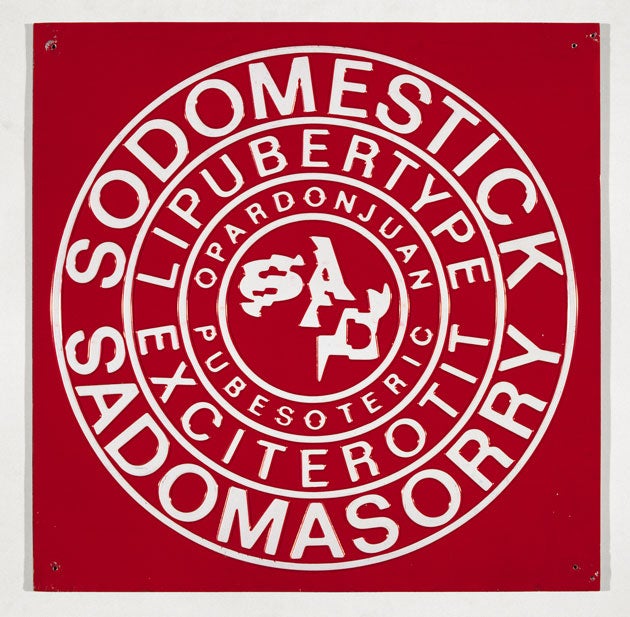
Ferdinand Kriwet's Text Sign, also from 1968, features 10, seemingly municipal square pieces made from stamped aluminium, display words laid out in circular patterns. They could be grid lids outside a New York police station or hospital or school. From the distance, the signs feel safe. It's what signs do. But, as I step closer there's un-nerving juxtapostion. Concrete poetry forcing a way into the real world: SODOMESTICK SADOMASORRY EXCITER- OTIT. Slamming words together makes for an emotional shock. Gorgeous. Words not bound by sentence but freed in their exisentence as Ferdinand might say.
Upstairs, more words, more investigation of the indefinite space between reality and fiction. I stand transfixed in front of a two-foot tall poster by Janice Kerbel with its invitation to roll up to Remarkable: Faintgirl (2007).
If aliens were to try and understand the human condition they would not find it in Parliament and its consititutions but at the ICA. Here, the alien would know humankind and cry. They should paint massive signs on the roof "Alight Here. A Light Here". You should. It might be one small step for man (or woman), but it's a great leap for the mind.
Until 23 August (020-7930 3647; www.ica.org.uk/poth )
Join our commenting forum
Join thought-provoking conversations, follow other Independent readers and see their replies
Comments