RA Summer Exhibition, Royal Academy, London
It's June again but where are all the Royal Academy's gondola scenes? Banished, in favour of post-Pop
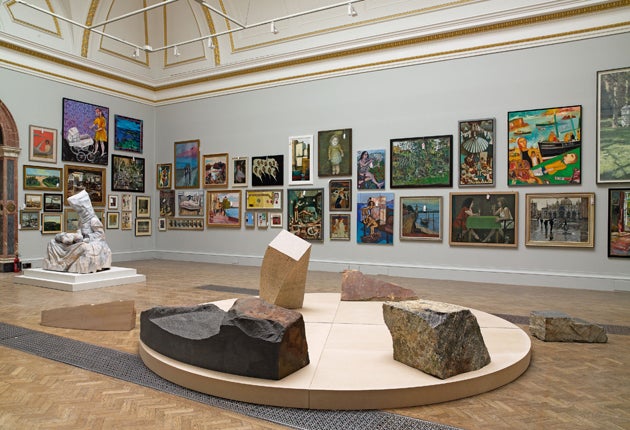
I recently relived a surreal experience of two years ago when I spent a morning limping around the Venice Biennale and the same afternoon dodging trays of Pimm's at the Royal Academy's Summer Exhibition.
Historically, the words "chalk" and "cheese" have come nowhere near summing up the difference between the two: the Biennale – a place of coutured collectors, Lear-jetted in from Los Angeles and Zurich and all hungry for the newest and most hot; the Summer Show – a redoubt of painterly figuration, regimental ties and orthopaedic footwear.
In 2007, the only overlap between the Summer Exhibition and the Biennale was the number of paintings within the former of the site of the latter, Venice having been a staple of Academicians and their like since Joshua Reynolds. This time, though, all that has changed.
The clearest sign of this was the disappearance of Venice and all its wonders from the Academy's teeming walls. I foster fond hopes of living long enough to see no canals or gondolas at all in the Summer Exhibition, and this year I thought I might die happy and soon.
That illusion was shattered, alas, but not until the show's 14th and last room and 1,099th work: a typically banal contre-jour picture called Morning Light Effect S. Giorgio Maggiore, by Ken Howard RA and yours for £20,000. What made this work remarkable – the only thing that did, in fact – was the rarity of both its subject and style. Along with scenes of Venice this year has gone academic figure-painting, a thing now relegated to the tiny hexagon of the Small Weston Room and Howard's tail-end and déclassé Lecture Room.
In place of these Summer Exhibition stalwarts are abstraction, New Painting and post-Pop – a change that announces itself from the outset, or at least from Room I, Work 6. This is a vast triptych, perhaps three metres by four, made up of branches and a black-and-white landscape caged in behind chicken wire in a box frame. The work, Tryptique, is by the German neo-symbolist artist, Anselm Kiefer – a giant of late 20th-century radicalism and not at all the kind of thing you expect to see in the Summer Exhibition. (Elderly Lady One, peering at her catalogue: "It's by someone called Anselm O'Keefer." Elderly Lady Two, sniffing: "I can live without it.") Next to this is Lenin Im Lehnstuhl [Lenin on an Easy Chair], one of Georg Baselitz's upside-down pictures, and across from these a mountain painting by Ed Ruscha called Blazing Orifices. (The Elderly Ladies make a rude joke about Indian restaurants.) And what are all these doing in Room I?
In recent years, the Royal Academy has set out to reinvent the Summer Show, no doubt reasoning that the aged eye to which its usual fare appealed was likely to be short-lived. To help with this transformation, various deeply un-Academic artists have been made Academicians: last year, one room in the show was curated by Tracey Emin RA. In the 2009 Summer Exhibition, though, the tone is set by what might be called the blue-chip avant garde – work by one-time young Turks who are getting on a bit (Kiefer is 64, Baselitz and Ruscha 71 apiece), and whose works have entered the canon as acknowledged modern masterpieces. In this process, there is a subtle rewriting of history. By co-opting Baselitz and the rest as Honorary RAs – Academicians have the right to show six works a year in the Summer Exhibition – their fellow, non-honorary peers are made giants by association. Thus the trio above are joined in Room I by Sir Anthony Caro RA and Flavia Irwin RA: all right if you like that sort of thing, but hardly of the stature of Ruscha and the rest.
There are two main outcomes of this curatorial sleight-of-hand. First, RA artists (and especially RA painters) are made to seem central to the history of modern art, which is not quite true. Second, and more positive, the 2009 Summer Exhibition is by far the most interesting I have seen. There is good, strong abstract work in almost every room, some by big names (see above), some by the unfairly under-sung (Mali Morris, Tess Jaray), some by the pretty well unknown. (Who are Mathew Sant and Caroline Isgar when they're at home, and where can I see more of their work?) With the recent renewal of interest in abstraction, this year's Summer Show even seems – dare one say it? – trendy, cutting-edge: more so than, say, the Saatchi's appalling Abstract America. Now there's a thing I never thought to find myself writing.
Royal Academy, London W1 (020-7300 8000), to 16 Aug. Last week's review of "Abstract America" gave an incorrect telephone number and closing date. The show, at the Saatchi Gallery (020- 7823 2363) closes on 13 Sep
Join our commenting forum
Join thought-provoking conversations, follow other Independent readers and see their replies
Comments