Ron Arad: Restless, Barbican Art Gallery, London
The Israeli-born innovator is obsessed with chairs, but his retrospective reveals a designer whose range defies categorisation
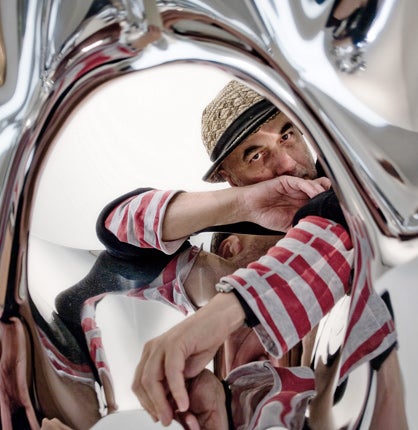
Tel Aviv-born, London-based, a designer, an architect and an artist, Ron Arad is a difficult man to pigeonhole. He trained as an architect in the 1970s, but finding the idea of a practice too confining, he set up a studio and workshop in Covent Garden, and rapidly moved into furniture design.
That field, in Arad's view, needed a good shake-up. It needed to ask itself challenging questions. Why shouldn't the maker of a chair be influenced by Pablo Picasso and Jean Arp? Why should furniture not take advantage of the rapid growth in new materials? In 1997 he became a professor at the Royal College of Art, where he created a department of design products, merging two hitherto distinct disciplines, furniture and industrial design.
Although Arad has dabbled in many kinds of products, the Barbican's exhibition proves once and for all that his abiding obsession was – and is – chairs. In fact, there are enough chairs in this glamorous, hi-tech retrospective, with its banks of LED screens and a spiralling chandelier called Lolita which welcomes (and displays) text messages – 07767 396 942 – to accommodate half the street bums in the City of London.
The show begins in the upstairs gallery spaces, and takes us through the various aspects of Arad as a maker, shunting backwards and forwards in time. We see him scavenging, tinkering, working through different ways in which chairs can be made to rock and roll and rise up, trying out new materials – translucent Corian, superplastic aluminium – new shapes, and ever more outrageous sitting experiences. He's making – but he's also doodling, thinking aloud. He makes chairs that rear up on end like a cobra about to strike. Another one – called London Papardelle, fashioned from woven stainless steel – flings itself out like a length of carpet. Every room has a film of him musing, scribbling, making in Italy, Sweden and God knows where, ever restless, ever on the move. He makes one-offs, but he also collaborates with other manufacturers and designers to make multiples. So he's at the high, expensive end of the market, and at the lower end too. A canny maker, you might say.
Downstairs, much of the pedagogy falls away, and some fun starts. It looks a bit like a department store. There's a sprawl of chairs that you can actually sit on, along with tables to sit at. There's even Arad's own stainless steel ping-pong table, which tips up weirdly at both ends. Arad made it like that to slow down the game. Balls and bats are available from the shop. No cost. I sit on the Ripple Chair, which feels too wide and too uncomfortable. Lo-Tilt can be made to rock back and forth – wildly, if you so wish.
All of a sudden, a great rumbling fills the air. There's a motorised steel track that runs the entire length of one side of the gallery. This device – it's called a Teeter-Totter – was first used at Arad's recent retrospective at the Pompidou Centre in Paris. Two giant wheels are being rolled back and forth. They contain bookshelving, and because the wheels skid rather than roll, the books never get displaced.
Arad has quite a way with serendipitous shelving. Along the opposite wall there's more of it, running horizontally like a length of string in tempered, sprung steel. Also on the ground floor several galleries are given over to his architectural schemes – a covered shopping mall in Belgium, a museum in Israel. Quite a few of them seem not to have been realised, not yet anyway. How many other architects would get away with showing models of unrealised projects?
Just occasionally you come across a figurative sculptural piece. Here's a homage to his friend Antony Gormley, called Rod Gomli. It's a negative impression of an invisible sitter, fashioned from individual metal rods.
Throughout the show, Arad seems to be trying to persuade us that his practice amounts to much more than mere innovative design, that this is design raised to the level of art. Alas, he doesn't quite convince us.
To 16 May (0845 120 7550)
Join our commenting forum
Join thought-provoking conversations, follow other Independent readers and see their replies
Comments