A longer shelf life for seasoned scribes
P D James has just collected an award, aged 90, but ageism is still all too common in the literary world, says Arifa Akbar
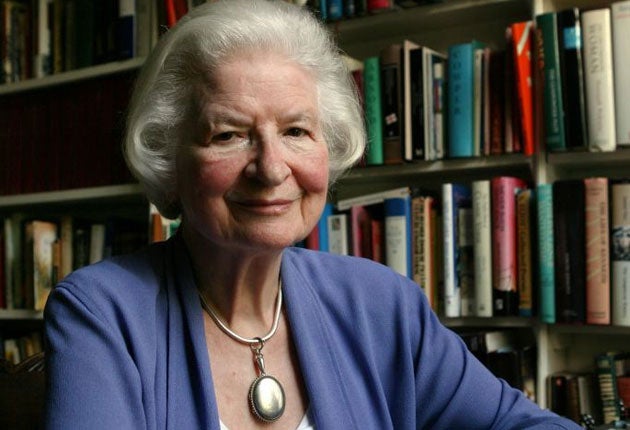
The magnificent P D James received an Outstanding Contribution to Crime Fiction award at the Theakstons Old Peculier Crime Writing Festival last week. Five decades of outstanding contribution to be precise, and still going strong, aged 90. Speaking about the honour on Radio 4, she admitted that she had been troubled by ageism: "There was something rather valedictory about The Private Patient. I had been very reluctant to begin a long detective story because I feared two things: that I might die before I finished it, and that there would be a falling off in quality, so reviewers would say 'considering she was 91 or 92, it is a remarkable achievement, but hardly vintage P D James'."
"A remarkable achievement for her age" – the barbed compliment implies that it's a marvel for her to be writing at all, when she should be sitting in a high-backed chair by the window. And though James intimated that the worry of any "falling off in quality" was her own, it isn't helped by a literary culture that tilts horribly towards the cult of youth.
In 1983, Granta magazine published the first of its "best young authors" under the age of 40 lists. These line-ups have now become a tradition. The New Yorker brought out its own "20 under 40" list last year. While these rightly draw attention to fledging talent, why must brilliance be confined to the under-40s? And why pluck out for commendation an exceptional debut writer aged 25, over an exceptional debut writer aged 60?
Philip Hensher was picked as one of Granta's 20 Best Young British Novelists in 2003 (then aged 37, he had already published five books). It was gratifying to be selected, he says, but he still regards such age-related line-ups as artificial and particularly unfair to women, whose writing careers can be delayed by motherhood. "Not everyone begins to publish in a routine way", he says. "The classic example is Penelope Fitzgerald, who published for the first time aged 60, and her last book, aged 83, was a masterpiece. I'd very much like the Granta list to shift from people under 40, to people publishing for the first time in the last 10 years."
He adds: "It is quite rare for novelists in their twenties to publish something really marvellous. The only one I can think of is Zadie Smith with White Teeth."
Seasoned novelists like Margaret Atwood and Joyce Carol Oates, now in their Seventies, are arguably at the height of their powers. Then there are those who made their debuts the other side of 40: Diana Athill, now 93, wrote the bulk of her work after 60; Raymond Chandler's debut was at 51.
More recently, there was The Wandering Falcon, a sensational debut from Jamil Ahmad, a 78-year old former civil servant in Pakistan's "tribal belt". Meru Gokhale, the editorial director of Vintage India at Random House, who discovered Ahmad while at Penguin, feels that age enriched his fiction: "The timeless quality of his writing must come from experience, and also the fact that he has lived a long and extraordinary life. He has lived in a society where minute human interaction determines your fate, and this gives him unusual powers of observation."
Barbara Strauch makes the scientific case in The Secret Life of the Grown-up Brain. She argues that while we become more forgetful, our capacity for creative, dextrous thought continues to grow. One could even argue that fiction written in later life is less ego-driven, less consumed by the desire to make a name for oneself.
Hensher does not believe literary skill withers with age, although material often gains its strengths and weaknesses: "The thing that might be a problem for older novelists is losing direct touch with the experiences of young people." But, he adds, "what often remains constant and interesting is a take on children."
Ironically, it is younger writers who are now writing novels featuring old age and dementia, a trend that Hensher has seen among his creative writing students. Being old in fiction, it appears, is fashionable only among the young.
Join our commenting forum
Join thought-provoking conversations, follow other Independent readers and see their replies
Comments
Bookmark popover
Removed from bookmarks