Arrogance of Socrates made a compelling case for his death
New book questions philosopher's reputation as an innocent martyr to his beliefs
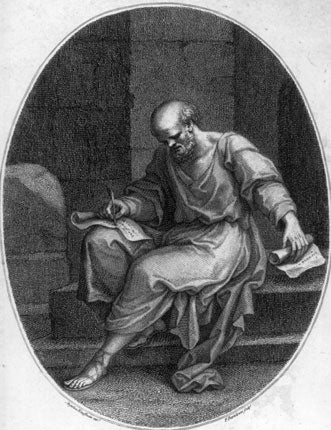
The infamous trial of the ancient Greek philosopher, Socrates, has long been regarded as one of the first, most dramatic cases of a miscarriage of justice, ending in the death penalty for the founding father of Western thought.
Socrates was accused of "impiety" and "corrupting the young" in 399BC – charges many historians think were invented by his prejudiced fellow citizens – and was required to perform his own execution by consuming hemlock. But now a Cambridge University professor claims that Socrates' trial was legally just and that he was guilty as charged. What's more, Professor Paul Cartledge believes that Socrates actually invited his own death.
In his new book, Ancient Greek Political Thought In Practice, published today, Professor Cartledge says that while politicians and historians have used the trial to suggest that democracy can sometimes descend into mob rule, this was not one such example. "Everyone knows the Greeks invented democracy, but it was not democracy as we know it, and we have misread history as a result," he said. "The charges Socrates faced seem ridiculous to us but in ancient Athens they were genuinely felt to serve the communal good."
In his book, Professor Cartledge questions traditional arguments that Socrates was purely the victim of political infighting. Historians influenced by ancient writers, including Plato, have claimed that Socrates' open criticism of prominent Athenian politicians had made him many enemies, who then pinned the impiety and corruption charges on him to silence him. Other historian believe Socrates' teachings stirred political rebellion, and he was made an example at his trial by those seeking to quash dissidents in Athenian society.
Professor Cartledge said Socrates questioned the authority of many of the accepted gods and claimed to be guided by his inner "daimonon", a term which he may have intended to mean "intuition", but which could also be interpreted as a dark, supernatural influence, which would have outraged conventional believers.
The charge of "impiety" was entirely acceptable in a democracy deeply reverential of their gods, Professor Cartledge said. Accusations were brought by amateur prosecutors before a jury of 501 ordinary citizens of "good standing" who acted on behalf of what they took to be the public interest. If the prosecution could prove that a defendant was responsible for jeopardising the public good, he was likely to be found guilty.
The author also believes that Socrates invited his own death. Under the Athenian system, in this kind of trial a defendant could suggest his own penalty. Instead of taking this opportunity seriously, Socrates first joked that he should be rewarded and eventually suggested a fine that was far too small.
Unsurprisingly, his jurors did not see the funny side and passed the death sentence. Instead of fleeing, Socrates accepted the verdict, claiming that "he owed it to the city under whose laws he had been raised to honour those laws to the letter".
Professor Cartledge said: "There is no denying his bravery, and he could even be seen as an intellectual hero. But the idea that Socrates himself was not guilty, but executed by mob rule, is wrong. By removing him, society had in, Athenians' eyes, been cleansed and reaffirmed."
Professor Angie Hobbs, a philosopher at Warwick University, said that, until recently, the official charges were regarded as being a smokescreen for what the democrats really wanted, revenge for Socrates's association with the rival oligarchic party.
But she added: "Whether one thinks this was a just case or not that he was a genuine trouble-maker is open to debate. Socrates had annoyed important and influential people. He was abrupt and tactless. Philosophers were seen as dangerous at the time and he was not the only one to get into trouble. Athenians were probably right to be a little bit disturbed by what he was up to, getting the young to think for themselves.
She agreed that Socrates "didn't have to die" and that he made it very difficult for the courts not to impose the death penalty. When prison guards made it clear they would allow him to "escape", he declined.
"Socrates wanted to be some kind of martyr for philosophy," Professor Hobbs continued. "According to Plato, he gives an incredibly arrogant speech in court, saying, 'far from punishing me, they should be so grateful for the way I have helped them cleanse their souls, they should give me free meals for the rest of my life'."
Professor Mary Beard, a classicist at Cambridge University, added: "We have invested in him [Socrates], re-invented him as a beacon of honourable free-thinking, standing by what he believed (and the right to believe it) even unto death, thanks to Plato, of course, in large measure. But, in Athenian terms, it was a fair cop."
Socrates: His thoughts
*Socrates is considered one of the founding fathers of Western philosophy but, problematically for scholars, his thought is preserved only through the accounts of his students, most notably in Plato's dialogues.
His most significant contribution to Western thought is the Socratic method of debate or Method of Elenchus, a dialectical method of questioning, testing and ultimately improving a hypothesis. Through asking a series of questions, the method sought to show contradictions in the beliefs of those who posed them, and systematically move towards a hypothesis free from contradiction. As such, it is a negative method, in that it seeks to identify and demarcate that which a person does not know, rather than which he does. Socrates applied this to the testing of moral concepts, such as justice. Plato produced 13 volumes of Socratic Dialogues, in which Socrates would question a prominent Athenian on moral and philosophical issues. So often cast as the questioner, it is hard to establish any of Socrates' own philosophical beliefs. He said his wisdom was an awareness of his own ignorance, and his statement, "I know that I know nothing" is often quoted.
Join our commenting forum
Join thought-provoking conversations, follow other Independent readers and see their replies
Comments
Bookmark popover
Removed from bookmarks