Henning Mankell: The special relationship
Henning Mankell's biopic of his late father-in-law, Ingmar Bergman, has generated enough drama to fill one of his Wallander novels – and it hasn't been shot yet. He talks to Geoffrey Macnab
The Scandinavians are taking over the world... or at least the world of crime fiction. Walk through a British railway station or airport or anywhere where they still sell books and you will see the volumes of Stieg Larsson and Jo Nesbø novels piled high. You're also very likely to find several of Swedish crime writer Henning Mankell's Wallander stories, which are said to have sold more than 30 million copies.
Put it to Mankell that the whole of Britain seems obsessed with yarns about Scandinavian detectives and he wryly observes: "I can assure you it's not only England." He tells a story to illustrate his point. Last year, he was on a book tour in Argentina. He was due to give a speech and was very nervous that no one at all would turn up. In fact, more than a thousand Wallander lovers appeared as if from nowhere.
Speaking from Sweden, where he has been attending the Gothenburg Book Fair, Mankell ponders the reasons for the extraordinary global popularity of Nordic detectives. "Naturally, I've been thinking about it," he tells me. "One [reason] must be pure coincidence. The second is that I guess I worked as a locomotive in some ways. My success has been an inspiration for others. You remember the tennis player Björn Borg? Before that, Sweden had very few good tennis players. After that, we suddenly had a hell of a lot. Maybe that is one kind of explanation."
The main subject of my interview isn't Larsson or Björn Borg. Nor is it the psychology and unlikely appeal of the morose Detective Kurt Wallander. It is Mankell's ongoing attempts to make an ambitious TV drama and feature film about his father-in-law, Ingmar Bergman – a project interrupted in surreal fashion by the Israeli army.
Earlier this summer, Mankell was aboard the Gaza-bound aid flotilla that was attacked by Israeli forces. To his consternation, part of the screenplay for his new film about Bergman was confiscated by the Israeli soldiers.
"Whatever I do, I am always working on something," says Mankell, explaining how he happened to have the Bergman screenplay in his possession at the same time as he was taking part in a mission to bring aid supplies to Gaza in defiance of the Israeli blockade. "When everything was stolen and confiscated, they [the Israeli troops] also took the manuscript," he recalls. "What the hell are they supposed to do with that?"
Four months later, the Israelis still haven't returned Mankell's screenplay. He jokes that the Israelis must have thought the screenplay – called Crisis in deference to Bergman's directorial debut – was written in code. Mankell very much doubts that the young commando soldiers who took the screenplay even knew who Bergman was.
Mankell, now 62, has spent many years living and working in Africa. In the 1960s and 1970s, he was a political activist, campaigning against apartheid in South Africa and the US war in Vietnam. Being aboard the Gaza flotilla didn't scare him at all. "I am not an afraid person," he blithely states. "In all the years I have lived in Africa, I have had some quite terrible experiences. What I still think about today is how very stupidly they [the Israeli army] behaved. If they really had had the ambition just to stop the flotilla, they should have done something with the rudder and propellers," he reflects on the incident, which left nine flotilla members dead, saw him arrested and provoked a huge international row.
The crime writer's outspoken opinions about the Middle East have been well chronicled. He likens the plight of the Palestinians to that of black South Africans in the apartheid era and expresses his confidence that the Gaza blockade will eventually be broken. He has no intention of letting up on his activism. "I am a very dangerous man because I know that we managed to crush the apartheid system in South Africa without violence. This is also the idea here. Sooner or later, people in Israel must understand that this is an unbearable situation."
Bergman lovers will be relieved to discover that Mankell had kept another copy of his screenplay about his father-in-law at home.
So just why has Mankell decided to write a movie about Bergman? "To be completely honest, it was actually my wife [Bergman's daughter, Eva] who said to me: 'I think you should write this Henning, before someone else does it.' What is also very funny is that four or five years before he died, when I was sitting talking with him, all of a sudden he said, 'Oh, Henning, for heaven's sake, you'll write about me when I am dead, won't you?'"
Mankell forgot about the conversation. However, after Bergman's death in 2007, he decided it was time to tackle the project. Bergman was a famously combustible and tormented figure whose towering artistic achievements ran alongside a private history of domestic discord. Mankell won't be glossing over any of this. In fact, the tension between Bergman's professional and personal lives are what drive the screenplay. "I had a critical view of his life, of some of his work and of his way of looking on people. He didn't mind that. He knew that," Mankell recalls of Bergman. "He wasn't afraid of what people would say when he was dead."
Mankell's Bergman film won't be a straight biopic. Instead, says Mankell, it will probe away at one important question, namely: "what price did he pay for his absolute, uncompromising way of relating himself to his art. You have to turn that question around and ask – what price did his family pay? This is exactly what I would like to talk about because this will give it some interesting meaning for other people. You can be a taxi driver, you can have a small company and you can experience the same thing – that you sacrifice certain things in life until it is too late to understand what you have done. Ingmar was a very, very lonely person when he was old... and he realised that he had treated people badly."
Danish director Susanne Bier will direct the film, which is being made in four parts for Swedish TV, but is also likely to surface as a feature film in cinemas. The film will follow Bergman from his childhood to his death. "This is a story very much about him, his art, his wife and his children," Mankell explains. Eva Bergman spent a week reading Mankell's screenplay and after she had finished it, told her husband: "I have a feeling that I have become a little bit closer to my father."
Mankell has fond memories of his own time with Bergman on the remote island of Farö. They would meet once a day to see a movie in Bergman's private cinema. "I think I saw 130 movies with him – it was everything from very old silent movies to very new movies that hadn't even been shown in Sweden," he recalls of a cinema diet that included Charlie Chaplin, Akira Kurosawa, Victor Sjöström and Georges Méliès. Every year, Mankell remembers, a lorry loaded with new movies would set off from Stockholm to Bergman's island.
Mankell only rarely saw instances of the film director's famously explosive temper. "He wouldn't have dared to do it against me so we never had any shouting matches. I think he used to say that he had a pedagogical view on his anger. He knew when it would be good to be a little angry and to scare people a little into doing what he wanted."
Bergman used to read all of Mankell's work, including the Wallander novels, and sometimes even gave him advice about adapting it for cinema. "In a book, I can let Wallander come into a room and stand and think for 10 pages. The challenge in literature is to make that interesting. He [Bergman] said, 'how do you do a movie out of this book? You can't have a person standing for 10 minutes, just thinking in a movie. How do you find other expressions for the same thing?' He saw that very clearly."
The Wallander novels invariably have a political undertow. The crimes that the detective investigates always cast light on injustices or social problems in contemporary Sweden. Unlike Mankell, Bergman wasn't remotely interested in politics. Mankell has written a telling scene in his Bergman film which shows the young film director when he was head of a theatre in Helsingborg in the south of Sweden during the Second World War. From Helsingborg you can see Denmark, which, in the war, was occupied by the Nazis. One night, Bergman is leaving the theatre late at night with one of the actors after rehearsals. They can hear planes in the air and bombing. The actor starts to talk about the war and the Nazis, but all that is on Bergman's mind are the problems in the performance. "That's rather a fair description of his look on things," says Mankell.
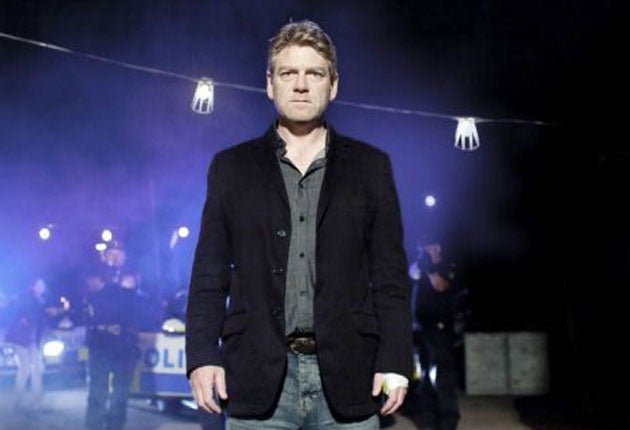
During the summer of 2007, British actor Kenneth Branagh came to Farö to meet Bergman. In the event, the director was too unwell to see him. However, shortly afterwards, Branagh began playing Wallander in the English-language TV adaptations of Mankell's crime novels. Mankell is very enthusiastic about Branagh's portrayal. "I like him, I like his approach and I am very, very fond of what he has been doing... it's sort of ancient Greek drama."
Crime fiction is only 25 per cent of Mankell's overall output, but he doesn't regret how closely his name has become intertwined with that of the fictional detective hero he created. There is little of the exasperation that Conan Doyle felt for Sherlock Holmes at the time he had Holmes fall to his death under the Reichenbach Falls in The Final Problem. "I don't regret anything I've written about him [Wallander] because I think the stories have been important. I think my Wallander stories give a fairly good image of the world in the 1990s. I don't regret anything about that – on the contrary!"
Mankell doesn't set himself a certain amount of words to write every day. Instead, he follows the example of a certain British novelist. "I work every day until I do not have more to say. I learned from Graham Greene that a very good way is to stop work in the middle of a sentence. Then you know exactly how to continue the day after... I remember that I once told Ingmar about it and he said, 'oh, yes, I will do the same!'"
Henning Mankell's latest book is 'Daniel'. The TV series and feature film about Ingmar Bergman's life are expected to be shot in 2011
Join our commenting forum
Join thought-provoking conversations, follow other Independent readers and see their replies
Comments
Bookmark popover
Removed from bookmarks